Q5ZLM0
Gene name |
CDC73 (RCJMB04_5j4) |
Protein name |
Parafibromin |
Names |
Cell division cycle protein 73 homolog |
Species |
Gallus gallus (Chicken) |
KEGG Pathway |
gga:424356 |
EC number |
|
Protein Class |
|
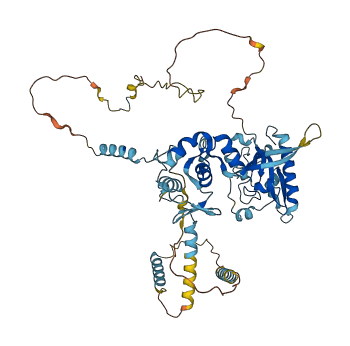
Descriptions
The autoinhibited protein was predicted that may have potential autoinhibitory elements via cis-regPred.
Autoinhibitory domains (AIDs)
Target domain |
|
Relief mechanism |
|
Assay |
cis-regPred |
Accessory elements
No accessory elements
Autoinhibited structure

Activated structure
1 structures for Q5ZLM0
| Entry ID | Method | Resolution | Chain | Position | Source |
|---|---|---|---|---|---|
| AF-Q5ZLM0-F1 | Predicted | AlphaFoldDB |
No variants for Q5ZLM0
| Variant ID(s) | Position | Change | Description | Diseaes Association | Provenance |
|---|---|---|---|---|---|
| No variants for Q5ZLM0 | |||||
No associated diseases with Q5ZLM0
2 GO annotations of cellular component
| Name | Definition |
|---|---|
| Cdc73/Paf1 complex | A multiprotein complex that associates with RNA polymerase II and general RNA polymerase II transcription factor complexes and may be involved in both transcriptional initiation and elongation. In Saccharomyces the complex contains Paf1p, Cdc73p, Ctr9p, Rtf1p, and Leo1p. |
| nucleus | A membrane-bounded organelle of eukaryotic cells in which chromosomes are housed and replicated. In most cells, the nucleus contains all of the cell's chromosomes except the organellar chromosomes, and is the site of RNA synthesis and processing. In some species, or in specialized cell types, RNA metabolism or DNA replication may be absent. |
1 GO annotations of molecular function
| Name | Definition |
|---|---|
| RNA polymerase II complex binding | Binding to an RNA polymerase II core enzyme, a multisubunit eukaryotic nuclear RNA polymerase typically composed of twelve subunits. |
15 GO annotations of biological process
| Name | Definition |
|---|---|
| cell cycle | The progression of biochemical and morphological phases and events that occur in a cell during successive cell replication or nuclear replication events. Canonically, the cell cycle comprises the replication and segregation of genetic material followed by the division of the cell, but in endocycles or syncytial cells nuclear replication or nuclear division may not be followed by cell division. |
| endodermal cell fate commitment | The cell differentiation process that results in commitment of a cell to become part of the endoderm. |
| histone modification | The covalent alteration of one or more amino acid residues within a histone protein. |
| mRNA polyadenylation | The enzymatic addition of a sequence of 40-200 adenylyl residues at the 3' end of a eukaryotic mRNA primary transcript. |
| negative regulation of cell population proliferation | Any process that stops, prevents or reduces the rate or extent of cell proliferation. |
| negative regulation of G1/S transition of mitotic cell cycle | Any signalling pathway that decreases or inhibits the activity of a cell cycle cyclin-dependent protein kinase to modulate the switch from G1 phase to S phase of the mitotic cell cycle. |
| negative regulation of myeloid cell differentiation | Any process that stops, prevents, or reduces the frequency, rate or extent of myeloid cell differentiation. |
| negative regulation of transcription by RNA polymerase II | Any process that stops, prevents, or reduces the frequency, rate or extent of transcription mediated by RNA polymerase II. |
| positive regulation of cell cycle G1/S phase transition | Any signalling pathway that activates or increases the activity of a cell cycle cyclin-dependent protein kinase to modulate the switch from G1 phase to S phase of the cell cycle. |
| positive regulation of mRNA 3'-end processing | Any process that activates or increases the frequency, rate or extent of mRNA 3'-end processing. |
| positive regulation of transcription elongation by RNA polymerase II | Any process that activates or increases the frequency, rate or extent of transcription elongation, the extension of an RNA molecule after transcription initiation and promoter clearance by the addition of ribonucleotides, catalyzed by RNA polymerase II. |
| positive regulation of Wnt signaling pathway | Any process that activates or increases the frequency, rate or extent of Wnt signal transduction. |
| recruitment of 3'-end processing factors to RNA polymerase II holoenzyme complex | The process in which proteins required for 3'-end transcript processing become associated with the RNA polymerase II holoenzyme complex and the 3' end of a transcript. |
| stem cell population maintenance | The process by which an organism or tissue maintains a population of stem cells of a single type. This can be achieved by a number of mechanisms: stem cell asymmetric division maintains stem cell numbers; stem cell symmetric division increases them; maintenance of a stem cell niche maintains the conditions for commitment to the stem cell fate for some types of stem cell; stem cells may arise de novo from other cell types. |
| transcription elongation by RNA polymerase II promoter | The extension of an RNA molecule after transcription initiation and promoter clearance at an RNA polymerase II promoter by the addition of ribonucleotides catalyzed by RNA polymerase II. |
| 10 | 20 | 30 | 40 | 50 | 60 |
| MADVLSVLRQ | YNTQKKEIVV | KGDEVIFGEF | SWPKNVKTNY | VIWGTGKEGQ | PREYYTLDSI |
| 70 | 80 | 90 | 100 | 110 | 120 |
| LFLLNNVHLS | HPVYVRRAAT | ENIPVVRRPD | RKDLLAYLNG | ETSTSSSIDR | SAPLEIGLQR |
| 130 | 140 | 150 | 160 | 170 | 180 |
| STQVKRAADE | ILAEAKKPRI | EDEECVRLDK | ERLAARLEGH | KEGIVQTEQI | RSLSEAMSVE |
| 190 | 200 | 210 | 220 | 230 | 240 |
| KIAAIKAKIM | AKKRSTIKTD | LDDDITALKQ | RSFVDAEVDV | TRDIVSRERV | WRTRTTILQS |
| 250 | 260 | 270 | 280 | 290 | 300 |
| TGKNFAKNIF | AILQSVKARE | EGRAPEQRPA | PNTAPTDPTL | RNKQPIPAAY | NRYDQERFKG |
| 310 | 320 | 330 | 340 | 350 | 360 |
| KEETEGFKID | TMGTYHGMTL | KSVTEGASAR | KTQTPAAQPV | PRPVSQARPP | PNQKKGSRTP |
| 370 | 380 | 390 | 400 | 410 | 420 |
| IIIIPAATTS | LITMLNAKDL | LQDLKFVPSD | EKKKQGCQRE | NETLIQRRKD | QMQPGGTTVS |
| 430 | 440 | 450 | 460 | 470 | 480 |
| VTVPYRVVDQ | PLKLMPQDWD | RVVAVFVQGP | AWQFKGWPWL | LPDGSPVDIF | AKIKAFHLKY |
| 490 | 500 | 510 | 520 | 530 | |
| DEVRLDPNVQ | KWDVTVLELS | YHKRHLDRPV | FLRFWETLDR | YMVKHKSHLR | F |