Q5ZJU2
Gene name |
KLHL15 (RCJMB04_15l4) |
Protein name |
Kelch-like protein 15 |
Names |
|
Species |
Gallus gallus (Chicken) |
KEGG Pathway |
gga:418598 |
EC number |
|
Protein Class |
|
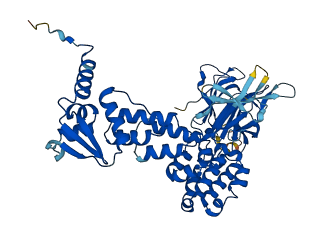
Descriptions
The autoinhibited protein was predicted that may have potential autoinhibitory elements via cis-regPred.
Autoinhibitory domains (AIDs)
Target domain |
|
Relief mechanism |
|
Assay |
cis-regPred |
Accessory elements
No accessory elements
Autoinhibited structure

Activated structure
1 structures for Q5ZJU2
| Entry ID | Method | Resolution | Chain | Position | Source |
|---|---|---|---|---|---|
| AF-Q5ZJU2-F1 | Predicted | AlphaFoldDB |
No variants for Q5ZJU2
| Variant ID(s) | Position | Change | Description | Diseaes Association | Provenance |
|---|---|---|---|---|---|
| No variants for Q5ZJU2 | |||||
No associated diseases with Q5ZJU2
6 regional properties for Q5ZJU2
| Type | Name | Position | InterPro Accession |
|---|---|---|---|
| domain | BTB/POZ domain | 23 - 128 | IPR000210 |
| repeat | Kelch repeat type 1 | 328 - 426 | IPR006652-1 |
| repeat | Kelch repeat type 1 | 427 - 488 | IPR006652-2 |
| domain | BTB/Kelch-associated | 133 - 237 | IPR011705 |
| domain | Kelch-like protein 15, BTB/POZ domain | 1 - 137 | IPR030597 |
| domain | Kelch-like protein 15, BACK domain | 128 - 235 | IPR047030 |
2 GO annotations of cellular component
| Name | Definition |
|---|---|
| Cul3-RING ubiquitin ligase complex | A ubiquitin ligase complex in which a cullin from the Cul3 subfamily and a RING domain protein form the catalytic core; substrate specificity is conferred by a BTB-domain-containing protein. |
| nucleus | A membrane-bounded organelle of eukaryotic cells in which chromosomes are housed and replicated. In most cells, the nucleus contains all of the cell's chromosomes except the organellar chromosomes, and is the site of RNA synthesis and processing. In some species, or in specialized cell types, RNA metabolism or DNA replication may be absent. |
1 GO annotations of molecular function
| Name | Definition |
|---|---|
| ubiquitin ligase-substrate adaptor activity | The binding activity of a molecule that brings together a ubiquitin ligase and its substrate. Usually mediated by F-box BTB/POZ domain proteins. |
3 GO annotations of biological process
| Name | Definition |
|---|---|
| negative regulation of double-strand break repair via homologous recombination | Any process that stops, prevents, or reduces the frequency, rate or extent of double-strand break repair via homologous recombination. |
| nuclear protein quality control by the ubiquitin-proteasome system | The chemical reactions and pathways resulting in the breakdown of misfolded proteins via a mechanism in which the proteins are transported to the nucleus for ubiquitination, and then targeted to proteasomes for degradation. |
| protein ubiquitination | The process in which one or more ubiquitin groups are added to a protein. |
1 homologous proteins in AiPD
| UniProt AC | Gene Name | Protein Name | Species | Evidence Code |
|---|---|---|---|---|
| Q96M94 | KLHL15 | Kelch-like protein 15 | Homo sapiens (Human) | PR |
| 10 | 20 | 30 | 40 | 50 | 60 |
| MAGDVEGFSS | SIHDTSVSAG | FRALYEEGLL | LDVTLVIEDH | QFQAHKALLA | TQSDYFRIMF |
| 70 | 80 | 90 | 100 | 110 | 120 |
| TADMRERDQD | KIHLKGLTAT | GFSHVLQFMY | YGTIELSMNT | VHEILQAAMY | VQLIEVVKFC |
| 130 | 140 | 150 | 160 | 170 | 180 |
| CSFLLAKICL | ENCAEIMRLL | DDFSVNIEGV | REKLDSFLLE | NFVPLMSRPD | FLSYLSFEKL |
| 190 | 200 | 210 | 220 | 230 | 240 |
| MSYLDNDHLS | RFPEIELYEA | VQAWLRHDRR | RWRHTDTIIQ | NIRFCLMTPS | SVFEKVKTSE |
| 250 | 260 | 270 | 280 | 290 | 300 |
| FYRYSRQLRH | EVDQAMNYFH | SVHQQPLMEM | KSNKIRSAKP | QTAVFRGMIG | HSMVNSKILL |
| 310 | 320 | 330 | 340 | 350 | 360 |
| LHKPRVWWEL | EGPQVPLRPD | CLAIVNNFVF | LLGGEELGPD | GEFHASSKVF | RYDPRQNTWL |
| 370 | 380 | 390 | 400 | 410 | 420 |
| RMADMSVPRS | EFAVGVIGRY | VYAVAGRTRD | ETFYSTERYD | ITEDKWEFVD | PYPVNKYGHE |
| 430 | 440 | 450 | 460 | 470 | 480 |
| GTVLGNKLYI | TGGITSSSTS | KQVCVFDPSK | EGTVEQRTRR | TQVATNCWEN | KCKMNYARCF |
| HKMISYNA |