Q5YJC2
Gene name |
GSK3B |
Protein name |
Glycogen synthase kinase-3 beta |
Names |
GSK-3 beta, Serine/threonine-protein kinase GSK3B |
Species |
Spermophilus citellus (European suslik) (Citellus citellus) |
KEGG Pathway |
|
EC number |
2.7.11.1: Protein-serine/threonine kinases |
Protein Class |
|
Descriptions
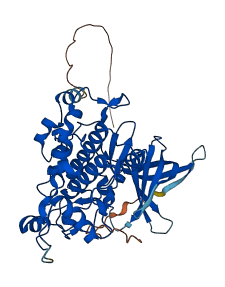
The autoinhibited protein was predicted that may have potential autoinhibitory elements via cis-regPred.
Autoinhibitory domains (AIDs)
Target domain |
|
Relief mechanism |
|
Assay |
cis-regPred |
Accessory elements
199-221 (Activation loop from InterPro)
Target domain |
56-340 (Protein kinase domain) |
Relief mechanism |
|
Assay |
|
Autoinhibited structure

Activated structure
1 structures for Q5YJC2
| Entry ID | Method | Resolution | Chain | Position | Source |
|---|---|---|---|---|---|
| AF-Q5YJC2-F1 | Predicted | AlphaFoldDB |
No variants for Q5YJC2
| Variant ID(s) | Position | Change | Description | Diseaes Association | Provenance |
|---|---|---|---|---|---|
| No variants for Q5YJC2 | |||||
No associated diseases with Q5YJC2
4 regional properties for Q5YJC2
Functions
| Description | ||
|---|---|---|
| EC Number | 2.7.11.1 | Protein-serine/threonine kinases |
| Subcellular Localization |
|
|
| PANTHER Family | ||
| PANTHER Subfamily | ||
| PANTHER Protein Class | ||
| PANTHER Pathway Category | No pathway information available | |
5 GO annotations of cellular component
| Name | Definition |
|---|---|
| cytoplasm | The contents of a cell excluding the plasma membrane and nucleus, but including other subcellular structures. |
| membrane | A lipid bilayer along with all the proteins and protein complexes embedded in it an attached to it. |
| mitochondrion | A semiautonomous, self replicating organelle that occurs in varying numbers, shapes, and sizes in the cytoplasm of virtually all eukaryotic cells. It is notably the site of tissue respiration. |
| nucleus | A membrane-bounded organelle of eukaryotic cells in which chromosomes are housed and replicated. In most cells, the nucleus contains all of the cell's chromosomes except the organellar chromosomes, and is the site of RNA synthesis and processing. In some species, or in specialized cell types, RNA metabolism or DNA replication may be absent. |
| plasma membrane | The membrane surrounding a cell that separates the cell from its external environment. It consists of a phospholipid bilayer and associated proteins. |
6 GO annotations of molecular function
| Name | Definition |
|---|---|
| ATP binding | Binding to ATP, adenosine 5'-triphosphate, a universally important coenzyme and enzyme regulator. |
| kinase activity | Catalysis of the transfer of a phosphate group, usually from ATP, to a substrate molecule. |
| protein kinase activity | Catalysis of the phosphorylation of an amino acid residue in a protein, usually according to the reaction: a protein + ATP = a phosphoprotein + ADP. |
| protein serine kinase activity | Catalysis of the reactions: ATP + protein serine = ADP + protein serine phosphate. |
| protein serine/threonine kinase activity | Catalysis of the reactions: ATP + protein serine = ADP + protein serine phosphate, and ATP + protein threonine = ADP + protein threonine phosphate. |
| tau-protein kinase activity | Catalysis of the reaction: ATP + tau-protein = ADP + O-phospho-tau-protein. |
18 GO annotations of biological process
| Name | Definition |
|---|---|
| cellular response to interleukin-3 | Any process that results in a change in state or activity of a cell (in terms of movement, secretion, enzyme production, gene expression, etc.) as a result of an interleukin-3 stimulus. |
| circadian rhythm | Any biological process in an organism that recurs with a regularity of approximately 24 hours. |
| epithelial to mesenchymal transition | A transition where an epithelial cell loses apical/basolateral polarity, severs intercellular adhesive junctions, degrades basement membrane components and becomes a migratory mesenchymal cell. |
| extrinsic apoptotic signaling pathway in absence of ligand | The series of molecular signals in which a signal is conveyed from the cell surface to trigger the apoptotic death of a cell. The pathway starts with withdrawal of a ligand from a cell surface receptor, and ends when the execution phase of apoptosis is triggered. |
| glycogen metabolic process | The chemical reactions and pathways involving glycogen, a polydisperse, highly branched glucan composed of chains of D-glucose residues in alpha-(1->4) glycosidic linkage, joined together by alpha-(1->6) glycosidic linkages. |
| negative regulation of calcineurin-NFAT signaling cascade | Any process that stops, prevents, or reduces the frequency, rate or extent of the calcineurin-NFAT signaling cascade. |
| negative regulation of developmental process | Any process that stops, prevents or reduces the rate or extent of development, the biological process whose specific outcome is the progression of an organism over time from an initial condition (e.g. a zygote, or a young adult) to a later condition (e.g. a multicellular animal or an aged adult). |
| negative regulation of extrinsic apoptotic signaling pathway via death domain receptors | Any process that stops, prevents or reduces the frequency, rate or extent of extrinsic apoptotic signaling pathway via death domain receptors. |
| nervous system development | The process whose specific outcome is the progression of nervous tissue over time, from its formation to its mature state. |
| peptidyl-serine phosphorylation | The phosphorylation of peptidyl-serine to form peptidyl-O-phospho-L-serine. |
| positive regulation of autophagy | Any process that activates, maintains or increases the rate of autophagy. Autophagy is the process in which cells digest parts of their own cytoplasm. |
| positive regulation of cilium assembly | Any process that activates or increases the frequency, rate or extent of the formation of a cilium. |
| positive regulation of mitochondrial outer membrane permeabilization involved in apoptotic signaling pathway | Any process that activates or increases the frequency, rate or extent of mitochondrial outer membrane permeabilization involved in apoptotic signaling pathway. |
| positive regulation of protein binding | Any process that activates or increases the frequency, rate or extent of protein binding. |
| positive regulation of protein localization to cilium | Any process that activates or increases the frequency, rate or extent of protein localization to cilium. |
| protein phosphorylation | The process of introducing a phosphate group on to a protein. |
| regulation of microtubule-based process | Any process that modulates the frequency, rate or extent of any cellular process that depends upon or alters the microtubule cytoskeleton. |
| Wnt signaling pathway | The series of molecular signals initiated by binding of a Wnt protein to a frizzled family receptor on the surface of the target cell and ending with a change in cell state. |
No homologous proteins in AiPD
| UniProt AC | Gene Name | Protein Name | Species | Evidence Code |
|---|---|---|---|---|
| No homologous proteins | ||||
| 10 | 20 | 30 | 40 | 50 | 60 |
| MSGRPRTTSF | AESCKPVQQP | SAFGSMKVSR | DKDGSKVTTV | VATPGQGPDR | PQEVSYTDTK |
| 70 | 80 | 90 | 100 | 110 | 120 |
| VIGNGSFGVV | YQAKLCDSGE | LVAIKKVLQD | KRFKNRELQI | MRKLDHCNIV | RLRYFFYSSG |
| 130 | 140 | 150 | 160 | 170 | 180 |
| EKKDVVYLNL | VLDYVPETVY | RVARHYSRAK | QTLPVIYVKL | YMYQLFRSLA | YIHSFGICHR |
| 190 | 200 | 210 | 220 | 230 | 240 |
| DIKPQNLLLD | PDTAVLKLCD | FGSAKQLVRG | EPNVSYICSR | YYRAPELIFG | ATDYTSSIDV |
| 250 | 260 | 270 | 280 | 290 | 300 |
| WSAGCVLAEL | LLGQPIFPGD | SGVDQLVEII | KVLGTPTREQ | IREMNPNYTE | FKFPQIKAHP |
| 310 | 320 | 330 | 340 | 350 | 360 |
| WTKVFRPRTP | PEAIALCSRL | LEYTPTARLT | PLEACAHSFF | DELRDPNVKL | PNGRDTPALF |
| 370 | 380 | 390 | 400 | 410 | |
| NFTTQELSSN | PPLATILIPP | HARIQAAAST | PTNATAASDA | NAGDRGQTNN | AAFASASNST |