Q5XIC8
Gene name |
Alkbh3 |
Protein name |
Alpha-ketoglutarate-dependent dioxygenase alkB homolog 3 |
Names |
Alkylated DNA repair protein alkB homolog 3 |
Species |
Rattus norvegicus (Rat) |
KEGG Pathway |
rno:362169 |
EC number |
1.14.11.33: With 2-oxoglutarate as one donor, and incorporation of one atom each of oxygen into both donors |
Protein Class |
|
Descriptions
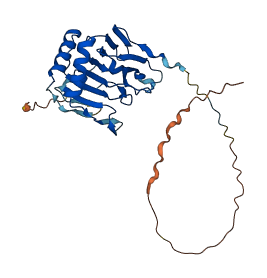
The autoinhibited protein was predicted that may have potential autoinhibitory elements via cis-regPred.
Autoinhibitory domains (AIDs)
Target domain |
|
Relief mechanism |
|
Assay |
cis-regPred |
Accessory elements
No accessory elements
Autoinhibited structure

Activated structure
1 structures for Q5XIC8
| Entry ID | Method | Resolution | Chain | Position | Source |
|---|---|---|---|---|---|
| AF-Q5XIC8-F1 | Predicted | AlphaFoldDB |
No variants for Q5XIC8
| Variant ID(s) | Position | Change | Description | Diseaes Association | Provenance |
|---|---|---|---|---|---|
| No variants for Q5XIC8 | |||||
No associated diseases with Q5XIC8
Functions
| Description | ||
|---|---|---|
| EC Number | 1.14.11.33 | With 2-oxoglutarate as one donor, and incorporation of one atom each of oxygen into both donors |
| Subcellular Localization |
|
|
| PANTHER Family | ||
| PANTHER Subfamily | ||
| PANTHER Protein Class | ||
| PANTHER Pathway Category | No pathway information available | |
4 GO annotations of cellular component
| Name | Definition |
|---|---|
| cytosol | The part of the cytoplasm that does not contain organelles but which does contain other particulate matter, such as protein complexes. |
| mitochondrion | A semiautonomous, self replicating organelle that occurs in varying numbers, shapes, and sizes in the cytoplasm of virtually all eukaryotic cells. It is notably the site of tissue respiration. |
| nucleoplasm | That part of the nuclear content other than the chromosomes or the nucleolus. |
| nucleus | A membrane-bounded organelle of eukaryotic cells in which chromosomes are housed and replicated. In most cells, the nucleus contains all of the cell's chromosomes except the organellar chromosomes, and is the site of RNA synthesis and processing. In some species, or in specialized cell types, RNA metabolism or DNA replication may be absent. |
7 GO annotations of molecular function
| Name | Definition |
|---|---|
| 2-oxoglutarate-dependent dioxygenase activity | Catalysis of the reaction: A + 2-oxoglutarate + O2 = B + succinate + CO2. This is an oxidation-reduction (redox) reaction in which hydrogen or electrons are transferred from 2-oxoglutarate and one other donor, and one atom of oxygen is incorporated into each donor. |
| cytosine C-5 DNA demethylase activity | Catalysis of the reaction: methyl-dCpdG DNA + H2O = dCpdG DNA + methanol. This reaction is the hydrolytic removal of the methyl group on the 5 position of cytosine in DNA. |
| DNA-N1-methyladenine dioxygenase activity | Catalysis of the oxidative demethylation of N1-methyladenine and N3-methylcytosine in DNA, with concomitant decarboxylation of 2-oxoglutarate and releases oxidized methyl group on N1-methyladenine and N3-methylcytosine as formaldehyde. |
| ferrous iron binding | Binding to a ferrous iron ion, Fe(II). |
| mRNA N1-methyladenosine dioxygenase activity | Catalysis of the oxidative demethylation of N1-methyladenosine RNA, with concomitant decarboxylation of 2-oxoglutarate and releases oxidized methyl group on N1-methyladenosine as formaldehyde. |
| oxidative DNA demethylase activity | Catalysis of the reaction: a methylated nucleobase within DNA + 2-oxoglutarate + O(2) = a nucleobase within DNA + formaldehyde + succinate + CO(2). |
| oxidative RNA demethylase activity | Catalysis of the removal of a methyl group from one or more nucleosides within a RNA molecule involving the oxidation (i.e. electron loss) of one or more atoms. |
5 GO annotations of biological process
| Name | Definition |
|---|---|
| cell population proliferation | The multiplication or reproduction of cells, resulting in the expansion of a cell population. |
| DNA dealkylation involved in DNA repair | The repair of alkylation damage, e.g. the removal of the alkyl group at the O6-position of guanine by O6-alkylguanine-DNA alkyltransferase (AGT). |
| DNA repair | The process of restoring DNA after damage. Genomes are subject to damage by chemical and physical agents in the environment (e.g. UV and ionizing radiations, chemical mutagens, fungal and bacterial toxins, etc.) and by free radicals or alkylating agents endogenously generated in metabolism. DNA is also damaged because of errors during its replication. A variety of different DNA repair pathways have been reported that include direct reversal, base excision repair, nucleotide excision repair, photoreactivation, bypass, double-strand break repair pathway, and mismatch repair pathway. |
| oxidative single-stranded DNA demethylation | Removal of the methyl group from one or more nucleotides within a single-stranded DNA molecule involving the oxidation (i.e. electron loss) of one or more atoms. |
| oxidative single-stranded RNA demethylation | Removal of the methyl group from one or more nucleotides within a single-stranded RNA molecule involving the oxidation (i.e. electron loss) of one or more atoms. |
1 homologous proteins in AiPD
| UniProt AC | Gene Name | Protein Name | Species | Evidence Code |
|---|---|---|---|---|
| Q8K1E6 | Alkbh3 | Alpha-ketoglutarate-dependent dioxygenase alkB homolog 3 | Mus musculus (Mouse) | PR |
| 10 | 20 | 30 | 40 | 50 | 60 |
| MGDKRQRARV | QGAWATPTKS | QSAARPATPA | RSRPSQTPGP | SWRSKEQQQC | DRRFVFKEPQ |
| 70 | 80 | 90 | 100 | 110 | 120 |
| LVVRAAPEPR | VIDREGVYEI | SLSPTGVSRV | CLYPGFVDLK | EADWILERLC | QDVPWKQRMG |
| 130 | 140 | 150 | 160 | 170 | 180 |
| IREDITYPQP | RLTAWYGELP | YTYSRVTMEP | NPHWLPVLWT | LKSRIEENTG | HTFNSLLCNF |
| 190 | 200 | 210 | 220 | 230 | 240 |
| YRDEKDSVDW | HSDDEPSLGS | CPVIASLSFG | ATRTFEMRKK | PPPEENGDYT | YVERVKIPLD |
| 250 | 260 | 270 | 280 | 290 | |
| HGTLLIMEGA | TQADWQHRVP | KEYHSRERRV | NLTFRTVYPD | PRGAPGDTSA | ELPLR |