Q5UE94
Gene name |
tbpl2 |
Protein name |
TATA box-binding protein-like 2 |
Names |
TBP-like 2, TATA box-binding protein-related factor 3, TBP-related factor 3 |
Species |
Xenopus laevis (African clawed frog) |
KEGG Pathway |
xla:387333 |
EC number |
|
Protein Class |
|
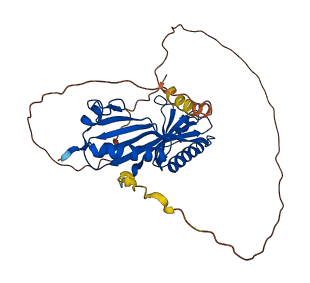
Descriptions
The autoinhibited protein was predicted that may have potential autoinhibitory elements via cis-regPred.
Autoinhibitory domains (AIDs)
Target domain |
|
Relief mechanism |
|
Assay |
cis-regPred |
Accessory elements
No accessory elements
Autoinhibited structure

Activated structure
1 structures for Q5UE94
| Entry ID | Method | Resolution | Chain | Position | Source |
|---|---|---|---|---|---|
| AF-Q5UE94-F1 | Predicted | AlphaFoldDB |
No variants for Q5UE94
| Variant ID(s) | Position | Change | Description | Diseaes Association | Provenance |
|---|---|---|---|---|---|
| No variants for Q5UE94 | |||||
No associated diseases with Q5UE94
1 regional properties for Q5UE94
| Type | Name | Position | InterPro Accession |
|---|---|---|---|
| conserved_site | TATA-box binding protein, conserved site | 264 - 313 | IPR030491 |
1 GO annotations of cellular component
| Name | Definition |
|---|---|
| nucleus | A membrane-bounded organelle of eukaryotic cells in which chromosomes are housed and replicated. In most cells, the nucleus contains all of the cell's chromosomes except the organellar chromosomes, and is the site of RNA synthesis and processing. In some species, or in specialized cell types, RNA metabolism or DNA replication may be absent. |
2 GO annotations of molecular function
| Name | Definition |
|---|---|
| DNA binding | Any molecular function by which a gene product interacts selectively and non-covalently with DNA (deoxyribonucleic acid). |
| DNA-binding transcription factor activity | A transcription regulator activity that modulates transcription of gene sets via selective and non-covalent binding to a specific double-stranded genomic DNA sequence (sometimes referred to as a motif) within a cis-regulatory region. Regulatory regions include promoters (proximal and distal) and enhancers. Genes are transcriptional units, and include bacterial operons. |
5 GO annotations of biological process
| Name | Definition |
|---|---|
| DNA-templated transcription | The synthesis of an RNA transcript from a DNA template. |
| DNA-templated transcription initiation | The initial step of transcription, consisting of the assembly of the RNA polymerase preinitiation complex (PIC) at a gene promoter, as well as the formation of the first few bonds of the RNA transcript. Transcription initiation includes abortive initiation events, which occur when the first few nucleotides are repeatedly synthesized and then released, and ends when promoter clearance takes place. |
| embryo development ending in birth or egg hatching | The process whose specific outcome is the progression of an embryo over time, from zygote formation until the end of the embryonic life stage. The end of the embryonic life stage is organism-specific and may be somewhat arbitrary; for mammals it is usually considered to be birth, for insects the hatching of the first instar larva from the eggshell. |
| gastrulation | A complex and coordinated series of cellular movements that occurs at the end of cleavage during embryonic development of most animals. The details of gastrulation vary from species to species, but usually result in the formation of the three primary germ layers, ectoderm, mesoderm and endoderm. |
| transcription by RNA polymerase II | The synthesis of RNA from a DNA template by RNA polymerase II (RNAP II), originating at an RNA polymerase II promoter. Includes transcription of messenger RNA (mRNA) and certain small nuclear RNAs (snRNAs). |
No homologous proteins in AiPD
| UniProt AC | Gene Name | Protein Name | Species | Evidence Code |
|---|---|---|---|---|
| No homologous proteins | ||||
| 10 | 20 | 30 | 40 | 50 | 60 |
| MDGESSLERY | LDQCDAEDVL | ASSHMFTPMT | PYDDLAIQPL | PGTSYSSTLE | HSKELSTDFS |
| 70 | 80 | 90 | 100 | 110 | 120 |
| SVDLSFLPDD | LNQENEDQQE | QTPSQSLEHD | SGICLDASNL | SQPFTPSECR | DATQDSSNLC |
| 130 | 140 | 150 | 160 | 170 | 180 |
| TMPITPMTPM | TPMTPVAESS | GIVPQLQNIV | STVNLACKLD | LKKIALHARN | AEYNPKRFAA |
| 190 | 200 | 210 | 220 | 230 | 240 |
| VIMRIREPRT | TALIFSSGKM | VCTGAKSEEQ | SRLAARKYAR | VVQKLGFPAK | FLDFKIQNMV |
| 250 | 260 | 270 | 280 | 290 | 300 |
| GSCDVRFPIR | LEGLVLTHQQ | FSSYEPELFP | GLIYRMVKPR | IVLLIFVSGK | VVLTGAKERS |
| 310 | |||||
| EIYEAFENIY | PILKGFKKTT |