Q5U239
Gene name |
tmem145 |
Protein name |
Transmembrane protein 145 |
Names |
|
Species |
Xenopus laevis (African clawed frog) |
KEGG Pathway |
xla:495696 |
EC number |
|
Protein Class |
|
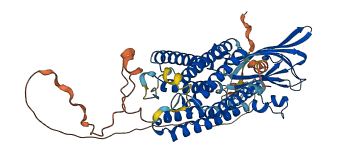
Descriptions
The autoinhibited protein was predicted that may have potential autoinhibitory elements via cis-regPred.
Autoinhibitory domains (AIDs)
Target domain |
|
Relief mechanism |
|
Assay |
cis-regPred |
Accessory elements
No accessory elements
Autoinhibited structure

Activated structure
1 structures for Q5U239
| Entry ID | Method | Resolution | Chain | Position | Source |
|---|---|---|---|---|---|
| AF-Q5U239-F1 | Predicted | AlphaFoldDB |
No variants for Q5U239
| Variant ID(s) | Position | Change | Description | Diseaes Association | Provenance |
|---|---|---|---|---|---|
| No variants for Q5U239 | |||||
No associated diseases with Q5U239
1 regional properties for Q5U239
| Type | Name | Position | InterPro Accession |
|---|---|---|---|
| domain | Intimal thickness related receptor, IRP | 151 - 404 | IPR019336 |
1 GO annotations of cellular component
| Name | Definition |
|---|---|
| integral component of membrane | The component of a membrane consisting of the gene products and protein complexes having at least some part of their peptide sequence embedded in the hydrophobic region of the membrane. |
No GO annotations of molecular function
| Name | Definition |
|---|---|
| No GO annotations for molecular function |
2 GO annotations of biological process
| Name | Definition |
|---|---|
| G protein-coupled receptor signaling pathway | The series of molecular signals initiated by a ligand binding to its receptor, in which the activated receptor promotes the exchange of GDP for GTP on the alpha-subunit of an associated heterotrimeric G-protein complex. The GTP-bound activated alpha-G-protein then dissociates from the beta- and gamma-subunits to further transmit the signal within the cell. The pathway begins with receptor-ligand interaction, and ends with regulation of a downstream cellular process. The pathway can start from the plasma membrane, Golgi or nuclear membrane. |
| response to pheromone | Any process that results in a change in state or activity of a cell or an organism (in terms of movement, secretion, enzyme production, gene expression, etc.) as a result of a pheromone stimulus. |
No homologous proteins in AiPD
| UniProt AC | Gene Name | Protein Name | Species | Evidence Code |
|---|---|---|---|---|
| No homologous proteins | ||||
| 10 | 20 | 30 | 40 | 50 | 60 |
| MGPHAGPGML | LLLLGFLRIS | AAKYVRGNLT | TKEDWVFLTR | FCFLSDYGRL | EFKFKYPEAK |
| 70 | 80 | 90 | 100 | 110 | 120 |
| CCQNILLYFD | DTSQWPAVYK | KDNKDCLMKE | SVIRPENNQV | INLTTQYVWS | GCQVIKEAGQ |
| 130 | 140 | 150 | 160 | 170 | 180 |
| SYLSCNSGRS | FRSVRERWWY | IALSKCGGDG | LQLEYEMTLT | NGKSFWTRHF | SADEFGILET |
| 190 | 200 | 210 | 220 | 230 | 240 |
| DITFLLIFIL | ILLLSCYFGY | ILRGRQLLHT | TYKMFMAAAG | VEVLSLLLFC | VYWGQYAQDG |
| 250 | 260 | 270 | 280 | 290 | 300 |
| VGNSSIKVLA | KLLFSASFLI | FLLMLILLGK | GFTVTRGRIS | HLGSIKLSVY | MTLYTVTHTV |
| 310 | 320 | 330 | 340 | 350 | 360 |
| LFIHEAQFFD | PAQVLYTYES | PAGYGNIALQ | FLAYIWFCYA | VLVTLKHFPE | KQAFYVPFFA |
| 370 | 380 | 390 | 400 | 410 | 420 |
| AYTLWFFAVP | VMALIANFGI | PKWAREKIVN | GIQLGIHLYA | HAVFLIITRP | SAANKNFPYH |
| 430 | 440 | 450 | 460 | 470 | 480 |
| VRTSQIGIME | QSTEKFPHHV | YGNVTFISDS | VPNVTELFSI | PSSNGSSAGI | TKPVPYPVTL |
| 490 | 500 | 510 | 520 | 530 | 540 |
| GQCYSQLTSD | SHQVISPPLL | NGVPGVQKVP | VGETQLGGLQ | QLHAPQIHHQ | NGFPEYFSIR |
| SAGPQPM |