Descriptions
The autoinhibited protein was predicted that may have potential autoinhibitory elements via cis-regPred.
Autoinhibitory domains (AIDs)
Target domain |
|
Relief mechanism |
|
Assay |
cis-regPred |
Accessory elements
No accessory elements
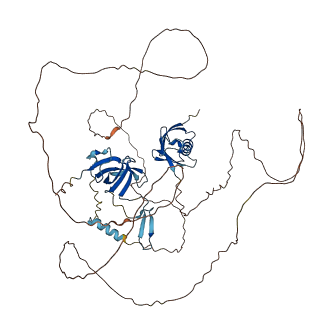
Autoinhibited structure

Activated structure
1 structures for Q5SU73
| Entry ID | Method | Resolution | Chain | Position | Source |
|---|---|---|---|---|---|
| AF-Q5SU73-F1 | Predicted | AlphaFoldDB |
19 variants for Q5SU73
| Variant ID(s) | Position | Change | Description | Diseaes Association | Provenance |
|---|---|---|---|---|---|
| rs3389128342 | 54 | G>R | No | EVA | |
| rs3401361764 | 129 | L>S | No | EVA | |
| rs3389128419 | 214 | Q>K | No | EVA | |
| rs3389192789 | 220 | R>S | No | EVA | |
| rs3389191788 | 221 | A>P | No | EVA | |
| rs3389191811 | 267 | T>I | No | EVA | |
| rs3389188237 | 287 | A>T | No | EVA | |
| rs3389190229 | 345 | F>I | No | EVA | |
| rs3389154362 | 357 | L>M | No | EVA | |
| rs3389179135 | 360 | P>L | No | EVA | |
| rs3389202557 | 365 | W>R | No | EVA | |
| rs3389194805 | 396 | E>D | No | EVA | |
| rs3389192780 | 408 | G>D | No | EVA | |
| rs3389179080 | 423 | V>L | No | EVA | |
| rs3389206030 | 437 | N>I | No | EVA | |
| rs3389194841 | 451 | V>I | No | EVA | |
| rs3402650210 | 471 | G>R | No | EVA | |
| rs3389186016 | 514 | S>T | No | EVA | |
| rs3389191808 | 532 | N>I | No | EVA |
No associated diseases with Q5SU73
1 regional properties for Q5SU73
| Type | Name | Position | InterPro Accession |
|---|---|---|---|
| domain | Coilin, N-terminal domain | 7 - 190 | IPR031722 |
7 GO annotations of cellular component
| Name | Definition |
|---|---|
| Cajal body | A class of nuclear body, first seen after silver staining by Ramon y Cajal in 1903, enriched in small nuclear ribonucleoproteins, and certain general RNA polymerase II transcription factors; ultrastructurally, they appear as a tangle of coiled, electron-dense threads roughly 0.5 micrometers in diameter; involved in aspects of snRNP biogenesis; the protein coilin serves as a marker for Cajal bodies. Some argue that Cajal bodies are the sites for preassembly of transcriptosomes, unitary particles involved in transcription and processing of RNA. |
| female germ cell nucleus | The nucleus of the female germ cell, a reproductive cell in females. |
| fibrillar center | A structure found most metazoan nucleoli, but not usually found in lower eukaryotes; surrounded by the dense fibrillar component; the zone of transcription from multiple copies of the pre-rRNA genes is in the border region between these two structures. |
| nuclear body | Extra-nucleolar nuclear domains usually visualized by confocal microscopy and fluorescent antibodies to specific proteins. |
| nucleolus | A small, dense body one or more of which are present in the nucleus of eukaryotic cells. It is rich in RNA and protein, is not bounded by a limiting membrane, and is not seen during mitosis. Its prime function is the transcription of the nucleolar DNA into 45S ribosomal-precursor RNA, the processing of this RNA into 5.8S, 18S, and 28S components of ribosomal RNA, and the association of these components with 5S RNA and proteins synthesized outside the nucleolus. This association results in the formation of ribonucleoprotein precursors; these pass into the cytoplasm and mature into the 40S and 60S subunits of the ribosome. |
| nucleoplasm | That part of the nuclear content other than the chromosomes or the nucleolus. |
| nucleus | A membrane-bounded organelle of eukaryotic cells in which chromosomes are housed and replicated. In most cells, the nucleus contains all of the cell's chromosomes except the organellar chromosomes, and is the site of RNA synthesis and processing. In some species, or in specialized cell types, RNA metabolism or DNA replication may be absent. |
5 GO annotations of molecular function
| Name | Definition |
|---|---|
| disulfide oxidoreductase activity | Catalysis of the reaction: substrate with reduced sulfide groups = substrate with oxidized disulfide bonds. |
| identical protein binding | Binding to an identical protein or proteins. |
| protein C-terminus binding | Binding to a protein C-terminus, the end of a peptide chain at which the 1-carboxyl function of a constituent amino acid is not attached in peptide linkage to another amino-acid residue. |
| U1 snRNA binding | Binding to a U1 small nuclear RNA (U1 snRNA). |
| U2 snRNA binding | Binding to a U2 small nuclear RNA (U2 snRNA). |
1 GO annotations of biological process
| Name | Definition |
|---|---|
| spliceosomal snRNP assembly | The aggregation, arrangement and bonding together of one or more snRNA and multiple protein components to form a ribonucleoprotein complex that is involved in formation of the spliceosome. |
No homologous proteins in AiPD
| UniProt AC | Gene Name | Protein Name | Species | Evidence Code |
|---|---|---|---|---|
| No homologous proteins | ||||
| 10 | 20 | 30 | 40 | 50 | 60 |
| MAASETVRLR | LQFDYPPPAT | PHCTVFWLLV | DLNRCRVVTD | LISLIRQRFG | FSSGALLGLY |
| 70 | 80 | 90 | 100 | 110 | 120 |
| LEGGLLPPAE | SARLVRDNDS | LRVKLEDQGL | PENLIVSNGG | DSSFPCRKAK | KRAFKLMEDE |
| 130 | 140 | 150 | 160 | 170 | 180 |
| ETDQGYKSLK | KHCKRQEDSG | QNEKASDLET | KLLPDETGRT | KSKKKSKVTG | SPAEEDEEET |
| 190 | 200 | 210 | 220 | 230 | 240 |
| KKKSSKRKEK | CEPKKQTRAS | KSSKQQTPKE | GASQNCSFPR | ASPRSLGKAR | RRSSTGLKGS |
| 250 | 260 | 270 | 280 | 290 | 300 |
| SGHLSESESC | PESVSDGHCS | VMMQEVTFSE | KLSAELLKDA | PATKTAAANR | QASKPGFTFS |
| 310 | 320 | 330 | 340 | 350 | 360 |
| SGKGKASRTS | SSSSDSSSES | EDQFLVSKNM | LEGASAGFLK | PTGLFAGQGG | SGPGLSLETP |
| 370 | 380 | 390 | 400 | 410 | 420 |
| GIMGWKSSDS | NRGRQAPGPP | STPVPTSLGR | GWGRGEDLLF | GKGLRGRGVR | GRGRGRGQAV |
| 430 | 440 | 450 | 460 | 470 | 480 |
| SCVFNRSSES | QKQRQLNDIL | TNSSVVIQNP | VEPPKKDYSL | LPLLAAAPQV | GEKIAFKLLE |
| 490 | 500 | 510 | 520 | 530 | 540 |
| LTSDYSPDVS | DYKEGKILSH | DPETQQVDIE | VLSSLPALKE | PGKFDLVYHN | ENGTEVVEYA |
| 550 | 560 | ||||
| VTQEKRITVL | WRELIDPRLI | IDSSGSISST |