Q5SJP8
Gene name |
TTHA0960 |
Protein name |
4-hydroxyphenylacetate 3-monooxygenase oxygenase component |
Names |
4-HPA 3-hydroxylase, 4-HPA 3-monooxygenase large component |
Species |
Thermus thermophilus (strain ATCC 27634 / DSM 579 / HB8) |
KEGG Pathway |
ttj:TTHA0960 |
EC number |
1.14.14.9: With reduced flavin or flavoprotein as one donor, and incorporation of one atom of oxygen |
Protein Class |
|
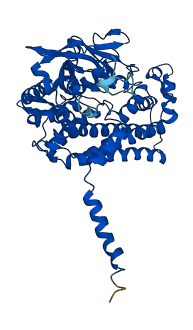
Descriptions
The autoinhibited protein was predicted that may have potential autoinhibitory elements via cis-regPred.
Autoinhibitory domains (AIDs)
Target domain |
|
Relief mechanism |
|
Assay |
cis-regPred |
Accessory elements
No accessory elements
Autoinhibited structure

Activated structure
No variants for Q5SJP8
| Variant ID(s) | Position | Change | Description | Diseaes Association | Provenance |
|---|---|---|---|---|---|
| No variants for Q5SJP8 | |||||
No associated diseases with Q5SJP8
Functions
| Description | ||
|---|---|---|
| EC Number | 1.14.14.9 | With reduced flavin or flavoprotein as one donor, and incorporation of one atom of oxygen |
| Subcellular Localization |
|
|
| PANTHER Family | ||
| PANTHER Subfamily | ||
| PANTHER Protein Class | ||
| PANTHER Pathway Category | No pathway information available | |
No GO annotations of cellular component
| Name | Definition |
|---|---|
| No GO annotations for cellular component |
3 GO annotations of molecular function
| Name | Definition |
|---|---|
| 4-hydroxyphenylacetate 3-monooxygenase activity | Catalysis of the reaction: (4-hydroxyphenyl)acetate + FADH(2) + O(2) = 3,4-dihydroxyphenylacetate + FAD + H(+) + H(2)O. |
| flavin adenine dinucleotide binding | Binding to FAD, flavin-adenine dinucleotide, the coenzyme or the prosthetic group of various flavoprotein oxidoreductase enzymes, in either the oxidized form, FAD, or the reduced form, FADH2. |
| oxidoreductase activity, acting on the CH-CH group of donors | Catalysis of an oxidation-reduction (redox) reaction in which a CH-CH group acts as a hydrogen or electron donor and reduces a hydrogen or electron acceptor. |
1 GO annotations of biological process
| Name | Definition |
|---|---|
| phenylacetate catabolic process | The chemical reactions and pathways resulting in the breakdown of phenylacetate. |
No homologous proteins in AiPD
| UniProt AC | Gene Name | Protein Name | Species | Evidence Code |
|---|---|---|---|---|
| No homologous proteins | ||||
| 10 | 20 | 30 | 40 | 50 | 60 |
| MARTGAEYIE | ALKTRPPNLW | YKGEKVEDPT | THPVFRGIVR | TMAALYDLQH | DPRYREVLTY |
| 70 | 80 | 90 | 100 | 110 | 120 |
| EEEGKRHGMS | FLIPKTKEDL | KRRGQAYKLW | ADQNLGMMGR | SPDYLNAVVM | AYAASADYFG |
| 130 | 140 | 150 | 160 | 170 | 180 |
| EFAENVRNYY | RYLRDQDLAT | THALTNPQVN | RARPPSGQPD | PYIPVGVVKQ | TEKGIVVRGA |
| 190 | 200 | 210 | 220 | 230 | 240 |
| RMTATFPLAD | EVLIFPSTLL | QAGSEKYALA | FALPTSTPGL | HFVCREALVG | GDSPFDHPLS |
| 250 | 260 | 270 | 280 | 290 | 300 |
| SRVEEMDCLV | IFDDVLVPWE | RVFILGNVEL | CNNAYAATGA | LNHMAHQVVA | LKTAKTEAFL |
| 310 | 320 | 330 | 340 | 350 | 360 |
| GVAALMAEGI | GADVYGHVQE | KIAEIIVYLE | AMRAFWTRAE | EEAKENAYGL | LVPDRGALDG |
| 370 | 380 | 390 | 400 | 410 | 420 |
| ARNLYPRLYP | RIREILEQIG | ASGLITLPSE | KDFKGPLGPF | LEKFLQGAAL | EAKERVALFR |
| 430 | 440 | 450 | 460 | 470 | 480 |
| LAWDMTLSGF | GARQELYERF | FFGDPVRMYQ | TLYNVYNKEP | YKERIRAFLK | ESLKVFEEVQ |
| A |