Q5SH28
Gene name |
TTHA1902 (TT1467) |
Protein name |
1,4-alpha-glucan branching enzyme TTHA1902 |
Names |
1,4-alpha-D-glucan:1,4-alpha-D-glucan 6-glucosyl-transferase, Alpha-(1->4)-glucan branching enzyme, Branching enzyme, BE |
Species |
Thermus thermophilus (strain ATCC 27634 / DSM 579 / HB8) |
KEGG Pathway |
ttj:TTHA1902 |
EC number |
2.4.1.18: Hexosyltransferases |
Protein Class |
|
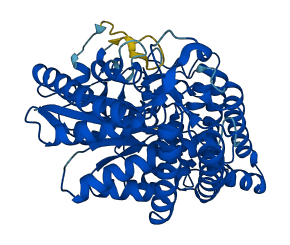
Descriptions
The autoinhibited protein was predicted that may have potential autoinhibitory elements via cis-regPred.
Autoinhibitory domains (AIDs)
Target domain |
|
Relief mechanism |
|
Assay |
cis-regPred |
Accessory elements
No accessory elements
Autoinhibited structure

Activated structure
3 structures for Q5SH28
| Entry ID | Method | Resolution | Chain | Position | Source |
|---|---|---|---|---|---|
| 1UFA | X-ray | 220 A | A | 1-520 | PDB |
| 3P0B | X-ray | 135 A | A | 1-520 | PDB |
| AF-Q5SH28-F1 | Predicted | AlphaFoldDB |
No variants for Q5SH28
| Variant ID(s) | Position | Change | Description | Diseaes Association | Provenance |
|---|---|---|---|---|---|
| No variants for Q5SH28 | |||||
No associated diseases with Q5SH28
Functions
| Description | ||
|---|---|---|
| EC Number | 2.4.1.18 | Hexosyltransferases |
| Subcellular Localization |
|
|
| PANTHER Family | ||
| PANTHER Subfamily | ||
| PANTHER Protein Class | ||
| PANTHER Pathway Category | No pathway information available | |
No GO annotations of cellular component
| Name | Definition |
|---|---|
| No GO annotations for cellular component |
2 GO annotations of molecular function
| Name | Definition |
|---|---|
| 1,4-alpha-glucan branching enzyme activity | Catalysis of the transfer of a segment of a (1->4)-alpha-D-glucan chain to a primary hydroxyl group in a similar glucan chain. |
| 1,4-alpha-glucan branching enzyme activity (using a glucosylated glycogenin as primer for glycogen synthesis) | Catalysis of the reaction: a glucosylated glycogenin = a glycogen. |
2 GO annotations of biological process
| Name | Definition |
|---|---|
| alpha-glucan biosynthetic process | The chemical reactions and pathways resulting in the formation of alpha-glucans, compounds composed of glucose residues linked by alpha-D-glucosidic bonds. |
| glycogen biosynthetic process | The chemical reactions and pathways resulting in the formation of glycogen, a polydisperse, highly branched glucan composed of chains of D-glucose residues. |
No homologous proteins in AiPD
| UniProt AC | Gene Name | Protein Name | Species | Evidence Code |
|---|---|---|---|---|
| No homologous proteins | ||||
| 10 | 20 | 30 | 40 | 50 | 60 |
| MARFALVLHA | HLPYVRAHGM | WPFGEETLYE | AMAETYLPLI | RVLERLRAEG | VEAPFTLGIT |
| 70 | 80 | 90 | 100 | 110 | 120 |
| PILAEQLADA | RIKEGFWAYA | KDRLERAQGD | YQRYRGTALE | ASARHQVAFW | ELTLDHFQRL |
| 130 | 140 | 150 | 160 | 170 | 180 |
| SGDLVAAFRK | AEEGGQVELI | TSNATHGYSP | LLGYDEALWA | QIKTGVSTYR | RHFAKDPTGF |
| 190 | 200 | 210 | 220 | 230 | 240 |
| WLPEMAYRPK | GPWKPPVEGP | PEGVRPGVDE | LLMRAGIRYT | FVDAHLVQGG | EPLSPYGEAA |
| 250 | 260 | 270 | 280 | 290 | 300 |
| LGPVESQEAT | YHVHELESGL | RVLARNPETT | LQVWSADYGY | PGEGLYREFH | RKDPLSGLHH |
| 310 | 320 | 330 | 340 | 350 | 360 |
| WRVTHRKADL | AEKAPYDPEA | AFAKTEEHAR | HFVGLLERLA | GRHPEGVILS | PYDAELFGHW |
| 370 | 380 | 390 | 400 | 410 | 420 |
| WYEGVAWLEA | VLRLLAQNPK | VRPVTAREAV | QGPAVRTALP | EGSWGRGGDH | RVWLNEKTLD |
| 430 | 440 | 450 | 460 | 470 | 480 |
| YWEKVYRAEG | AMREAARRGV | LPEGVLRQAM | RELLLLEASD | WPFLMETGQA | EAYARERYEE |
| 490 | 500 | 510 | |||
| HARAFFHLLK | GASPEELRAL | EERDNPFPEA | DPRLYLFREA |