Q5S1V9
Gene name |
IL27 (IL27A) |
Protein name |
Interleukin-27 subunit alpha |
Names |
IL-27 subunit alpha, IL-27-A, IL27-A, p28 |
Species |
Sus scrofa (Pig) |
KEGG Pathway |
ssc:493187 |
EC number |
|
Protein Class |
|
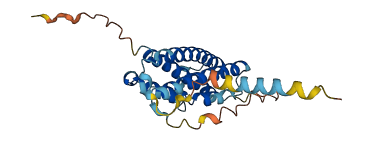
Descriptions
The autoinhibited protein was predicted that may have potential autoinhibitory elements via cis-regPred.
Autoinhibitory domains (AIDs)
Target domain |
|
Relief mechanism |
|
Assay |
cis-regPred |
Accessory elements
No accessory elements
Autoinhibited structure

Activated structure
1 structures for Q5S1V9
| Entry ID | Method | Resolution | Chain | Position | Source |
|---|---|---|---|---|---|
| AF-Q5S1V9-F1 | Predicted | AlphaFoldDB |
No variants for Q5S1V9
| Variant ID(s) | Position | Change | Description | Diseaes Association | Provenance |
|---|---|---|---|---|---|
| No variants for Q5S1V9 | |||||
No associated diseases with Q5S1V9
No regional properties for Q5S1V9
| Type | Name | Position | InterPro Accession |
|---|---|---|---|
| No domain, repeats, and functional sites for Q5S1V9 | |||
1 GO annotations of cellular component
| Name | Definition |
|---|---|
| extracellular space | That part of a multicellular organism outside the cells proper, usually taken to be outside the plasma membranes, and occupied by fluid. |
2 GO annotations of molecular function
| Name | Definition |
|---|---|
| cytokine activity | The activity of a soluble extracellular gene product that interacts with a receptor to effect a change in the activity of the receptor to control the survival, growth, differentiation and effector function of tissues and cells. |
| interleukin-27 receptor binding | Binding to an interleukin-27 receptor. |
3 GO annotations of biological process
| Name | Definition |
|---|---|
| inflammatory response | The immediate defensive reaction (by vertebrate tissue) to infection or injury caused by chemical or physical agents. The process is characterized by local vasodilation, extravasation of plasma into intercellular spaces and accumulation of white blood cells and macrophages. |
| innate immune response | Innate immune responses are defense responses mediated by germline encoded components that directly recognize components of potential pathogens. |
| regulation of T cell proliferation | Any process that modulates the frequency, rate or extent of T cell proliferation. |
No homologous proteins in AiPD
| UniProt AC | Gene Name | Protein Name | Species | Evidence Code |
|---|---|---|---|---|
| No homologous proteins | ||||
| 10 | 20 | 30 | 40 | 50 | 60 |
| MGQMADDLGW | RLSLLLLSLL | LARAGVWGFP | RPPGRPPLSL | QELQREFKVS | LHLARKLLSE |
| 70 | 80 | 90 | 100 | 110 | 120 |
| VRVQARHFAE | SHLPGVNLDL | LPLGEQLPNV | SLNFQAWRGL | SDPERLCFLS | MTLRPFHTLL |
| 130 | 140 | 150 | 160 | 170 | 180 |
| GGLGSQGFWT | SSERMQLWAI | RLDLRDLQQH | LRFQVLAAGF | NLPGQEEEEN | EAGRELLPGA |
| 190 | 200 | 210 | 220 | 230 | |
| PGGPSKPAAQ | VSWPRLLYTY | QLLHSLELVL | SRAMRDFLLL | SRAGNPAPAL | GFPTPSSPP |