Q5RF94
Gene name |
VAMP7 (SYBL1) |
Protein name |
Vesicle-associated membrane protein 7 |
Names |
VAMP-7, Synaptobrevin-like protein 1 |
Species |
Pongo abelii (Sumatran orangutan) (Pongo pygmaeus abelii) |
KEGG Pathway |
pon:100171531 |
EC number |
|
Protein Class |
|
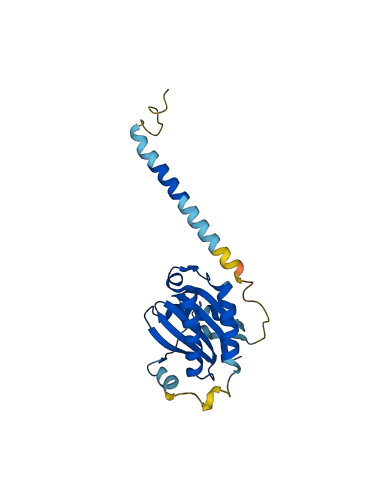
Descriptions
The autoinhibited protein was predicted that may have potential autoinhibitory elements via cis-regPred.
Autoinhibitory domains (AIDs)
Target domain |
|
Relief mechanism |
|
Assay |
cis-regPred |
Accessory elements
No accessory elements
Autoinhibited structure

Activated structure
1 structures for Q5RF94
| Entry ID | Method | Resolution | Chain | Position | Source |
|---|---|---|---|---|---|
| AF-Q5RF94-F1 | Predicted | AlphaFoldDB |
No variants for Q5RF94
| Variant ID(s) | Position | Change | Description | Diseaes Association | Provenance |
|---|---|---|---|---|---|
| No variants for Q5RF94 | |||||
No associated diseases with Q5RF94
Functions
12 GO annotations of cellular component
| Name | Definition |
|---|---|
| anchoring junction | A cell junction that mechanically attaches a cell (and its cytoskeleton) to neighboring cells or to the extracellular matrix. |
| endoplasmic reticulum membrane | The lipid bilayer surrounding the endoplasmic reticulum. |
| Golgi apparatus | A membrane-bound cytoplasmic organelle of the endomembrane system that further processes the core oligosaccharides (e.g. N-glycans) added to proteins in the endoplasmic reticulum and packages them into membrane-bound vesicles. The Golgi apparatus operates at the intersection of the secretory, lysosomal, and endocytic pathways. |
| integral component of membrane | The component of a membrane consisting of the gene products and protein complexes having at least some part of their peptide sequence embedded in the hydrophobic region of the membrane. |
| late endosome membrane | The lipid bilayer surrounding a late endosome. |
| lysosomal membrane | The lipid bilayer surrounding the lysosome and separating its contents from the cell cytoplasm. |
| neuron projection | A prolongation or process extending from a nerve cell, e.g. an axon or dendrite. |
| phagocytic vesicle | A membrane-bounded intracellular vesicle that arises from the ingestion of particulate material by phagocytosis. |
| phagocytic vesicle membrane | The lipid bilayer surrounding a phagocytic vesicle. |
| SNARE complex | A protein complex involved in membrane fusion; a stable ternary complex consisting of a four-helix bundle, usually formed from one R-SNARE and three Q-SNAREs with an ionic layer sandwiched between hydrophobic layers. One well-characterized example is the neuronal SNARE complex formed of synaptobrevin 2, syntaxin 1a, and SNAP-25. |
| synapse | The junction between an axon of one neuron and a dendrite of another neuron, a muscle fiber or a glial cell. As the axon approaches the synapse it enlarges into a specialized structure, the presynaptic terminal bouton, which contains mitochondria and synaptic vesicles. At the tip of the terminal bouton is the presynaptic membrane; facing it, and separated from it by a minute cleft (the synaptic cleft) is a specialized area of membrane on the receiving cell, known as the postsynaptic membrane. In response to the arrival of nerve impulses, the presynaptic terminal bouton secretes molecules of neurotransmitters into the synaptic cleft. These diffuse across the cleft and transmit the signal to the postsynaptic membrane. |
| transport vesicle membrane | The lipid bilayer surrounding a transport vesicle. |
No GO annotations of molecular function
| Name | Definition |
|---|---|
| No GO annotations for molecular function |
9 GO annotations of biological process
| Name | Definition |
|---|---|
| calcium-ion regulated exocytosis | The release of intracellular molecules (e.g. hormones, matrix proteins) contained within a membrane-bounded vesicle by fusion of the vesicle with the plasma membrane of a cell, induced by a rise in cytosolic calcium-ion levels. |
| endoplasmic reticulum to Golgi vesicle-mediated transport | The directed movement of substances from the endoplasmic reticulum (ER) to the Golgi, mediated by COP II vesicles. Small COP II coated vesicles form from the ER and then fuse directly with the cis-Golgi. Larger structures are transported along microtubules to the cis-Golgi. |
| endosome to lysosome transport | The directed movement of substances from endosomes to lysosomes. |
| eosinophil degranulation | The regulated exocytosis of secretory granules containing preformed mediators such as major basic protein, eosinophil peroxidase, and eosinophil cationic protein by an eosinophil. |
| neutrophil degranulation | The regulated exocytosis of secretory granules containing preformed mediators such as proteases, lipases, and inflammatory mediators by a neutrophil. |
| phagocytosis, engulfment | The internalization of bacteria, immune complexes and other particulate matter or of an apoptotic cell by phagocytosis, including the membrane and cytoskeletal processes required, which involves one of three mechanisms: zippering of pseudopods around a target via repeated receptor-ligand interactions, sinking of the target directly into plasma membrane of the phagocytosing cell, or induced uptake via an enhanced membrane ruffling of the phagocytosing cell similar to macropinocytosis. |
| protein transport | The directed movement of proteins into, out of or within a cell, or between cells, by means of some agent such as a transporter or pore. |
| vesicle fusion | Fusion of the membrane of a transport vesicle with its target membrane. |
| vesicle-mediated transport | A cellular transport process in which transported substances are moved in membrane-bounded vesicles; transported substances are enclosed in the vesicle lumen or located in the vesicle membrane. The process begins with a step that directs a substance to the forming vesicle, and includes vesicle budding and coating. Vesicles are then targeted to, and fuse with, an acceptor membrane. |
No homologous proteins in AiPD
| UniProt AC | Gene Name | Protein Name | Species | Evidence Code |
|---|---|---|---|---|
| No homologous proteins | ||||
| 10 | 20 | 30 | 40 | 50 | 60 |
| MAILFAVVAR | GTTILAKHAW | CGGNFLEVTE | QILAKIPSEN | NKLTYPHGNY | LFHYICQDRI |
| 70 | 80 | 90 | 100 | 110 | 120 |
| VYLCITDDDF | ERSRAFNFLN | EIKKRFQTTY | GSRAQTALPY | AMNSEFSSVL | AAQLKHHSEN |
| 130 | 140 | 150 | 160 | 170 | 180 |
| KGLDKVMETQ | AQVDELKGIM | VRNIDLVAQR | GERLELLIDK | TENLVDSSVT | FKTTSRNLAR |
| 190 | 200 | 210 | |||
| AMCMKNLKLT | IIIIIVSIVF | IYIIVSPLCG | GFTWPSCVKK |