Q5RE47
Gene name |
DDX39B (BAT1, UAP56) |
Protein name |
Spliceosome RNA helicase DDX39B |
Names |
56 kDa U2AF65-associated protein, DEAD box protein UAP56 |
Species |
Pongo abelii (Sumatran orangutan) (Pongo pygmaeus abelii) |
KEGG Pathway |
|
EC number |
3.6.4.13: Acting on ATP; involved in cellular and subcellular movement |
Protein Class |
|
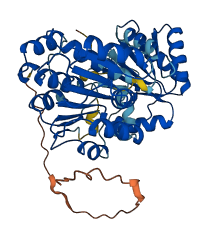
Descriptions
The autoinhibited protein was predicted that may have potential autoinhibitory elements via cis-regPred.
Autoinhibitory domains (AIDs)
Target domain |
|
Relief mechanism |
|
Assay |
cis-regPred |
Accessory elements
No accessory elements
Autoinhibited structure

Activated structure
1 structures for Q5RE47
| Entry ID | Method | Resolution | Chain | Position | Source |
|---|---|---|---|---|---|
| AF-Q5RE47-F1 | Predicted | AlphaFoldDB |
No variants for Q5RE47
| Variant ID(s) | Position | Change | Description | Diseaes Association | Provenance |
|---|---|---|---|---|---|
| No variants for Q5RE47 | |||||
No associated diseases with Q5RE47
4 regional properties for Q5RE47
Functions
| Description | ||
|---|---|---|
| EC Number | 3.6.4.13 | Acting on ATP; involved in cellular and subcellular movement |
| Subcellular Localization |
|
|
| PANTHER Family | ||
| PANTHER Subfamily | ||
| PANTHER Protein Class | ||
| PANTHER Pathway Category | No pathway information available | |
6 GO annotations of cellular component
| Name | Definition |
|---|---|
| cytoplasm | The contents of a cell excluding the plasma membrane and nucleus, but including other subcellular structures. |
| nuclear speck | A discrete extra-nucleolar subnuclear domain, 20-50 in number, in which splicing factors are seen to be localized by immunofluorescence microscopy. |
| spliceosomal complex | Any of a series of ribonucleoprotein complexes that contain snRNA(s) and small nuclear ribonucleoproteins (snRNPs), and are formed sequentially during the spliceosomal splicing of one or more substrate RNAs, and which also contain the RNA substrate(s) from the initial target RNAs of splicing, the splicing intermediate RNA(s), to the final RNA products. During cis-splicing, the initial target RNA is a single, contiguous RNA transcript, whether mRNA, snoRNA, etc., and the released products are a spliced RNA and an excised intron, generally as a lariat structure. During trans-splicing, there are two initial substrate RNAs, the spliced leader RNA and a pre-mRNA. |
| transcription export complex | The transcription export (TREX) complex couples transcription elongation by RNA polymerase II to mRNA export. The complex associates with the polymerase and travels with it along the length of the transcribed gene. TREX is composed of the THO transcription elongation complex as well as other proteins that couple THO to mRNA export proteins. The TREX complex is known to be found in a wide range of eukaryotes, including S. cerevisiae and metazoans. |
| U4 snRNP | A ribonucleoprotein complex that contains small nuclear RNA U4, a heptameric ring of Sm proteins, as well as several proteins that are unique to the U4 snRNP, most of which remain associated with the U4 snRNA both while the U4 snRNP is free or assembled into the U4/U6 snRNP or into a series of spliceosomal complexes. |
| U6 snRNP | A ribonucleoprotein complex that contains small nuclear RNA U6, the Lsm2-8 heptameric ring complex, as well as several proteins that are unique to the U6 snRNP, most of which remain associated with the U6 snRNA both while the U6 snRNP is free or assembled into the U4/U6 snRNP or into a series of spliceosomal complexes. |
7 GO annotations of molecular function
| Name | Definition |
|---|---|
| ATP binding | Binding to ATP, adenosine 5'-triphosphate, a universally important coenzyme and enzyme regulator. |
| ATP hydrolysis activity | Catalysis of the reaction: ATP + H2O = ADP + H+ phosphate. ATP hydrolysis is used in some reactions as an energy source, for example to catalyze a reaction or drive transport against a concentration gradient. |
| ATP-dependent protein binding | Binding to a protein or protein complex using energy from ATP hydrolysis. |
| identical protein binding | Binding to an identical protein or proteins. |
| RNA helicase activity | Unwinding of an RNA helix, driven by ATP hydrolysis. |
| U4 snRNA binding | Binding to a U4 small nuclear RNA (U4 snRNA). |
| U6 snRNA binding | Binding to a U6 small nuclear RNA (U6 snRNA). |
6 GO annotations of biological process
| Name | Definition |
|---|---|
| mRNA export from nucleus | The directed movement of mRNA from the nucleus to the cytoplasm. |
| negative regulation of DNA damage checkpoint | Any process that stops, prevents, or reduces the frequency, rate or extent of a DNA damage checkpoint. |
| positive regulation of DNA-templated transcription, elongation | Any process that activates or increases the frequency, rate or extent of transcription elongation, the extension of an RNA molecule after transcription initiation and promoter clearance by the addition of ribonucleotides catalyzed by a DNA-dependent RNA polymerase. |
| RNA secondary structure unwinding | The process in which a secondary structure of RNA are broken or 'melted'. |
| spliceosomal complex assembly | The aggregation, arrangement and bonding together of a spliceosomal complex, a ribonucleoprotein apparatus that catalyzes nuclear mRNA splicing via transesterification reactions. |
| viral mRNA export from host cell nucleus | The directed movement of intronless viral mRNA from the host nucleus to the cytoplasm for translation. |
No homologous proteins in AiPD
| UniProt AC | Gene Name | Protein Name | Species | Evidence Code |
|---|---|---|---|---|
| No homologous proteins | ||||
| 10 | 20 | 30 | 40 | 50 | 60 |
| MAENDVDNEL | LDYEDDEVET | AAGGDGAEAP | AKKDVKGSYV | SIHSSGFRDF | LLKPELLRAI |
| 70 | 80 | 90 | 100 | 110 | 120 |
| VDCGFEHPSE | VQHECIPQAI | LGMDVLCQAK | SGMGKTAVFV | LATLQQLEPV | TGQVSVLVMC |
| 130 | 140 | 150 | 160 | 170 | 180 |
| HTRELAFQIS | KEYERFSKYM | PNVKVAVFFG | GLSIKKDEEV | LKKNCPHIVV | GTPGRILALA |
| 190 | 200 | 210 | 220 | 230 | 240 |
| RNKSLNLKHI | KHFILDECDK | MLEQLDMRRD | VQEIFRMTPH | EKQVMMFSAT | LSKEIRPVCR |
| 250 | 260 | 270 | 280 | 290 | 300 |
| KFMQDPMEIF | VDDETKLTLH | GLQQYYVKLK | DNEKNRKLFD | LLDVLEFNQV | VIFVKSVQRC |
| 310 | 320 | 330 | 340 | 350 | 360 |
| IALAQLLVEQ | NFPAIAIHRG | MPQEERLSRY | QQFKDFQRRI | LVATNLFGRG | MDIERVNIAF |
| 370 | 380 | 390 | 400 | 410 | 420 |
| NYDMPEDSDT | YLHRVARAGR | FGTKGLAITF | VSDENDAKIL | NDVQDRFEVN | ISELPDEIDI |
| SSYIEQTR |