Q5RDT5
Gene name |
SAP18 |
Protein name |
Histone deacetylase complex subunit SAP18 |
Names |
18 kDa Sin3-associated polypeptide, Sin3-associated polypeptide p18 |
Species |
Pongo abelii (Sumatran orangutan) (Pongo pygmaeus abelii) |
KEGG Pathway |
pon:100190849 |
EC number |
|
Protein Class |
|
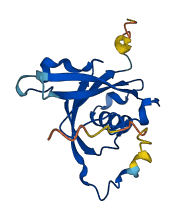
Descriptions
The autoinhibited protein was predicted that may have potential autoinhibitory elements via cis-regPred.
Autoinhibitory domains (AIDs)
Target domain |
|
Relief mechanism |
|
Assay |
cis-regPred |
Accessory elements
No accessory elements
Autoinhibited structure

Activated structure
1 structures for Q5RDT5
| Entry ID | Method | Resolution | Chain | Position | Source |
|---|---|---|---|---|---|
| AF-Q5RDT5-F1 | Predicted | AlphaFoldDB |
No variants for Q5RDT5
| Variant ID(s) | Position | Change | Description | Diseaes Association | Provenance |
|---|---|---|---|---|---|
| No variants for Q5RDT5 | |||||
No associated diseases with Q5RDT5
No regional properties for Q5RDT5
| Type | Name | Position | InterPro Accession |
|---|---|---|---|
| No domain, repeats, and functional sites for Q5RDT5 | |||
Functions
4 GO annotations of cellular component
| Name | Definition |
|---|---|
| ASAP complex | A protein complex involved in regulation of mRNA processing and apoptosis. It binds to RNA in a sequence-independent manner and is recruited to the EJC prior to or during the splicing process. In humans the core proteins are RNPS1, SAP18 and ACIN1. |
| cytosol | The part of the cytoplasm that does not contain organelles but which does contain other particulate matter, such as protein complexes. |
| exon-exon junction complex | A multi-subunit complex deposited by the spliceosome upstream of messenger RNA exon-exon junctions. The exon-exon junction complex provides a binding platform for factors involved in mRNA export and nonsense-mediated mRNA decay. |
| nuclear speck | A discrete extra-nucleolar subnuclear domain, 20-50 in number, in which splicing factors are seen to be localized by immunofluorescence microscopy. |
1 GO annotations of molecular function
| Name | Definition |
|---|---|
| transcription corepressor activity | A transcription coregulator activity that represses or decreases the transcription of specific gene sets via binding to a DNA-bound DNA-binding transcription factor, either on its own or as part of a complex. Corepressors often act by altering chromatin structure and modifications. For example, one class of transcription corepressors modifies chromatin structure through covalent modification of histones. A second class remodels the conformation of chromatin in an ATP-dependent fashion. A third class modulates interactions of DNA-bound DNA-binding transcription factors with other transcription coregulators. |
5 GO annotations of biological process
| Name | Definition |
|---|---|
| mRNA processing | Any process involved in the conversion of a primary mRNA transcript into one or more mature mRNA(s) prior to translation into polypeptide. |
| negative regulation of mRNA splicing, via spliceosome | Any process that stops, prevents or reduces the rate or extent of mRNA splicing via a spliceosomal mechanism. |
| positive regulation of apoptotic process | Any process that activates or increases the frequency, rate or extent of cell death by apoptotic process. |
| regulation of alternative mRNA splicing, via spliceosome | Any process that modulates the frequency, rate or extent of alternative splicing of nuclear mRNAs. |
| RNA splicing | The process of removing sections of the primary RNA transcript to remove sequences not present in the mature form of the RNA and joining the remaining sections to form the mature form of the RNA. |
No homologous proteins in AiPD
| UniProt AC | Gene Name | Protein Name | Species | Evidence Code |
|---|---|---|---|---|
| No homologous proteins | ||||
| 10 | 20 | 30 | 40 | 50 | 60 |
| MAVESRVTQE | EIKKEPEKPI | DREKTCPLLL | RVFTTNNGRH | HRMDEFSRGN | VPSSELQIYT |
| 70 | 80 | 90 | 100 | 110 | 120 |
| WMDATLKELT | SLVKEVYPEA | RKKGTHFNFA | IVFTDVKRPG | YRVKEIGSTM | SGRKGTDDSM |
| 130 | 140 | 150 | |||
| TLQSQKFQIG | DYLDIAITPP | NRAPPPSGRM | RPY |