Q5RDJ7
Gene name |
CLCN3 |
Protein name |
H(+)/Cl(-) exchange transporter 3 |
Names |
Chloride channel protein 3, ClC-3, Chloride transporter ClC-3 |
Species |
Pongo abelii (Sumatran orangutan) (Pongo pygmaeus abelii) |
KEGG Pathway |
pon:100174300 |
EC number |
|
Protein Class |
|
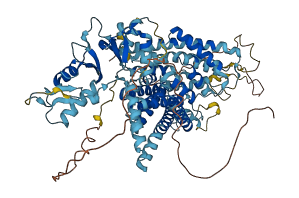
Descriptions
The autoinhibited protein was predicted that may have potential autoinhibitory elements via cis-regPred.
Autoinhibitory domains (AIDs)
Target domain |
|
Relief mechanism |
|
Assay |
cis-regPred |
Accessory elements
No accessory elements
Autoinhibited structure

Activated structure
1 structures for Q5RDJ7
| Entry ID | Method | Resolution | Chain | Position | Source |
|---|---|---|---|---|---|
| AF-Q5RDJ7-F1 | Predicted | AlphaFoldDB |
No variants for Q5RDJ7
| Variant ID(s) | Position | Change | Description | Diseaes Association | Provenance |
|---|---|---|---|---|---|
| No variants for Q5RDJ7 | |||||
No associated diseases with Q5RDJ7
Functions
11 GO annotations of cellular component
| Name | Definition |
|---|---|
| early endosome | A membrane-bounded organelle that receives incoming material from primary endocytic vesicles that have been generated by clathrin-dependent and clathrin-independent endocytosis; vesicles fuse with the early endosome to deliver cargo for sorting into recycling or degradation pathways. |
| early endosome membrane | The lipid bilayer surrounding an early endosome. |
| endosome membrane | The lipid bilayer surrounding an endosome. |
| Golgi apparatus | A membrane-bound cytoplasmic organelle of the endomembrane system that further processes the core oligosaccharides (e.g. N-glycans) added to proteins in the endoplasmic reticulum and packages them into membrane-bound vesicles. The Golgi apparatus operates at the intersection of the secretory, lysosomal, and endocytic pathways. |
| integral component of membrane | The component of a membrane consisting of the gene products and protein complexes having at least some part of their peptide sequence embedded in the hydrophobic region of the membrane. |
| late endosome | A prelysosomal endocytic organelle differentiated from early endosomes by lower lumenal pH and different protein composition. Late endosomes are more spherical than early endosomes and are mostly juxtanuclear, being concentrated near the microtubule organizing center. |
| late endosome membrane | The lipid bilayer surrounding a late endosome. |
| lysosomal membrane | The lipid bilayer surrounding the lysosome and separating its contents from the cell cytoplasm. |
| plasma membrane | The membrane surrounding a cell that separates the cell from its external environment. It consists of a phospholipid bilayer and associated proteins. |
| recycling endosome | An organelle consisting of a network of tubules that functions in targeting molecules, such as receptors transporters and lipids, to the plasma membrane. |
| vesicle membrane | The lipid bilayer surrounding any membrane-bounded vesicle in the cell. |
4 GO annotations of molecular function
| Name | Definition |
|---|---|
| antiporter activity | Enables the active transport of a solute across a membrane by a mechanism whereby two or more species are transported in opposite directions in a tightly coupled process not directly linked to a form of energy other than chemiosmotic energy. The reaction is: solute A(out) + solute B(in) = solute A(in) + solute B(out). |
| ATP binding | Binding to ATP, adenosine 5'-triphosphate, a universally important coenzyme and enzyme regulator. |
| PDZ domain binding | Binding to a PDZ domain of a protein, a domain found in diverse signaling proteins. |
| voltage-gated chloride channel activity | Enables the transmembrane transfer of a chloride ion by a voltage-gated channel. A voltage-gated channel is a channel whose open state is dependent on the voltage across the membrane in which it is embedded. |
No GO annotations of biological process
| Name | Definition |
|---|---|
| No GO annotations for biological process |
No homologous proteins in AiPD
| UniProt AC | Gene Name | Protein Name | Species | Evidence Code |
|---|---|---|---|---|
| No homologous proteins | ||||
| 10 | 20 | 30 | 40 | 50 | 60 |
| MESEQLFHRG | YYRNSYNSIT | SASSDEELLD | GAGVIMDFQT | SEDDNLLDGD | TAVGTHYTMT |
| 70 | 80 | 90 | 100 | 110 | 120 |
| NGGSINSSTH | LLDLLDEPIP | GVGTYDDFHT | IDWVREKCKD | RERHRRINSK | KKESAWEMTK |
| 130 | 140 | 150 | 160 | 170 | 180 |
| SLYDAWSGWL | VVTLTGLASG | ALAGLIDIAA | DWMTDLKEGI | CLSALWYNHE | QCCWGSNETT |
| 190 | 200 | 210 | 220 | 230 | 240 |
| FEERDKCPQW | KTWAELIIGQ | AEGPGSYIMN | YIMYIFWALS | FAFLAVSLVK | VFAPYACGSG |
| 250 | 260 | 270 | 280 | 290 | 300 |
| IPEIKTILSG | FIIRGYLGKW | TLMIKTVTLV | LAVASGLSLG | KEGPLVHVAC | CCGNIFSYLF |
| 310 | 320 | 330 | 340 | 350 | 360 |
| PKYSTNEAKK | REVLSAASAA | GVSVAFGAPI | GGVLFSLEEV | SYYFPLKTLW | RSFFAALVAA |
| 370 | 380 | 390 | 400 | 410 | 420 |
| FVLRSINPFG | NSRLVLFYVE | YHTPWYLFEL | FPFILLGVFG | GLWGAFFIRA | NIAWCRRRKS |
| 430 | 440 | 450 | 460 | 470 | 480 |
| TKFGKYPVLE | VIIVAAITAV | IAFPNPYTRL | NTSELIKELF | TDCGPLESSS | LCDYRNDMNA |
| 490 | 500 | 510 | 520 | 530 | 540 |
| SKIVDDIPDR | PAGIGVYSAI | WQLCLALIFK | IIMTVFTFGI | KVPSGLFIPS | MAYYHHDWFI |
| 550 | 560 | 570 | 580 | 590 | 600 |
| FKEWCEVGAD | CITPGLYAMV | GAAACLGGVT | RMTVSLVVIV | FELTGGLEYI | VPLMAAVMTS |
| 610 | 620 | 630 | 640 | 650 | 660 |
| KWVGDAFGRE | GIYEAHIRLN | GYPFLDAKEE | FTHTTLAADV | MRPRRNDPPL | AVLTQDNMTV |
| 670 | 680 | 690 | 700 | 710 | 720 |
| DDIENMINET | SYNGFPVIMS | KESQRLVGFA | LRRDLTIAIE | SARKKQEGIV | GSSRVCFAQH |
| 730 | 740 | 750 | 760 | 770 | 780 |
| TPSLPAESPR | PLKLRSILDM | SPFTVTDHTP | MEIVVDIFRK | LGLRQCLVTH | NGRLLGIITK |
| 790 | 800 | ||||
| KDILRHMAQT | ANQDPASIMF | N |