Q5RDH5
Gene name |
PRKAA1 |
Protein name |
5'-AMP-activated protein kinase catalytic subunit alpha-1 |
Names |
AMPK subunit alpha-1, Acetyl-CoA carboxylase kinase, ACACA kinase, Hydroxymethylglutaryl-CoA reductase kinase, HMGCR kinase, Tau-protein kinase PRKAA1 |
Species |
Pongo abelii (Sumatran orangutan) (Pongo pygmaeus abelii) |
KEGG Pathway |
pon:100174304 |
EC number |
2.7.11.1: Protein-serine/threonine kinases |
Protein Class |
|
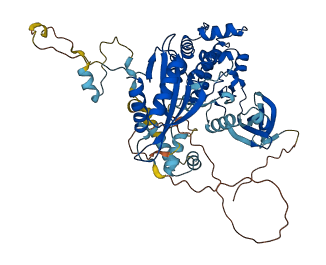
Descriptions
The autoinhibited protein was predicted that may have potential autoinhibitory elements via cis-regPred.
Autoinhibitory domains (AIDs)
Target domain |
|
Relief mechanism |
|
Assay |
cis-regPred |
Accessory elements
162-184 (Activation loop from InterPro)
Target domain |
22-274 (Protein kinase domain) |
Relief mechanism |
|
Assay |
|
Autoinhibited structure

Activated structure
1 structures for Q5RDH5
| Entry ID | Method | Resolution | Chain | Position | Source |
|---|---|---|---|---|---|
| AF-Q5RDH5-F1 | Predicted | AlphaFoldDB |
No variants for Q5RDH5
| Variant ID(s) | Position | Change | Description | Diseaes Association | Provenance |
|---|---|---|---|---|---|
| No variants for Q5RDH5 | |||||
No associated diseases with Q5RDH5
6 regional properties for Q5RDH5
| Type | Name | Position | InterPro Accession |
|---|---|---|---|
| domain | Protein kinase domain | 22 - 274 | IPR000719 |
| active_site | Serine/threonine-protein kinase, active site | 141 - 153 | IPR008271 |
| binding_site | Protein kinase, ATP binding site | 28 - 51 | IPR017441 |
| domain | PRKAA1, UBA-like autoinhibitory domain | 291 - 355 | IPR028797 |
| domain | AMPK, C-terminal adenylate sensor domain | 401 - 475 | IPR032270 |
| domain | 5'-AMP-activated protein kinase alpha 1 catalytic subunit, C-terminal | 399 - 552 | IPR039137 |
Functions
| Description | ||
|---|---|---|
| EC Number | 2.7.11.1 | Protein-serine/threonine kinases |
| Subcellular Localization |
|
|
| PANTHER Family | ||
| PANTHER Subfamily | ||
| PANTHER Protein Class | ||
| PANTHER Pathway Category | No pathway information available | |
3 GO annotations of cellular component
| Name | Definition |
|---|---|
| cytoplasm | The contents of a cell excluding the plasma membrane and nucleus, but including other subcellular structures. |
| nucleotide-activated protein kinase complex | A protein complex that possesses nucleotide-dependent protein kinase activity. The nucleotide can be AMP (in S. pombe and human) or ADP (in S. cerevisiae). |
| nucleus | A membrane-bounded organelle of eukaryotic cells in which chromosomes are housed and replicated. In most cells, the nucleus contains all of the cell's chromosomes except the organellar chromosomes, and is the site of RNA synthesis and processing. In some species, or in specialized cell types, RNA metabolism or DNA replication may be absent. |
10 GO annotations of molecular function
| Name | Definition |
|---|---|
| [acetyl-CoA carboxylase] kinase activity | Catalysis of the reaction: ATP |
| [hydroxymethylglutaryl-CoA reductase (NADPH)] kinase activity | +Catalysis of the reaction: [3-hydroxy-3-methylglutaryl-CoA reductase (NADPH)] + ATP = [3-hydroxy-3-methylglutaryl-CoA reductase (NADPH)] phosphate + ADP. |
| AMP-activated protein kinase activity | Catalysis of the reaction: ATP + a protein = ADP + a phosphoprotein. This reaction requires the presence of AMP. |
| ATP binding | Binding to ATP, adenosine 5'-triphosphate, a universally important coenzyme and enzyme regulator. |
| chromatin binding | Binding to chromatin, the network of fibers of DNA, protein, and sometimes RNA, that make up the chromosomes of the eukaryotic nucleus during interphase. |
| histone serine kinase activity | Catalysis of the transfer of a phosphate group to a serine residue of a histone. |
| metal ion binding | Binding to a metal ion. |
| protein serine kinase activity | Catalysis of the reactions: ATP + protein serine = ADP + protein serine phosphate. |
| protein serine/threonine kinase activity | Catalysis of the reactions: ATP + protein serine = ADP + protein serine phosphate, and ATP + protein threonine = ADP + protein threonine phosphate. |
| tau-protein kinase activity | Catalysis of the reaction: ATP + tau-protein = ADP + O-phospho-tau-protein. |
23 GO annotations of biological process
| Name | Definition |
|---|---|
| autophagy | The cellular catabolic process in which cells digest parts of their own cytoplasm; allows for both recycling of macromolecular constituents under conditions of cellular stress and remodeling the intracellular structure for cell differentiation. |
| cellular response to glucose starvation | Any process that results in a change in state or activity of a cell (in terms of movement, secretion, enzyme production, gene expression, etc.) as a result of deprivation of glucose. |
| cellular response to nutrient levels | Any process that results in a change in state or activity of a cell (in terms of movement, secretion, enzyme production, gene expression, etc.) as a result of a stimulus reflecting the presence, absence, or concentration of nutrients. |
| cholesterol biosynthetic process | The chemical reactions and pathways resulting in the formation of cholesterol, cholest-5-en-3 beta-ol, the principal sterol of vertebrates and the precursor of many steroids, including bile acids and steroid hormones. |
| chromatin organization | The assembly or remodeling of chromatin composed of DNA complexed with histones, other associated proteins, and sometimes RNA. |
| energy homeostasis | Any process involved in the balance between food intake (energy input) and energy expenditure. |
| fatty acid biosynthetic process | The chemical reactions and pathways resulting in the formation of a fatty acid, any of the aliphatic monocarboxylic acids that can be liberated by hydrolysis from naturally occurring fats and oils. Fatty acids are predominantly straight-chain acids of 4 to 24 carbon atoms, which may be saturated or unsaturated; branched fatty acids and hydroxy fatty acids also occur, and very long chain acids of over 30 carbons are found in waxes. |
| fatty acid homeostasis | Any process involved in the maintenance of an internal steady state of fatty acid within an organism or cell. |
| glucose homeostasis | Any process involved in the maintenance of an internal steady state of glucose within an organism or cell. |
| lipid biosynthetic process | The chemical reactions and pathways resulting in the formation of lipids, compounds soluble in an organic solvent but not, or sparingly, in an aqueous solvent. |
| lipid droplet disassembly | The disaggregation of a lipid particle into its constituent components. |
| negative regulation of apoptotic process | Any process that stops, prevents, or reduces the frequency, rate or extent of cell death by apoptotic process. |
| negative regulation of hepatocyte apoptotic process | Any process that stops, prevents or reduces the frequency, rate or extent of hepatocyte apoptotic process. |
| negative regulation of lipid catabolic process | Any process that stops, prevents, or reduces the frequency, rate or extent of the chemical reactions and pathways resulting in the breakdown of lipids. |
| negative regulation of TOR signaling | Any process that stops, prevents, or reduces the frequency, rate or extent of TOR signaling. |
| positive regulation of autophagy | Any process that activates, maintains or increases the rate of autophagy. Autophagy is the process in which cells digest parts of their own cytoplasm. |
| positive regulation of glycolytic process | Any process that activates or increases the frequency, rate or extent of glycolysis. |
| protein localization to lipid droplet | A process in which a protein is transported to, or maintained in, a location on or within a lipid droplet. |
| protein phosphorylation | The process of introducing a phosphate group on to a protein. |
| regulation of circadian rhythm | Any process that modulates the frequency, rate or extent of a circadian rhythm. A circadian rhythm is a biological process in an organism that recurs with a regularity of approximately 24 hours. |
| response to gamma radiation | Any process that results in a change in state or activity of a cell or an organism (in terms of movement, secretion, enzyme production, gene expression, etc.) as a result of a gamma radiation stimulus. Gamma radiation is a form of electromagnetic radiation (EMR) or light emission of a specific frequency produced from sub-atomic particle interaction, such as electron-positron annihilation and radioactive decay. Gamma rays are generally characterized as EMR having the highest frequency and energy, and also the shortest wavelength, within the electromagnetic radiation spectrum. |
| rhythmic process | Any process pertinent to the generation and maintenance of rhythms in the physiology of an organism. |
| Wnt signaling pathway | The series of molecular signals initiated by binding of a Wnt protein to a frizzled family receptor on the surface of the target cell and ending with a change in cell state. |
No homologous proteins in AiPD
| UniProt AC | Gene Name | Protein Name | Species | Evidence Code |
|---|---|---|---|---|
| No homologous proteins | ||||
| 10 | 20 | 30 | 40 | 50 | 60 |
| SWRKMATAEK | QKHDGRVRIG | HYILGDTLGV | GTFGKVKVGK | HELTGHKVAV | KILNRQKIRS |
| 70 | 80 | 90 | 100 | 110 | 120 |
| LDVVGKIRRE | IQNLKLFRHP | HIIKLYQVIS | TPSDIFMVME | YVSGGELFDY | ICKNGRLDEK |
| 130 | 140 | 150 | 160 | 170 | 180 |
| ESRRLFQQIL | SGVDYCHRHM | VVHRDLKPEN | VLLDAHMNAK | IADFGLSNMM | SDGEFLRTSC |
| 190 | 200 | 210 | 220 | 230 | 240 |
| GSPNYAAPEV | ISGRLYAGPE | VDIWSSGVIL | YALLCGTLPF | DDDHVPTLFK | KICDGIFYTP |
| 250 | 260 | 270 | 280 | 290 | 300 |
| QYLNPSVISL | LKHMLQVDPM | KRATIKDIRE | HEWFKQDLPK | YLFPEDPSYS | STMIDDEALK |
| 310 | 320 | 330 | 340 | 350 | 360 |
| EVCEKFECSE | EEVLSCLYNR | NHQDPLAVAY | HLIIDNRRIM | NEAKDFYLAT | SPPDSFLDDH |
| 370 | 380 | 390 | 400 | 410 | 420 |
| HLTRPHPERV | PFLVAETPRA | RHTLDELNPQ | KSKHQGVRKA | KWHLGIRSQS | RPNDIMAEVC |
| 430 | 440 | 450 | 460 | 470 | 480 |
| RAIKQLDYEW | KVVNPYYLRV | RRKNPVTSTY | SKMSLQLYQV | DSRTYLLDFR | SIDDEITEAK |
| 490 | 500 | 510 | 520 | 530 | 540 |
| SGTATPQRSG | SVSNYRSCQR | SDSDAEAQGK | SSEVSLTSSV | TSLDSSPVDL | TPRPGSHTIE |
| 550 | |||||
| FFEMCANLIK | ILAQ |