Q5RCU5
Gene name |
CBR1 |
Protein name |
Carbonyl reductase [NADPH] 1 |
Names |
15-hydroxyprostaglandin dehydrogenase [NADP(+)], 20-beta-hydroxysteroid dehydrogenase, Alcohol dehydrogenase [NAD(P)+] CBR1, NADPH-dependent carbonyl reductase 1, Prostaglandin 9-ketoreductase, PG-9-KR, Prostaglandin-E(2) 9-reductase |
Species |
Pongo abelii (Sumatran orangutan) (Pongo pygmaeus abelii) |
KEGG Pathway |
pon:100172097 |
EC number |
1.1.1.184: With NAD(+) or NADP(+) as acceptor |
Protein Class |
|
Descriptions
The autoinhibited protein was predicted that may have potential autoinhibitory elements via cis-regPred.
Autoinhibitory domains (AIDs)
Target domain |
|
Relief mechanism |
|
Assay |
cis-regPred |
Accessory elements
No accessory elements
Autoinhibited structure

Activated structure
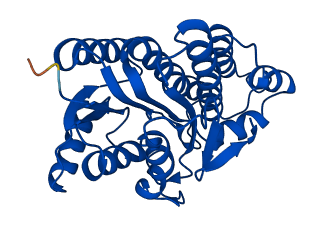
1 structures for Q5RCU5
| Entry ID | Method | Resolution | Chain | Position | Source |
|---|---|---|---|---|---|
| AF-Q5RCU5-F1 | Predicted | AlphaFoldDB |
No variants for Q5RCU5
| Variant ID(s) | Position | Change | Description | Diseaes Association | Provenance |
|---|---|---|---|---|---|
| No variants for Q5RCU5 | |||||
No associated diseases with Q5RCU5
No regional properties for Q5RCU5
| Type | Name | Position | InterPro Accession |
|---|---|---|---|
| No domain, repeats, and functional sites for Q5RCU5 | |||
Functions
| Description | ||
|---|---|---|
| EC Number | 1.1.1.184 | With NAD(+) or NADP(+) as acceptor |
| Subcellular Localization |
|
|
| PANTHER Family | ||
| PANTHER Subfamily | ||
| PANTHER Protein Class | ||
| PANTHER Pathway Category | No pathway information available | |
1 GO annotations of cellular component
| Name | Definition |
|---|---|
| cytoplasm | The contents of a cell excluding the plasma membrane and nucleus, but including other subcellular structures. |
5 GO annotations of molecular function
| Name | Definition |
|---|---|
| 15-hydroxyprostaglandin dehydrogenase (NADP+) activity | Catalysis of the reaction: NADP(+) + prostaglandin E(1) = 15-dehydro-prostaglandin E1 + H(+) + NADPH. |
| 15-hydroxyprostaglandin-D dehydrogenase (NADP+) activity | Catalysis of the reaction: NADP+ + (5Z,13E)-(15S)-9-alpha,15-dihydroxy-11-oxoprosta-5,13-dienoate = NADPH + H+ + (5Z,13E)-9-alpha-hydroxy-11,15-dioxoprosta-5,13-dienoate. |
| alcohol dehydrogenase (NADP+) activity | Catalysis of the reaction: an alcohol + NADP+ = an aldehyde + NADPH + H+. |
| carbonyl reductase (NADPH) activity | Catalysis of the reaction: R-CHOH-R' + NADP+ = R-CO-R' + NADPH + H+. |
| prostaglandin-E2 9-reductase activity | Catalysis of the reaction: (5Z,13E)-(15S)-9-alpha,11-alpha,15-trihydroxyprosta-5,13-dienoate + NADP+ = (5Z,13E)-(15S)-11-alpha,15-dihydroxy-9-oxoprosta-5,13-dienoate + NADPH. |
3 GO annotations of biological process
| Name | Definition |
|---|---|
| lipid metabolic process | The chemical reactions and pathways involving lipids, compounds soluble in an organic solvent but not, or sparingly, in an aqueous solvent. Includes fatty acids; neutral fats, other fatty-acid esters, and soaps; long-chain (fatty) alcohols and waxes; sphingoids and other long-chain bases; glycolipids, phospholipids and sphingolipids; and carotenes, polyprenols, sterols, terpenes and other isoprenoids. |
| vitamin K metabolic process | The chemical reactions and pathways involving any of the forms of vitamin K, quinone-derived vitamins which are involved in the synthesis of blood-clotting factors in mammals. Vitamin K substances share a methylated naphthoquinone ring structure and vary in the aliphatic side chains attached to the molecule. |
| xenobiotic metabolic process | The chemical reactions and pathways involving a xenobiotic compound, a compound foreign to the organim exposed to it. It may be synthesized by another organism (like ampicilin) or it can be a synthetic chemical. |
No homologous proteins in AiPD
| UniProt AC | Gene Name | Protein Name | Species | Evidence Code |
|---|---|---|---|---|
| No homologous proteins | ||||
| 10 | 20 | 30 | 40 | 50 | 60 |
| MSSGMHVALV | TGGNKGIGLA | IVRDLCRLFS | GDVVLTARDV | ARGQAAVQQL | QAEGLSPRFH |
| 70 | 80 | 90 | 100 | 110 | 120 |
| QLDIDDLQSI | RALRDFLRKE | YGGLDVLVNN | AGIAFKVADP | TPFHIQAEVT | MKTNFFGTRD |
| 130 | 140 | 150 | 160 | 170 | 180 |
| VCTELLPLIK | PQGRVVNVSS | IMSVRALKSC | SPELQQKFRS | ETITEEELVG | LMNKFVEDTK |
| 190 | 200 | 210 | 220 | 230 | 240 |
| KGVHQKEGWP | SSAYGVTKIG | VTVLSRIHAR | KLSEQRKGDR | ILLNACCPGW | VRTDMAGPKA |
| 250 | 260 | 270 | |||
| TKSPEEGAET | PVYLALLPPD | AEGPHGQFVS | EKRVEQW |