Q5RCN6
Gene name |
CYP4V2 |
Protein name |
Cytochrome P450 4V2 |
Names |
Docosahexaenoic acid omega-hydroxylase CYP4V2, Long-chain fatty acid omega-monooxygenase |
Species |
Pongo abelii (Sumatran orangutan) (Pongo pygmaeus abelii) |
KEGG Pathway |
pon:100172140 |
EC number |
1.14.14.79: With reduced flavin or flavoprotein as one donor, and incorporation of one atom of oxygen |
Protein Class |
|
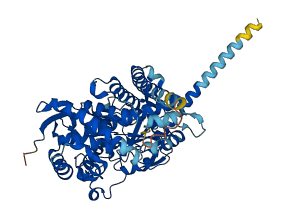
Descriptions
The autoinhibited protein was predicted that may have potential autoinhibitory elements via cis-regPred.
Autoinhibitory domains (AIDs)
Target domain |
|
Relief mechanism |
|
Assay |
cis-regPred |
Accessory elements
No accessory elements
Autoinhibited structure

Activated structure
1 structures for Q5RCN6
| Entry ID | Method | Resolution | Chain | Position | Source |
|---|---|---|---|---|---|
| AF-Q5RCN6-F1 | Predicted | AlphaFoldDB |
No variants for Q5RCN6
| Variant ID(s) | Position | Change | Description | Diseaes Association | Provenance |
|---|---|---|---|---|---|
| No variants for Q5RCN6 | |||||
No associated diseases with Q5RCN6
1 regional properties for Q5RCN6
| Type | Name | Position | InterPro Accession |
|---|---|---|---|
| conserved_site | Cytochrome P450, conserved site | 460 - 469 | IPR017972 |
Functions
| Description | ||
|---|---|---|
| EC Number | 1.14.14.79 | With reduced flavin or flavoprotein as one donor, and incorporation of one atom of oxygen |
| Subcellular Localization |
|
|
| PANTHER Family | ||
| PANTHER Subfamily | ||
| PANTHER Protein Class | ||
| PANTHER Pathway Category | No pathway information available | |
2 GO annotations of cellular component
| Name | Definition |
|---|---|
| endoplasmic reticulum membrane | The lipid bilayer surrounding the endoplasmic reticulum. |
| integral component of membrane | The component of a membrane consisting of the gene products and protein complexes having at least some part of their peptide sequence embedded in the hydrophobic region of the membrane. |
3 GO annotations of molecular function
| Name | Definition |
|---|---|
| heme binding | Binding to a heme, a compound composed of iron complexed in a porphyrin (tetrapyrrole) ring. |
| iron ion binding | Binding to an iron (Fe) ion. |
| long-chain fatty acid omega-hydroxylase activity | Catalysis of the reaction: an omega-methyl-long-chain fatty acid + O2 + reduced = an omega-hydroxy-long-chain fatty acid + H(+) + H2O + oxidized |
1 GO annotations of biological process
| Name | Definition |
|---|---|
| fatty acid omega-oxidation | A fatty acid oxidation process in which the methyl group at the end of the fatty acid molecule (the omega carbon) is first oxidized to a hydroxyl group, then to an oxo group, and finally to a carboxyl group. The long chain dicarboxylates derived from omega-oxidation then enter the beta-oxidation pathway for further degradation. |
No homologous proteins in AiPD
| UniProt AC | Gene Name | Protein Name | Species | Evidence Code |
|---|---|---|---|---|
| No homologous proteins | ||||
| 10 | 20 | 30 | 40 | 50 | 60 |
| MAGLWLGLVW | QKLLLWGAAS | AVSLAGASLV | LSLLQRVASY | ARKWQQMRPI | PTVARAYPLV |
| 70 | 80 | 90 | 100 | 110 | 120 |
| GHALLMKRDG | REFFQQIIEY | TEEYRHMPLL | KLWVGPVPMV | ALYNAENVEV | ILTSSRQIDK |
| 130 | 140 | 150 | 160 | 170 | 180 |
| SSMYKFLEPW | LGLGLLTSTG | NKWRSRRKML | TPTFHFTILE | DFLDIMNEQA | NILVKKLEKH |
| 190 | 200 | 210 | 220 | 230 | 240 |
| VNQEAFNCFF | YITLCALDII | CETAMGKNIG | AQSNDDSEYV | RAVYRMSQMI | FQRIKMPWLW |
| 250 | 260 | 270 | 280 | 290 | 300 |
| LDLWYLMFKE | GWEHEKGLKI | LHTFTNNVIA | ERANEMNADE | DCRGVGRGSA | PSKNKRRAFL |
| 310 | 320 | 330 | 340 | 350 | 360 |
| DLLLSVTDDE | GNRLSHEDIR | EEVDTFMFEG | HDTTAAAINW | SLYLLGCNPE | VQQKVDHELD |
| 370 | 380 | 390 | 400 | 410 | 420 |
| DVFGKSDRPA | TVEDLKKLRY | LECVIKETLR | LFPSVPLFAR | SVSEDCEVAG | YRVLKGTEAV |
| 430 | 440 | 450 | 460 | 470 | 480 |
| IIPYALHRDP | RYFPNPEEFQ | PERFFPENAQ | GRHPYAYVPF | SAGPRNCIGQ | KFAVMEEKTI |
| 490 | 500 | 510 | 520 | ||
| LSCILRHFWI | ESNQKREELG | LEGQLILRPS | NGIWIKLKRR | DADEP |