Q5RCK6
Gene name |
SYT10 |
Protein name |
Synaptotagmin-10 |
Names |
Synaptotagmin X, SytX |
Species |
Pongo abelii (Sumatran orangutan) (Pongo pygmaeus abelii) |
KEGG Pathway |
pon:100172160 |
EC number |
|
Protein Class |
|
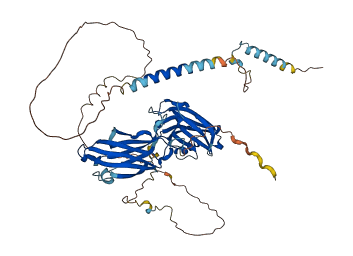
Descriptions
The autoinhibited protein was predicted that may have potential autoinhibitory elements via cis-regPred.
Autoinhibitory domains (AIDs)
Target domain |
|
Relief mechanism |
|
Assay |
cis-regPred |
Accessory elements
No accessory elements
Autoinhibited structure

Activated structure
1 structures for Q5RCK6
| Entry ID | Method | Resolution | Chain | Position | Source |
|---|---|---|---|---|---|
| AF-Q5RCK6-F1 | Predicted | AlphaFoldDB |
No variants for Q5RCK6
| Variant ID(s) | Position | Change | Description | Diseaes Association | Provenance |
|---|---|---|---|---|---|
| No variants for Q5RCK6 | |||||
No associated diseases with Q5RCK6
6 regional properties for Q5RCK6
| Type | Name | Position | InterPro Accession |
|---|---|---|---|
| domain | C2 domain | 231 - 352 | IPR000008-1 |
| domain | C2 domain | 363 - 496 | IPR000008-2 |
| domain | Synaptotagmin | 235 - 250 | IPR001565-1 |
| domain | Synaptotagmin | 250 - 263 | IPR001565-2 |
| domain | Synaptotagmin | 305 - 320 | IPR001565-3 |
| domain | Synaptotagmin | 325 - 335 | IPR001565-4 |
Functions
4 GO annotations of cellular component
| Name | Definition |
|---|---|
| exocytic vesicle | A transport vesicle that mediates transport from an intracellular compartment to the plasma membrane, and fuses with the plasma membrane to release various cargo molecules, such as proteins or hormones, by exocytosis. |
| integral component of membrane | The component of a membrane consisting of the gene products and protein complexes having at least some part of their peptide sequence embedded in the hydrophobic region of the membrane. |
| synapse | The junction between an axon of one neuron and a dendrite of another neuron, a muscle fiber or a glial cell. As the axon approaches the synapse it enlarges into a specialized structure, the presynaptic terminal bouton, which contains mitochondria and synaptic vesicles. At the tip of the terminal bouton is the presynaptic membrane; facing it, and separated from it by a minute cleft (the synaptic cleft) is a specialized area of membrane on the receiving cell, known as the postsynaptic membrane. In response to the arrival of nerve impulses, the presynaptic terminal bouton secretes molecules of neurotransmitters into the synaptic cleft. These diffuse across the cleft and transmit the signal to the postsynaptic membrane. |
| transport vesicle membrane | The lipid bilayer surrounding a transport vesicle. |
1 GO annotations of molecular function
| Name | Definition |
|---|---|
| calcium ion binding | Binding to a calcium ion (Ca2+). |
4 GO annotations of biological process
| Name | Definition |
|---|---|
| chemical synaptic transmission | The vesicular release of classical neurotransmitter molecules from a presynapse, across a chemical synapse, the subsequent activation of neurotransmitter receptors at the postsynapse of a target cell (neuron, muscle, or secretory cell) and the effects of this activation on the postsynaptic membrane potential and ionic composition of the postsynaptic cytosol. This process encompasses both spontaneous and evoked release of neurotransmitter and all parts of synaptic vesicle exocytosis. Evoked transmission starts with the arrival of an action potential at the presynapse. |
| exocytosis | A process of secretion by a cell that results in the release of intracellular molecules (e.g. hormones, matrix proteins) contained within a membrane-bounded vesicle. Exocytosis can occur either by full fusion, when the vesicle collapses into the plasma membrane, or by a kiss-and-run mechanism that involves the formation of a transient contact, a pore, between a granule (for exemple of chromaffin cells) and the plasma membrane. The latter process most of the time leads to only partial secretion of the granule content. Exocytosis begins with steps that prepare vesicles for fusion with the membrane (tethering and docking) and ends when molecules are secreted from the cell. |
| positive regulation of calcium ion-dependent exocytosis | Any process that activates or increases the frequency, rate or extent of calcium ion-dependent exocytosis. |
| sensory perception of smell | The series of events required for an organism to receive an olfactory stimulus, convert it to a molecular signal, and recognize and characterize the signal. Olfaction involves the detection of chemical composition of an organism's ambient medium by chemoreceptors. This is a neurological process. |
No homologous proteins in AiPD
| UniProt AC | Gene Name | Protein Name | Species | Evidence Code |
|---|---|---|---|---|
| No homologous proteins | ||||
| 10 | 20 | 30 | 40 | 50 | 60 |
| MSFHKEDGVN | SLCQKALHIV | TELCFAGQVE | WEKCSGIFPR | DRGSQGGSST | DISVSLLAVV |
| 70 | 80 | 90 | 100 | 110 | 120 |
| VSFCGLALLV | VSLFVFWKLC | WPCWKSKPVT | SNITTLPQSI | SSAPTEVFET | EEKKEIKENE |
| 130 | 140 | 150 | 160 | 170 | 180 |
| KPAMKAIEPA | IKISHTSPDI | PAEVQTALKE | HLIKHARVQR | QITEPTSSSR | HNSFRRHLPR |
| 190 | 200 | 210 | 220 | 230 | 240 |
| QMQVSSVDFS | MGTEPVLQRG | ETTTSIGRIK | PELYKQKSVD | SEGNQKEDVK | ICGKLNFTLQ |
| 250 | 260 | 270 | 280 | 290 | 300 |
| YDYENELLVV | KIIKALDLPA | KDFTGTSDPY | VKMYLLPDRK | KKFQTRVHRK | TLNPLFDETF |
| 310 | 320 | 330 | 340 | 350 | 360 |
| QFPVAYDQLS | NRKLHFSVYD | FDRFSRHDMI | GEVILDNLFE | VSDLSREATV | WKDIHCATTE |
| 370 | 380 | 390 | 400 | 410 | 420 |
| SIDLGEIMFS | LCYLPTAGRM | TLTVIKCRNL | KAMDITGSSD | PYVKVSLMCE | GRRLKKRKTT |
| 430 | 440 | 450 | 460 | 470 | 480 |
| TKKNTLNPVY | NEAIIFDIPP | ENVDQVSLSI | AVMDYDRVGH | NEVIGVCRTG | LDAEGLGRDH |
| 490 | 500 | 510 | 520 | ||
| WNEMLAYHRK | PITHWHPLLE | LPGRATSFDS | QGSCPSPKPP | STP |