Q5RCE2
Gene name |
STT3A |
Protein name |
Dolichyl-diphosphooligosaccharide--protein glycosyltransferase subunit STT3A |
Names |
Oligosaccharyl transferase subunit STT3A, STT3-A |
Species |
Pongo abelii (Sumatran orangutan) (Pongo pygmaeus abelii) |
KEGG Pathway |
pon:100174363 |
EC number |
2.4.99.18: Transferring other glycosyl groups |
Protein Class |
|
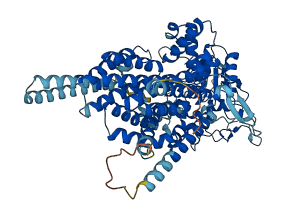
Descriptions
The autoinhibited protein was predicted that may have potential autoinhibitory elements via cis-regPred.
Autoinhibitory domains (AIDs)
Target domain |
|
Relief mechanism |
|
Assay |
cis-regPred |
Accessory elements
No accessory elements
Autoinhibited structure

Activated structure
1 structures for Q5RCE2
| Entry ID | Method | Resolution | Chain | Position | Source |
|---|---|---|---|---|---|
| AF-Q5RCE2-F1 | Predicted | AlphaFoldDB |
No variants for Q5RCE2
| Variant ID(s) | Position | Change | Description | Diseaes Association | Provenance |
|---|---|---|---|---|---|
| No variants for Q5RCE2 | |||||
No associated diseases with Q5RCE2
No regional properties for Q5RCE2
| Type | Name | Position | InterPro Accession |
|---|---|---|---|
| No domain, repeats, and functional sites for Q5RCE2 | |||
Functions
| Description | ||
|---|---|---|
| EC Number | 2.4.99.18 | Transferring other glycosyl groups |
| Subcellular Localization |
|
|
| PANTHER Family | ||
| PANTHER Subfamily | ||
| PANTHER Protein Class | ||
| PANTHER Pathway Category | No pathway information available | |
2 GO annotations of cellular component
| Name | Definition |
|---|---|
| integral component of membrane | The component of a membrane consisting of the gene products and protein complexes having at least some part of their peptide sequence embedded in the hydrophobic region of the membrane. |
| oligosaccharyltransferase III complex | An oligosaccharyltransferase (OST) complex that contains the seven polypeptides found in OST complex I, plus heterotrimeric Sec61alpha-beta-gamma and the tetrameric TRAP complex. Of the three forms of mammalian OST complexes identified, the OSTIII complex has the strongest affinity for ribosomes. |
2 GO annotations of molecular function
| Name | Definition |
|---|---|
| dolichyl-diphosphooligosaccharide-protein glycotransferase activity | Catalysis of the reaction: dolichyl diphosphooligosaccharide + protein L-asparagine = dolichyl diphosphate + a glycoprotein with the oligosaccharide chain attached by glycosylamine linkage to protein L-asparagine. |
| metal ion binding | Binding to a metal ion. |
2 GO annotations of biological process
| Name | Definition |
|---|---|
| co-translational protein modification | The process of covalently altering one or more amino acids in a protein after translation has begun but before the protein has been released from the ribosome. |
| protein N-linked glycosylation via asparagine | The glycosylation of protein via the N4 atom of peptidyl-asparagine forming N4-glycosyl-L-asparagine; the most common form is N-acetylglucosaminyl asparagine; N-acetylgalactosaminyl asparagine and N4 glucosyl asparagine also occur. This modification typically occurs in extracellular peptides with an N-X-(ST) motif. Partial modification has been observed to occur with cysteine, rather than serine or threonine, in the third position; secondary structure features are important, and proline in the second or fourth positions inhibits modification. |
No homologous proteins in AiPD
| UniProt AC | Gene Name | Protein Name | Species | Evidence Code |
|---|---|---|---|---|
| No homologous proteins | ||||
| 10 | 20 | 30 | 40 | 50 | 60 |
| MTKFGFLRLS | YEKQDTLLKL | LILSMAAVLS | FSTRLFAVLR | FESVIHEFDP | YFNYRTTRFL |
| 70 | 80 | 90 | 100 | 110 | 120 |
| AEEGFYKFHN | WFDDRAWYPL | GRIIGGTIYP | GLMITSAAIY | HVLHFFHITI | DIRNVCVFLA |
| 130 | 140 | 150 | 160 | 170 | 180 |
| PLFSSFTTIV | TYHLTKELKD | AGAGLLAAAM | IAVVPGYISR | SVAGSYDNEG | IAIFCMLLTY |
| 190 | 200 | 210 | 220 | 230 | 240 |
| YMWIKAVKTG | SICWAAKCAL | AYFYMVSSWG | GYVFLINLIP | LHVLVLMLTG | RFSHRIYVAY |
| 250 | 260 | 270 | 280 | 290 | 300 |
| CTVYCLGTIL | SMQISFVGFQ | PVLSSEHMAA | FGVFGLCQIH | AFVDYLRSKL | NPQQFEVLFR |
| 310 | 320 | 330 | 340 | 350 | 360 |
| SVISLVGFVL | LTVGALLMLT | GKISPWTGRF | YSLLDPSYAK | NNIPIIASVS | EHQPTTWSSY |
| 370 | 380 | 390 | 400 | 410 | 420 |
| YFDLQLLVFM | FPVGLYYCFS | NLSDARIFII | MYGVTSMYFS | AVMVRLMLVL | APVMCILSGI |
| 430 | 440 | 450 | 460 | 470 | 480 |
| GVSQVLSTYM | KNLDISRPDK | KSKKQQDSTY | PIKNEVASGM | ILVMAFFLIT | YTFHSTWVTS |
| 490 | 500 | 510 | 520 | 530 | 540 |
| EAYSSPSIVL | SARGGDGSRI | IFDDFREAYY | WLRHNTPEDA | KVMSWWDYGY | QITAMANRTI |
| 550 | 560 | 570 | 580 | 590 | 600 |
| LVDNNTWNNT | HISRVGQAMA | STEEKAYEIM | RELDVSYVLV | IFGGLTGYSS | DDINKFLWMV |
| 610 | 620 | 630 | 640 | 650 | 660 |
| RIGGSTDTGK | HIKENDYYTP | TGEFRVDREG | SPVLLNCLMY | KMCYYRFGQV | YTEAKRPPGF |
| 670 | 680 | 690 | 700 | ||
| DRVRNAEIGN | KDFELDVLEE | AYTTEHWLVR | IYKVKDLDNR | GLSRT |