Q5RCA6
Gene name |
CLVS1 (RLBP1L1) |
Protein name |
Clavesin-1 |
Names |
Retinaldehyde-binding protein 1-like 1 |
Species |
Pongo abelii (Sumatran orangutan) (Pongo pygmaeus abelii) |
KEGG Pathway |
pon:100172224 |
EC number |
|
Protein Class |
|
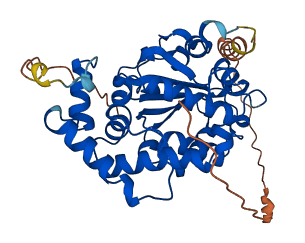
Descriptions
The autoinhibited protein was predicted that may have potential autoinhibitory elements via cis-regPred.
Autoinhibitory domains (AIDs)
Target domain |
|
Relief mechanism |
|
Assay |
cis-regPred |
Accessory elements
No accessory elements
Autoinhibited structure

Activated structure
1 structures for Q5RCA6
| Entry ID | Method | Resolution | Chain | Position | Source |
|---|---|---|---|---|---|
| AF-Q5RCA6-F1 | Predicted | AlphaFoldDB |
1 variants for Q5RCA6
| Variant ID(s) | Position | Change | Description | Diseaes Association | Provenance |
|---|---|---|---|---|---|
| rs178713558 | 88 | A>V | No | Ensembl |
No associated diseases with Q5RCA6
Functions
4 GO annotations of cellular component
| Name | Definition |
|---|---|
| clathrin-coated vesicle | A vesicle with a coat formed of clathrin connected to the membrane via one of the clathrin adaptor complexes. |
| early endosome membrane | The lipid bilayer surrounding an early endosome. |
| endosome | A vacuole to which materials ingested by endocytosis are delivered. |
| trans-Golgi network | The network of interconnected tubular and cisternal structures located within the Golgi apparatus on the side distal to the endoplasmic reticulum, from which secretory vesicles emerge. The trans-Golgi network is important in the later stages of protein secretion where it is thought to play a key role in the sorting and targeting of secreted proteins to the correct destination. |
1 GO annotations of molecular function
| Name | Definition |
|---|---|
| phosphatidylinositol-3,5-bisphosphate binding | Binding to phosphatidylinositol-3,5-bisphosphate, a derivative of phosphatidylinositol in which the inositol ring is phosphorylated at the 3' and 5' positions. |
1 GO annotations of biological process
| Name | Definition |
|---|---|
| lysosome organization | A process that is carried out at the cellular level which results in the assembly, arrangement of constituent parts, or disassembly of a lysosome. A lysosome is a cytoplasmic, membrane-bounded organelle that is found in most animal cells and that contains a variety of hydrolases. |
No homologous proteins in AiPD
| UniProt AC | Gene Name | Protein Name | Species | Evidence Code |
|---|---|---|---|---|
| No homologous proteins | ||||
| 10 | 20 | 30 | 40 | 50 | 60 |
| MGPVSLLPKY | QKLNTWNGDL | AKMTHLQAGL | SPETIEKARL | ELNENPDILH | QDIQQVRDMI |
| 70 | 80 | 90 | 100 | 110 | 120 |
| ITRPDIGFLR | TDDAFILRFL | RARKFHQADA | FRLLAQYFQY | RQLNLDMFKN | FKADDPGIKR |
| 130 | 140 | 150 | 160 | 170 | 180 |
| ALIDGFPGVL | ENRDHYGRKI | LLLFAANWDQ | SRNSFTDILR | AILLSLEVLI | EDPELQINGF |
| 190 | 200 | 210 | 220 | 230 | 240 |
| ILIIDWSNFS | FKQASKLTPS | ILKLAIEGLQ | DSFPARFGGV | HFVNQPWYIH | ALYTLIKPFL |
| 250 | 260 | 270 | 280 | 290 | 300 |
| KDKTRKRIFL | HGNNLNSLHQ | LIHPEFLPSE | FGGTLPPYDM | GTWARTLLGP | DYSDENDYTH |
| 310 | 320 | 330 | 340 | 350 | |
| TSYNAMHVKH | TSSNLERECS | PKLMKRSQSV | VEAGTLKHEE | KGENENTQPL | LALD |