Q5RC35
Gene name |
EMC4 (TMEM85) |
Protein name |
ER membrane protein complex subunit 4 |
Names |
Transmembrane protein 85 |
Species |
Pongo abelii (Sumatran orangutan) (Pongo pygmaeus abelii) |
KEGG Pathway |
pon:100172270 |
EC number |
|
Protein Class |
|
Descriptions
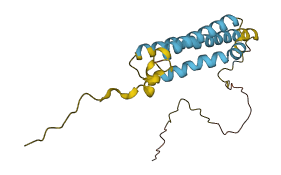
The autoinhibited protein was predicted that may have potential autoinhibitory elements via cis-regPred.
Autoinhibitory domains (AIDs)
Target domain |
|
Relief mechanism |
|
Assay |
cis-regPred |
Accessory elements
No accessory elements
Autoinhibited structure

Activated structure
1 structures for Q5RC35
| Entry ID | Method | Resolution | Chain | Position | Source |
|---|---|---|---|---|---|
| AF-Q5RC35-F1 | Predicted | AlphaFoldDB |
No variants for Q5RC35
| Variant ID(s) | Position | Change | Description | Diseaes Association | Provenance |
|---|---|---|---|---|---|
| No variants for Q5RC35 | |||||
No associated diseases with Q5RC35
No regional properties for Q5RC35
| Type | Name | Position | InterPro Accession |
|---|---|---|---|
| No domain, repeats, and functional sites for Q5RC35 | |||
Functions
3 GO annotations of cellular component
| Name | Definition |
|---|---|
| EMC complex | A transmembrane protein complex located in the endoplasmic reticulum (ER) involved in the insertion of newly synthesized proteins in the membrane of the ER. In S. cerevisiae, it has six members: EMC1, EMC2, AIM27, EMC4, KRE27, and EMC6. |
| integral component of endoplasmic reticulum membrane | The component of the endoplasmic reticulum membrane consisting of the gene products and protein complexes having at least some part of their peptide sequence embedded in the hydrophobic region of the membrane. |
| integral component of membrane | The component of a membrane consisting of the gene products and protein complexes having at least some part of their peptide sequence embedded in the hydrophobic region of the membrane. |
1 GO annotations of molecular function
| Name | Definition |
|---|---|
| membrane insertase activity | Binds transmembrane domain-containing proteins and mediates their integration into a membrane. |
3 GO annotations of biological process
| Name | Definition |
|---|---|
| apoptotic process | A programmed cell death process which begins when a cell receives an internal (e.g. DNA damage) or external signal (e.g. an extracellular death ligand), and proceeds through a series of biochemical events (signaling pathway phase) which trigger an execution phase. The execution phase is the last step of an apoptotic process, and is typically characterized by rounding-up of the cell, retraction of pseudopodes, reduction of cellular volume (pyknosis), chromatin condensation, nuclear fragmentation (karyorrhexis), plasma membrane blebbing and fragmentation of the cell into apoptotic bodies. When the execution phase is completed, the cell has died. |
| protein insertion into ER membrane by stop-transfer membrane-anchor sequence | A process of protein insertion into the endoplasmic reticulum (ER) membrane in which stop-transfer membrane-anchor sequences become an ER membrane spanning helix. |
| tail-anchored membrane protein insertion into ER membrane | A process of protein insertion into the endoplasmic reticulum (ER) membrane in which a tail-anchored (TA) transmembrane protein is incorporated into an endoplasmic reticulum (ER) membrane. TA transmembrane protein, also named type II transmembrane proteins, contain a single C- terminal transmembrane region. |
No homologous proteins in AiPD
| UniProt AC | Gene Name | Protein Name | Species | Evidence Code |
|---|---|---|---|---|
| No homologous proteins | ||||
| 10 | 20 | 30 | 40 | 50 | 60 |
| MTAQGGLVAN | RGRRFKWAIE | LSGPGGGSRG | RSDRGSGQGD | SLYPVGYLDK | QVPDTSVQET |
| 70 | 80 | 90 | 100 | 110 | 120 |
| DRILVEKRCW | DIALGPLKQI | PMNLFIMYMA | GNTISIFPTM | MVCMMAWRPI | QALMAISATF |
| 130 | 140 | 150 | 160 | 170 | 180 |
| KMLESSSQKF | LQGLVYLIGN | LMGLALAVYK | CQSMGLLPTH | ASDWLAFIEP | PERMEFSGGG |
| LLL |