Q5RBL5
Gene name |
NMNAT2 |
Protein name |
Nicotinamide/nicotinic acid mononucleotide adenylyltransferase 2 |
Names |
NMN/NaMN adenylyltransferase 2, Nicotinamide mononucleotide adenylyltransferase 2, NMN adenylyltransferase 2, Nicotinate-nucleotide adenylyltransferase 2, NaMN adenylyltransferase 2 |
Species |
Pongo abelii (Sumatran orangutan) (Pongo pygmaeus abelii) |
KEGG Pathway |
pon:100172391 |
EC number |
2.7.7.1: Nucleotidyltransferases |
Protein Class |
|
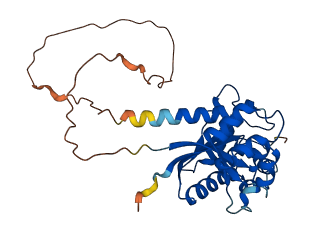
Descriptions
The autoinhibited protein was predicted that may have potential autoinhibitory elements via cis-regPred.
Autoinhibitory domains (AIDs)
Target domain |
|
Relief mechanism |
|
Assay |
cis-regPred |
Accessory elements
No accessory elements
Autoinhibited structure

Activated structure
1 structures for Q5RBL5
| Entry ID | Method | Resolution | Chain | Position | Source |
|---|---|---|---|---|---|
| AF-Q5RBL5-F1 | Predicted | AlphaFoldDB |
No variants for Q5RBL5
| Variant ID(s) | Position | Change | Description | Diseaes Association | Provenance |
|---|---|---|---|---|---|
| No variants for Q5RBL5 | |||||
No associated diseases with Q5RBL5
1 regional properties for Q5RBL5
| Type | Name | Position | InterPro Accession |
|---|---|---|---|
| domain | Cytidyltransferase-like domain | 12 - 274 | IPR004821 |
Functions
| Description | ||
|---|---|---|
| EC Number | 2.7.7.1 | Nucleotidyltransferases |
| Subcellular Localization |
|
|
| PANTHER Family | ||
| PANTHER Subfamily | ||
| PANTHER Protein Class | ||
| PANTHER Pathway Category | No pathway information available | |
7 GO annotations of cellular component
| Name | Definition |
|---|---|
| axon | The long process of a neuron that conducts nerve impulses, usually away from the cell body to the terminals and varicosities, which are sites of storage and release of neurotransmitter. |
| cytoplasmic vesicle membrane | The lipid bilayer surrounding a cytoplasmic vesicle. |
| cytosol | The part of the cytoplasm that does not contain organelles but which does contain other particulate matter, such as protein complexes. |
| Golgi membrane | The lipid bilayer surrounding any of the compartments of the Golgi apparatus. |
| late endosome | A prelysosomal endocytic organelle differentiated from early endosomes by lower lumenal pH and different protein composition. Late endosomes are more spherical than early endosomes and are mostly juxtanuclear, being concentrated near the microtubule organizing center. |
| synapse | The junction between an axon of one neuron and a dendrite of another neuron, a muscle fiber or a glial cell. As the axon approaches the synapse it enlarges into a specialized structure, the presynaptic terminal bouton, which contains mitochondria and synaptic vesicles. At the tip of the terminal bouton is the presynaptic membrane; facing it, and separated from it by a minute cleft (the synaptic cleft) is a specialized area of membrane on the receiving cell, known as the postsynaptic membrane. In response to the arrival of nerve impulses, the presynaptic terminal bouton secretes molecules of neurotransmitters into the synaptic cleft. These diffuse across the cleft and transmit the signal to the postsynaptic membrane. |
| trans-Golgi network | The network of interconnected tubular and cisternal structures located within the Golgi apparatus on the side distal to the endoplasmic reticulum, from which secretory vesicles emerge. The trans-Golgi network is important in the later stages of protein secretion where it is thought to play a key role in the sorting and targeting of secreted proteins to the correct destination. |
4 GO annotations of molecular function
| Name | Definition |
|---|---|
| ATP binding | Binding to ATP, adenosine 5'-triphosphate, a universally important coenzyme and enzyme regulator. |
| nicotinamide-nucleotide adenylyltransferase activity | Catalysis of the reaction: ATP + nicotinamide nucleotide = diphosphate + NAD+. |
| nicotinate-nucleotide adenylyltransferase activity | Catalysis of the reaction: ATP + nicotinate ribonucleotide = diphosphate + deamido-NAD+. |
| protein ADP-ribosyltransferase-substrate adaptor activity | An enzyme-substrate adaptor that bings together a protein ADP-ribosyl transferase and its substrate. |
1 GO annotations of biological process
| Name | Definition |
|---|---|
| NAD biosynthetic process | The chemical reactions and pathways resulting in the formation of nicotinamide adenine dinucleotide, a coenzyme present in most living cells and derived from the B vitamin nicotinic acid; biosynthesis may be of either the oxidized form, NAD, or the reduced form, NADH. |
No homologous proteins in AiPD
| UniProt AC | Gene Name | Protein Name | Species | Evidence Code |
|---|---|---|---|---|
| No homologous proteins | ||||
| 10 | 20 | 30 | 40 | 50 | 60 |
| MTETTKTHVI | LLACGSFNPI | TKGHIQMFER | ARDYLHKTGR | FIVIGGIVSP | VHDSYGKQGL |
| 70 | 80 | 90 | 100 | 110 | 120 |
| VSSRHRLIMC | QLAVQNSDWI | RVDPWECYQD | TWQTTCSVLE | HHRDLMKRVT | GCILSNVNTP |
| 130 | 140 | 150 | 160 | 170 | 180 |
| SMTPVIGQPQ | NETPQPIYQN | SNVPTKPTAA | KILGKVGESL | SRICCVRPPV | ERFTFVDENA |
| 190 | 200 | 210 | 220 | 230 | 240 |
| NLGTVMRYEE | IELRILLLCG | SDLLESFCIP | GLWNEADMEV | IVGDFGIVVV | PRDAADTDRI |
| 250 | 260 | 270 | 280 | 290 | 300 |
| MNHSSILRKY | KNNIMVVKDD | INHPMSVVSS | TKSRLALQHG | DGHVVDYLSQ | PVIDYILKSQ |
| LYINASG |