Q5RBG3
Gene name |
NSFL1C |
Protein name |
NSFL1 cofactor p47 |
Names |
p97 cofactor p47 |
Species |
Pongo abelii (Sumatran orangutan) (Pongo pygmaeus abelii) |
KEGG Pathway |
pon:100172420 |
EC number |
|
Protein Class |
|
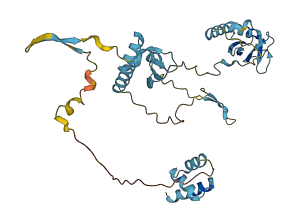
Descriptions
The autoinhibited protein was predicted that may have potential autoinhibitory elements via cis-regPred.
Autoinhibitory domains (AIDs)
Target domain |
|
Relief mechanism |
|
Assay |
cis-regPred |
Accessory elements
No accessory elements
Autoinhibited structure

Activated structure
1 structures for Q5RBG3
| Entry ID | Method | Resolution | Chain | Position | Source |
|---|---|---|---|---|---|
| AF-Q5RBG3-F1 | Predicted | AlphaFoldDB |
1 variants for Q5RBG3
| Variant ID(s) | Position | Change | Description | Diseaes Association | Provenance |
|---|---|---|---|---|---|
| rs174431436 | 310 | Q>K | No | Ensembl |
No associated diseases with Q5RBG3
3 regional properties for Q5RBG3
| Type | Name | Position | InterPro Accession |
|---|---|---|---|
| domain | Neutral trehalase Ca2+ binding | 93 - 122 | IPR011120 |
| conserved_site | Glycoside hydrolase, family 37, conserved site | 286 - 299 | IPR018232-1 |
| conserved_site | Glycoside hydrolase, family 37, conserved site | 609 - 618 | IPR018232-2 |
Functions
4 GO annotations of cellular component
| Name | Definition |
|---|---|
| chromosome | A structure composed of a very long molecule of DNA and associated proteins (e.g. histones) that carries hereditary information. |
| Golgi stack | The set of thin, flattened membrane-bounded compartments, called cisternae, that form the central portion of the Golgi complex. The stack usually comprises cis, medial, and trans cisternae; the cis- and trans-Golgi networks are not considered part of the stack. |
| microtubule organizing center | An intracellular structure that can catalyze gamma-tubulin-dependent microtubule nucleation and that can anchor microtubules by interacting with their minus ends, plus ends or sides. |
| nucleus | A membrane-bounded organelle of eukaryotic cells in which chromosomes are housed and replicated. In most cells, the nucleus contains all of the cell's chromosomes except the organellar chromosomes, and is the site of RNA synthesis and processing. In some species, or in specialized cell types, RNA metabolism or DNA replication may be absent. |
1 GO annotations of molecular function
| Name | Definition |
|---|---|
| lipid binding | Binding to a lipid. |
No GO annotations of biological process
| Name | Definition |
|---|---|
| No GO annotations for biological process |
No homologous proteins in AiPD
| UniProt AC | Gene Name | Protein Name | Species | Evidence Code |
|---|---|---|---|---|
| No homologous proteins | ||||
| 10 | 20 | 30 | 40 | 50 | 60 |
| MAAERQEALR | EFVAVTGAEE | DRARFFLESA | GWDLQIALAS | FYEDGGDEDI | VTISQATPSS |
| 70 | 80 | 90 | 100 | 110 | 120 |
| VSRGTAPSDN | RVTSFRDLIH | DQDEDEEEEE | GQRFYAGGSE | RSGQQIVGPP | RKKSPNELVD |
| 130 | 140 | 150 | 160 | 170 | 180 |
| DLFKGAKEHG | AVAVERVTKS | PGETSKPRPF | AGGGYRLGAA | PEEESAYVAG | EKRQHSSQDV |
| 190 | 200 | 210 | 220 | 230 | 240 |
| HVVLKLWKSG | FSLDNGELRS | YQDPSNAQFL | ESIRRGEVPA | ELRRLAHGGQ | VNLDMEDHRD |
| 250 | 260 | 270 | 280 | 290 | 300 |
| EDFVKPKGAF | KAFTGEGQKL | GSTAPQVLST | SSPAQQAENE | AKASSSILID | ESEPTTNIQI |
| 310 | 320 | 330 | 340 | 350 | 360 |
| RLADGGRLVQ | KFNHSHRISD | IRLFIVDARP | AMAATSFILM | TTFPNKELAD | ESQTLKEANL |
| LNAVIVQRLT |