Q5RBB3
Gene name |
NOB1 |
Protein name |
RNA-binding protein NOB1 |
Names |
|
Species |
Pongo abelii (Sumatran orangutan) (Pongo pygmaeus abelii) |
KEGG Pathway |
pon:100174418 |
EC number |
|
Protein Class |
|
Descriptions
The autoinhibited protein was predicted that may have potential autoinhibitory elements via cis-regPred.
Autoinhibitory domains (AIDs)
Target domain |
|
Relief mechanism |
|
Assay |
cis-regPred |
Accessory elements
No accessory elements
Autoinhibited structure

Activated structure
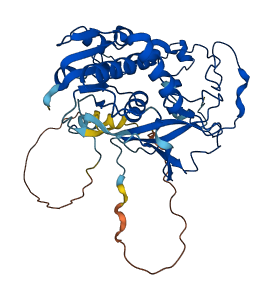
1 structures for Q5RBB3
| Entry ID | Method | Resolution | Chain | Position | Source |
|---|---|---|---|---|---|
| AF-Q5RBB3-F1 | Predicted | AlphaFoldDB |
1 variants for Q5RBB3
| Variant ID(s) | Position | Change | Description | Diseaes Association | Provenance |
|---|---|---|---|---|---|
| rs173656476 | 185 | D>E | No | Ensembl |
No associated diseases with Q5RBB3
1 GO annotations of cellular component
| Name | Definition |
|---|---|
| nucleus | A membrane-bounded organelle of eukaryotic cells in which chromosomes are housed and replicated. In most cells, the nucleus contains all of the cell's chromosomes except the organellar chromosomes, and is the site of RNA synthesis and processing. In some species, or in specialized cell types, RNA metabolism or DNA replication may be absent. |
2 GO annotations of molecular function
| Name | Definition |
|---|---|
| endoribonuclease activity | Catalysis of the hydrolysis of ester linkages within ribonucleic acid by creating internal breaks. |
| metal ion binding | Binding to a metal ion. |
3 GO annotations of biological process
| Name | Definition |
|---|---|
| cleavage involved in rRNA processing | Any phosphodiester bond hydrolysis involved in the conversion of a primary ribosomal RNA (rRNA) transcript into a mature rRNA molecule. |
| ribosomal small subunit biogenesis | A cellular process that results in the biosynthesis of constituent macromolecules, assembly, and arrangement of constituent parts of a small ribosomal subunit; includes transport to the sites of protein synthesis. |
| visual perception | The series of events required for an organism to receive a visual stimulus, convert it to a molecular signal, and recognize and characterize the signal. Visual stimuli are detected in the form of photons and are processed to form an image. |
No homologous proteins in AiPD
| UniProt AC | Gene Name | Protein Name | Species | Evidence Code |
|---|---|---|---|---|
| No homologous proteins | ||||
| 10 | 20 | 30 | 40 | 50 | 60 |
| MAPVEHVVAD | AGAFLRDAAL | QDIGKNIYTI | REVVTEIRDK | ATRRRLAVLP | YELRFKEPLP |
| 70 | 80 | 90 | 100 | 110 | 120 |
| EYVRLVTEFS | KKTGDYPSLS | ATDIQVLALT | YQLEAEFVGV | SHLKQEPQKV | KVSSSIQHPE |
| 130 | 140 | 150 | 160 | 170 | 180 |
| TPLHISGFHL | PSKPKPPQET | EKGHPACEPE | NLEFSSFMFW | RNPLPNIDHE | LQELLIDRGE |
| 190 | 200 | 210 | 220 | 230 | 240 |
| DIPSDEEEEE | NGFEDRRDDS | DDDGGGWITP | SNIKQIQQEL | EQCDVPEDVR | VGCVTTDFAM |
| 250 | 260 | 270 | 280 | 290 | 300 |
| QNVLLQMGLH | VLAVNGMLIR | EARSYILRCH | GCFKTTSDMS | RVFCSHCGNK | TLKKVSVTVS |
| 310 | 320 | 330 | 340 | 350 | 360 |
| DDGTLHMHFS | RNPKVLNPRG | LRYSLPTPKG | GKYAINPHLT | EDQRFPQLRL | SRKARQKTNV |
| 370 | 380 | 390 | 400 | 410 | |
| FAPDYVAGVS | PFVENDISSR | SATLQVRDSS | LGAGRRRLNP | NASRRKFVKK | R |