Q5RB68
Gene name |
IGF2BP2 (VICKZ2) |
Protein name |
Insulin-like growth factor 2 mRNA-binding protein 2 |
Names |
IGF2 mRNA-binding protein 2, IMP-2, IGF-II mRNA-binding protein 2, VICKZ family member 2 |
Species |
Pongo abelii (Sumatran orangutan) (Pongo pygmaeus abelii) |
KEGG Pathway |
pon:100172487 |
EC number |
|
Protein Class |
|
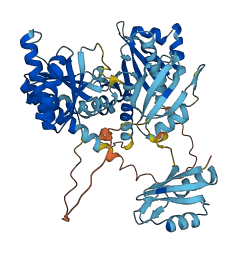
Descriptions
The autoinhibited protein was predicted that may have potential autoinhibitory elements via cis-regPred.
Autoinhibitory domains (AIDs)
Target domain |
|
Relief mechanism |
|
Assay |
cis-regPred |
Accessory elements
No accessory elements
Autoinhibited structure

Activated structure
1 structures for Q5RB68
| Entry ID | Method | Resolution | Chain | Position | Source |
|---|---|---|---|---|---|
| AF-Q5RB68-F1 | Predicted | AlphaFoldDB |
No variants for Q5RB68
| Variant ID(s) | Position | Change | Description | Diseaes Association | Provenance |
|---|---|---|---|---|---|
| No variants for Q5RB68 | |||||
No associated diseases with Q5RB68
11 regional properties for Q5RB68
| Type | Name | Position | InterPro Accession |
|---|---|---|---|
| domain | RNA recognition motif domain | 3 - 76 | IPR000504-1 |
| domain | RNA recognition motif domain | 82 - 157 | IPR000504-2 |
| domain | K Homology domain | 192 - 263 | IPR004087-1 |
| domain | K Homology domain | 273 - 346 | IPR004087-2 |
| domain | K Homology domain | 383 - 454 | IPR004087-3 |
| domain | K Homology domain | 465 - 537 | IPR004087-4 |
| domain | K Homology domain, type 1 | 196 - 260 | IPR004088-1 |
| domain | K Homology domain, type 1 | 278 - 342 | IPR004088-2 |
| domain | K Homology domain, type 1 | 389 - 449 | IPR004088-3 |
| domain | K Homology domain, type 1 | 470 - 534 | IPR004088-4 |
| domain | IGF2BP2, RNA recognition motif 1 | 2 - 78 | IPR034843 |
Functions
5 GO annotations of cellular component
| Name | Definition |
|---|---|
| cytoplasm | The contents of a cell excluding the plasma membrane and nucleus, but including other subcellular structures. |
| cytoplasmic stress granule | A dense aggregation in the cytosol composed of proteins and RNAs that appear when the cell is under stress. |
| cytoskeleton | A cellular structure that forms the internal framework of eukaryotic and prokaryotic cells. The cytoskeleton includes intermediate filaments, microfilaments, microtubules, the microtrabecular lattice, and other structures characterized by a polymeric filamentous nature and long-range order within the cell. The various elements of the cytoskeleton not only serve in the maintenance of cellular shape but also have roles in other cellular functions, including cellular movement, cell division, endocytosis, and movement of organelles. |
| nucleus | A membrane-bounded organelle of eukaryotic cells in which chromosomes are housed and replicated. In most cells, the nucleus contains all of the cell's chromosomes except the organellar chromosomes, and is the site of RNA synthesis and processing. In some species, or in specialized cell types, RNA metabolism or DNA replication may be absent. |
| P-body | A focus in the cytoplasm where mRNAs may become inactivated by decapping or some other mechanism. Protein and RNA localized to these foci are involved in mRNA degradation, nonsense-mediated mRNA decay (NMD), translational repression, and RNA-mediated gene silencing. |
3 GO annotations of molecular function
| Name | Definition |
|---|---|
| mRNA 3'-UTR binding | Binding to a 3' untranslated region of an mRNA molecule. |
| mRNA 5'-UTR binding | Binding to an mRNA molecule at its 5' untranslated region. |
| N6-methyladenosine-containing RNA binding | Binding to an RNA molecule modified by N6-methyladenosine (m6A), a modification present at internal sites of mRNAs and some non-coding RNAs. |
3 GO annotations of biological process
| Name | Definition |
|---|---|
| CRD-mediated mRNA stabilization | An mRNA stabilization process in which one or more RNA-binding proteins associate with a sequence in the open reading frame called the coding region instability determinant (CRD). |
| mRNA transport | The directed movement of mRNA, messenger ribonucleic acid, into, out of or within a cell, or between cells, by means of some agent such as a transporter or pore. |
| regulation of translation | Any process that modulates the frequency, rate or extent of the chemical reactions and pathways resulting in the formation of proteins by the translation of mRNA or circRNA. |
No homologous proteins in AiPD
| UniProt AC | Gene Name | Protein Name | Species | Evidence Code |
|---|---|---|---|---|
| No homologous proteins | ||||
| 10 | 20 | 30 | 40 | 50 | 60 |
| MMNKLYIGNL | SPAVTVDDLR | QLFGDRKLPL | AGQVLLKSGY | AFVDYPDQNW | AIRAIETLSG |
| 70 | 80 | 90 | 100 | 110 | 120 |
| KVELHGKIME | VDYSVSKKLR | SRKIQIRNIP | PHLQWEVLDG | LLAQYGTVEN | VEQVNTDTET |
| 130 | 140 | 150 | 160 | 170 | 180 |
| AVVNVTYATR | EEAKIAVEKL | SGHQFENYSF | KISYIPDEEV | SSPSPPQRAQ | RGDHSSREQG |
| 190 | 200 | 210 | 220 | 230 | 240 |
| HAPGGTSQAR | QIDFPLRILV | PTQFVGAIIG | KEGLTIKNIT | KQTQSRVDIH | RKENSGAAEK |
| 250 | 260 | 270 | 280 | 290 | 300 |
| PVTIHATPEG | TSEACRMILE | IMQKEADETK | LAEEIPLKIL | AHNGLVGRLI | GKEGRNLKKI |
| 310 | 320 | 330 | 340 | 350 | 360 |
| EHETGTKITI | SSLQDLSIYN | PERTITVKGT | VEACASAEIE | IMKKLREAFE | NDMLAVNTHS |
| 370 | 380 | 390 | 400 | 410 | 420 |
| GYFSSLYPHH | QFGPFPHHHS | YPEQEIVNLF | IPTQAVGAII | GKKGAHIKQL | ARFAGASIKI |
| 430 | 440 | 450 | 460 | 470 | 480 |
| APAEGPDVSE | RMVIITGPPE | AQFKAQGRIF | GKLKEENFFN | PKEEVKLEAH | IRVPSSTAGR |
| 490 | 500 | 510 | 520 | 530 | 540 |
| VIGKGGKTVN | ELQNLTSAEV | IVPRDQTPDE | NEEVIVRIIG | HFFASQTAQR | KIREIVQQVK |
| 550 | |||||
| QQEQKYPQGV | ASQCSK |