Q5RAC9
Gene name |
ATG16L1 (APG16L) |
Protein name |
Autophagy-related protein 16-1 |
Names |
APG16-like 1 |
Species |
Pongo abelii (Sumatran orangutan) (Pongo pygmaeus abelii) |
KEGG Pathway |
pon:100172682 |
EC number |
|
Protein Class |
|
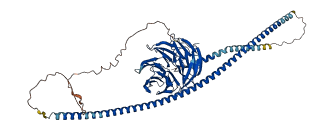
Descriptions
The autoinhibited protein was predicted that may have potential autoinhibitory elements via cis-regPred.
Autoinhibitory domains (AIDs)
Target domain |
|
Relief mechanism |
|
Assay |
cis-regPred |
Accessory elements
No accessory elements
Autoinhibited structure

Activated structure
1 structures for Q5RAC9
| Entry ID | Method | Resolution | Chain | Position | Source |
|---|---|---|---|---|---|
| AF-Q5RAC9-F1 | Predicted | AlphaFoldDB |
No variants for Q5RAC9
| Variant ID(s) | Position | Change | Description | Diseaes Association | Provenance |
|---|---|---|---|---|---|
| No variants for Q5RAC9 | |||||
No associated diseases with Q5RAC9
Functions
8 GO annotations of cellular component
| Name | Definition |
|---|---|
| Atg12-Atg5-Atg16 complex | A protein complex required for the expansion of the autophagosomal membrane. In budding yeast, this complex consists of Atg12p, Atg5p and Atg16p. |
| autophagosome membrane | The lipid bilayer surrounding an autophagosome, a double-membrane-bounded vesicle in which endogenous cellular material is sequestered. |
| axoneme | The bundle of microtubules and associated proteins that forms the core of cilia (also called flagella) in eukaryotic cells and is responsible for their movements. |
| cytoplasm | The contents of a cell excluding the plasma membrane and nucleus, but including other subcellular structures. |
| endolysosome membrane | The lipid bilayer surrounding an endolysosome. An endolysosome is a transient hybrid organelle formed by fusion of a late endosome with a lysosome. |
| phagophore assembly site membrane | A cellular membrane associated with the phagophore assembly site. |
| sperm midpiece | The highly organized segment of the sperm flagellum which begins at the connecting piece and is characterized by the presence of 9 outer dense fibers (ODFs) that lie outside each of the 9 outer axonemal microtubule doublets and by a sheath of mitochondria that encloses the ODFs and the axoneme; the midpiece terminates about one-fourth of the way down the sperm flagellum at the annulus, which marks the beginning of the principal piece. |
| vacuole-isolation membrane contact site | An organelle membrane contact site formed at the junction of the vacuolar membrane and the isolation membrane or phagophore in response to starvation or other stresses, leading to the formation of the autophagosome. |
No GO annotations of molecular function
| Name | Definition |
|---|---|
| No GO annotations for molecular function |
5 GO annotations of biological process
| Name | Definition |
|---|---|
| autophagosome assembly | The formation of a double membrane-bounded structure, the autophagosome, that occurs when a specialized membrane sac, called the isolation membrane, starts to enclose a portion of the cytoplasm. |
| C-terminal protein lipidation | The covalent attachment of a lipid group to the carboxy-terminus of a protein. |
| lysosomal microautophagy | The transfer of cytosolic components into the lysosomal compartment by direct invagination of the lysosomal membrane without prior sequestration into an autophagosome. The engulfing membranes fuse, resulting in the lysosomal delivery of the cargo wrapped in a single membrane derived from the invaginated lysosomal membrane. In S. cerevisiae, the vacuole is the lysosomal compartment. |
| macroautophagy | The major inducible pathway for the general turnover of cytoplasmic constituents in eukaryotic cells, it is also responsible for the degradation of active cytoplasmic enzymes and organelles during nutrient starvation. Macroautophagy involves the formation of double-membrane-bounded autophagosomes which enclose the cytoplasmic constituent targeted for degradation in a membrane-bounded structure. Autophagosomes then fuse with a lysosome (or vacuole) releasing single-membrane-bounded autophagic bodies that are then degraded within the lysosome (or vacuole). Some types of macroautophagy, e.g. pexophagy, mitophagy, involve selective targeting of the targets to be degraded. |
| protein transport | The directed movement of proteins into, out of or within a cell, or between cells, by means of some agent such as a transporter or pore. |
No homologous proteins in AiPD
| UniProt AC | Gene Name | Protein Name | Species | Evidence Code |
|---|---|---|---|---|
| No homologous proteins | ||||
| 10 | 20 | 30 | 40 | 50 | 60 |
| MSSGLRAADF | PRWKRHISEQ | LRRRDRLQRQ | AFEEIILQYN | KLLEKSDLHS | VLAQKLQAEK |
| 70 | 80 | 90 | 100 | 110 | 120 |
| HDVPNRHEIS | PGHDGTWNDS | QLQEMAQLRI | KHQEELTELH | KKRGELAQLV | IDLNNQMQRK |
| 130 | 140 | 150 | 160 | 170 | 180 |
| DREMQMNEAK | IAECLQTISD | LETECLDLRT | KLCDLERANQ | TLKDEYDALQ | ITFTALEGKL |
| 190 | 200 | 210 | 220 | 230 | 240 |
| RKTTEENQEL | VTRWMAEKAQ | EANRLNAENE | KDSRRRQARL | QKELAEAAKE | PLPVEQDDDI |
| 250 | 260 | 270 | 280 | 290 | 300 |
| EVIVDETSDH | TEETSPVRAI | SRAATKRLSQ | PAGGLLDSIT | NIFGRRSVSS | FPVPQDNVDT |
| 310 | 320 | 330 | 340 | 350 | 360 |
| HPGSGKEVRV | PTTALCVFDA | HDGEVNAVQF | SPGSRLLATG | GMDRRVKLWE | VFGEKCEFKG |
| 370 | 380 | 390 | 400 | 410 | 420 |
| SLSGSNAGIT | SIEFDSAGSY | LLAASNDFAS | RIWTVDDSRL | RHTLTGHSGK | VLSAKFLLDN |
| 430 | 440 | 450 | 460 | 470 | 480 |
| ARIVSGSHDR | TLKHWDLRSK | VCIKTVFAGS | SCNDIVCTEQ | CVMSGHFDKK | IRFWDIRSES |
| 490 | 500 | 510 | 520 | 530 | 540 |
| IVREMELLGK | ITALDLNPER | TELLSCSRDD | LLKVIDLRTN | AIKQTFSAPG | FKCGSDWTRV |
| 550 | 560 | 570 | 580 | 590 | 600 |
| VFSPDGSYVA | AGSAEGSLYT | WSVLTGKVEK | VLSKQHSSSI | NAVAWSPSGL | HVVSVDKGCK |
| AVLWAQY |