Q5R9G1
Gene name |
DCUN1D3 |
Protein name |
DCN1-like protein 3 |
Names |
DCNL3, DCUN1 domain-containing protein 3, Defective in cullin neddylation protein 1-like protein 3 |
Species |
Pongo abelii (Sumatran orangutan) (Pongo pygmaeus abelii) |
KEGG Pathway |
pon:100172877 |
EC number |
|
Protein Class |
|
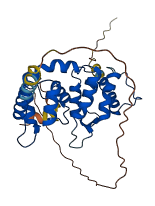
Descriptions
The autoinhibited protein was predicted that may have potential autoinhibitory elements via cis-regPred.
Autoinhibitory domains (AIDs)
Target domain |
|
Relief mechanism |
|
Assay |
cis-regPred |
Accessory elements
No accessory elements
Autoinhibited structure

Activated structure
1 structures for Q5R9G1
| Entry ID | Method | Resolution | Chain | Position | Source |
|---|---|---|---|---|---|
| AF-Q5R9G1-F1 | Predicted | AlphaFoldDB |
No variants for Q5R9G1
| Variant ID(s) | Position | Change | Description | Diseaes Association | Provenance |
|---|---|---|---|---|---|
| No variants for Q5R9G1 | |||||
No associated diseases with Q5R9G1
1 regional properties for Q5R9G1
| Type | Name | Position | InterPro Accession |
|---|---|---|---|
| domain | Potentiating neddylation domain | 86 - 278 | IPR005176 |
Functions
4 GO annotations of cellular component
| Name | Definition |
|---|---|
| cytoplasm | The contents of a cell excluding the plasma membrane and nucleus, but including other subcellular structures. |
| nucleus | A membrane-bounded organelle of eukaryotic cells in which chromosomes are housed and replicated. In most cells, the nucleus contains all of the cell's chromosomes except the organellar chromosomes, and is the site of RNA synthesis and processing. In some species, or in specialized cell types, RNA metabolism or DNA replication may be absent. |
| perinuclear region of cytoplasm | Cytoplasm situated near, or occurring around, the nucleus. |
| plasma membrane | The membrane surrounding a cell that separates the cell from its external environment. It consists of a phospholipid bilayer and associated proteins. |
1 GO annotations of molecular function
| Name | Definition |
|---|---|
| cullin family protein binding | Binding to a member of the cullin family, hydrophobic proteins that act as scaffolds for ubiquitin ligases (E3). |
9 GO annotations of biological process
| Name | Definition |
|---|---|
| negative regulation of cell growth | Any process that stops, prevents, or reduces the frequency, rate, extent or direction of cell growth. |
| negative regulation of G1/S transition of mitotic cell cycle | Any signalling pathway that decreases or inhibits the activity of a cell cycle cyclin-dependent protein kinase to modulate the switch from G1 phase to S phase of the mitotic cell cycle. |
| negative regulation of protein neddylation | Any process that stops, prevents or reduces the frequency, rate or extent of protein neddylation. |
| positive regulation of apoptotic process | Any process that activates or increases the frequency, rate or extent of cell death by apoptotic process. |
| positive regulation of protein neddylation | Any process that activates or increases the frequency, rate or extent of protein neddylation. |
| regulation of cell cycle process | Any process that modulates a cellular process that is involved in the progression of biochemical and morphological phases and events that occur in a cell during successive cell replication or nuclear replication events. |
| regulation of protein neddylation | Any process that modulates the frequency, rate or extent of protein neddylation. |
| response to gamma radiation | Any process that results in a change in state or activity of a cell or an organism (in terms of movement, secretion, enzyme production, gene expression, etc.) as a result of a gamma radiation stimulus. Gamma radiation is a form of electromagnetic radiation (EMR) or light emission of a specific frequency produced from sub-atomic particle interaction, such as electron-positron annihilation and radioactive decay. Gamma rays are generally characterized as EMR having the highest frequency and energy, and also the shortest wavelength, within the electromagnetic radiation spectrum. |
| response to UV-C | Any process that results in a change in state or activity of a cell or an organism (in terms of movement, secretion, enzyme production, gene expression, etc.) as a result of a UV-C radiation stimulus. UV-C radiation (UV-C light) spans the wavelengths 100 to 280 nm. |
No homologous proteins in AiPD
| UniProt AC | Gene Name | Protein Name | Species | Evidence Code |
|---|---|---|---|---|
| No homologous proteins | ||||
| 10 | 20 | 30 | 40 | 50 | 60 |
| MGQCVTKCKN | PSSTLGSKNG | DRDPSNKSHS | RRGAGHREEQ | VPPCGKPGGD | ILVNGTKKAE |
| 70 | 80 | 90 | 100 | 110 | 120 |
| AATEACQLPT | SSGDAGRESK | SNAEESSLQR | LEELFRRYKD | EREDAILEEG | MERFCNDLCV |
| 130 | 140 | 150 | 160 | 170 | 180 |
| DPTEFRVLLL | AWKFQAATMC | KFTRKEFFDG | CKAISADSID | GICARFPSLL | TEAKQEDKFK |
| 190 | 200 | 210 | 220 | 230 | 240 |
| DLYRFTFQFG | LDSEEGQRSL | HREIAIALWK | LVFTQNNPPV | LDQWLNFLTE | NPSGIKGISR |
| 250 | 260 | 270 | 280 | 290 | 300 |
| DTWNMFLNFT | QVIGPDLSNY | SEDEAWPSLF | DTFVEWEMER | RKREGEGRGA | LSSGPEGLCP |
| EEQT |