Q5R9C9
Gene name |
ATF7 |
Protein name |
Cyclic AMP-dependent transcription factor ATF-7 |
Names |
cAMP-dependent transcription factor ATF-7, Activating transcription factor 7, Transcription factor ATF-A |
Species |
Pongo abelii (Sumatran orangutan) (Pongo pygmaeus abelii) |
KEGG Pathway |
pon:100172894 |
EC number |
|
Protein Class |
|
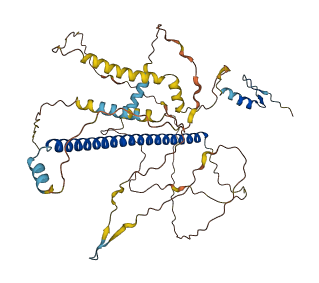
Descriptions
The autoinhibited protein was predicted that may have potential autoinhibitory elements via cis-regPred.
Autoinhibitory domains (AIDs)
Target domain |
|
Relief mechanism |
|
Assay |
cis-regPred |
Accessory elements
No accessory elements
Autoinhibited structure

Activated structure
1 structures for Q5R9C9
| Entry ID | Method | Resolution | Chain | Position | Source |
|---|---|---|---|---|---|
| AF-Q5R9C9-F1 | Predicted | AlphaFoldDB |
No variants for Q5R9C9
| Variant ID(s) | Position | Change | Description | Diseaes Association | Provenance |
|---|---|---|---|---|---|
| No variants for Q5R9C9 | |||||
No associated diseases with Q5R9C9
1 regional properties for Q5R9C9
| Type | Name | Position | InterPro Accession |
|---|---|---|---|
| domain | Signal transduction response regulator, receiver domain | 28 - 146 | IPR001789 |
Functions
2 GO annotations of cellular component
| Name | Definition |
|---|---|
| chromosome, telomeric region | The end of a linear chromosome, required for the integrity and maintenance of the end. A chromosome telomere usually includes a region of telomerase-encoded repeats the length of which rarely exceeds 20 bp each and that permits the formation of a telomeric loop (T-loop). The telomeric repeat region is usually preceded by a sub-telomeric region that is gene-poor but rich in repetitive elements. Some telomeres only consist of the latter part (for eg. D. melanogaster telomeres). |
| nucleoplasm | That part of the nuclear content other than the chromosomes or the nucleolus. |
3 GO annotations of molecular function
| Name | Definition |
|---|---|
| DNA binding | Any molecular function by which a gene product interacts selectively and non-covalently with DNA (deoxyribonucleic acid). |
| DNA-binding transcription factor activity | A transcription regulator activity that modulates transcription of gene sets via selective and non-covalent binding to a specific double-stranded genomic DNA sequence (sometimes referred to as a motif) within a cis-regulatory region. Regulatory regions include promoters (proximal and distal) and enhancers. Genes are transcriptional units, and include bacterial operons. |
| metal ion binding | Binding to a metal ion. |
No GO annotations of biological process
| Name | Definition |
|---|---|
| No GO annotations for biological process |
No homologous proteins in AiPD
| UniProt AC | Gene Name | Protein Name | Species | Evidence Code |
|---|---|---|---|---|
| No homologous proteins | ||||
| 10 | 20 | 30 | 40 | 50 | 60 |
| MGDDRPFVCN | APGCGQRFTN | EDHLAVHKHK | HEMTLKFGPA | RTDSVIIADQ | TPTPTRFLKN |
| 70 | 80 | 90 | 100 | 110 | 120 |
| CEEVGLFNEL | ASSFEHEFKK | AADEDEKKAA | AGPLDMSLPS | TPDIKIKEEE | PVEVDSSPPD |
| 130 | 140 | 150 | 160 | 170 | 180 |
| SPASSPCSPP | LKEKEVTPKP | VLISTPTPTI | VRPGSLPLHL | GYDPLHPTLP | SPTSVITQAP |
| 190 | 200 | 210 | 220 | 230 | 240 |
| PSNRQMGSPT | GSLPLVMHLA | NGQTMPVLPG | PPVQMPSVIS | LARPVSMVPN | IPGIPGPPVN |
| 250 | 260 | 270 | 280 | 290 | 300 |
| SSGSISPSGH | PIPSEAKMRL | KATLTHQVSS | INGGCGMVVG | SASTMVTARP | EQSQILIQHP |
| 310 | 320 | 330 | 340 | 350 | 360 |
| DAPSPAQPQV | SPAQPTPSTG | GRRRRTVDED | PDERRQRFLE | RNRAAASRCR | QKRKLWVSSL |
| 370 | 380 | 390 | 400 | 410 | 420 |
| EKKAEELTSQ | NIQLSNEVTL | LRNEVAQLKQ | LLLAHKDCPV | TALQKKTQGY | LESPKESSEP |
| 430 | 440 | 450 | 460 | 470 | 480 |
| TGSPAPVIQH | SSATAPSNGL | SVRSAAEAVA | TSVLTQMASQ | RTELSMPIQS | HVIMTPQSQS |
| AGR |