Q5R8Z4
Gene name |
PAK6 |
Protein name |
Serine/threonine-protein kinase PAK 6 |
Names |
p21-activated kinase 6, PAK-6 |
Species |
Pongo abelii (Sumatran orangutan) (Pongo pygmaeus abelii) |
KEGG Pathway |
pon:100172971 |
EC number |
2.7.11.1: Protein-serine/threonine kinases |
Protein Class |
|
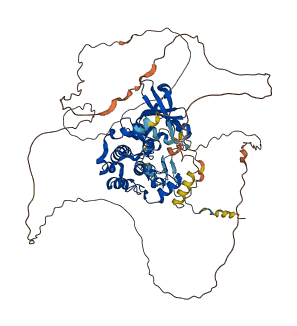
Descriptions
The autoinhibited protein was predicted that may have potential autoinhibitory elements via cis-regPred.
Autoinhibitory domains (AIDs)
Target domain |
|
Relief mechanism |
|
Assay |
cis-regPred |
Accessory elements
543-566 (Activation loop from InterPro)
Target domain |
407-658 (Protein kinase domain) |
Relief mechanism |
|
Assay |
|
Autoinhibited structure

Activated structure
1 structures for Q5R8Z4
| Entry ID | Method | Resolution | Chain | Position | Source |
|---|---|---|---|---|---|
| AF-Q5R8Z4-F1 | Predicted | AlphaFoldDB |
No variants for Q5R8Z4
| Variant ID(s) | Position | Change | Description | Diseaes Association | Provenance |
|---|---|---|---|---|---|
| No variants for Q5R8Z4 | |||||
No associated diseases with Q5R8Z4
5 regional properties for Q5R8Z4
| Type | Name | Position | InterPro Accession |
|---|---|---|---|
| domain | CRIB domain | 11 - 63 | IPR000095 |
| domain | Protein kinase domain | 407 - 658 | IPR000719 |
| binding_site | Protein kinase, ATP binding site | 413 - 436 | IPR017441 |
| domain | p21 activated kinase binding domain | 10 - 55 | IPR033923 |
| domain | Serine/threonine-protein kinase PAK 6, catalytic domain | 385 - 681 | IPR035066 |
Functions
| Description | ||
|---|---|---|
| EC Number | 2.7.11.1 | Protein-serine/threonine kinases |
| Subcellular Localization |
|
|
| PANTHER Family | ||
| PANTHER Subfamily | ||
| PANTHER Protein Class | ||
| PANTHER Pathway Category | No pathway information available | |
4 GO annotations of cellular component
| Name | Definition |
|---|---|
| cell junction | A cellular component that forms a specialized region of connection between two or more cells, or between a cell and the extracellular matrix, or between two membrane-bound components of a cell, such as flagella. |
| cytoplasm | The contents of a cell excluding the plasma membrane and nucleus, but including other subcellular structures. |
| fibrillar center | A structure found most metazoan nucleoli, but not usually found in lower eukaryotes; surrounded by the dense fibrillar component; the zone of transcription from multiple copies of the pre-rRNA genes is in the border region between these two structures. |
| nucleoplasm | That part of the nuclear content other than the chromosomes or the nucleolus. |
3 GO annotations of molecular function
| Name | Definition |
|---|---|
| ATP binding | Binding to ATP, adenosine 5'-triphosphate, a universally important coenzyme and enzyme regulator. |
| protein serine kinase activity | Catalysis of the reactions: ATP + protein serine = ADP + protein serine phosphate. |
| protein serine/threonine kinase activity | Catalysis of the reactions: ATP + protein serine = ADP + protein serine phosphate, and ATP + protein threonine = ADP + protein threonine phosphate. |
6 GO annotations of biological process
| Name | Definition |
|---|---|
| learning | Any process in an organism in which a relatively long-lasting adaptive behavioral change occurs as the result of experience. |
| locomotory behavior | The specific movement from place to place of an organism in response to external or internal stimuli. Locomotion of a whole organism in a manner dependent upon some combination of that organism's internal state and external conditions. |
| memory | The activities involved in the mental information processing system that receives (registers), modifies, stores, and retrieves informational stimuli. The main stages involved in the formation and retrieval of memory are encoding (processing of received information by acquisition), storage (building a permanent record of received information as a result of consolidation) and retrieval (calling back the stored information and use it in a suitable way to execute a given task). |
| neuron projection arborization | The process in which the anatomical structures of a neuron projection are generated and organized into branches. A neuron projection is any process extending from a neural cell, such as axons or dendrites. |
| neuron projection extension | Long distance growth of a single neuron projection involved in cellular development. A neuron projection is a prolongation or process extending from a nerve cell, e.g. an axon or dendrite. |
| protein phosphorylation | The process of introducing a phosphate group on to a protein. |
No homologous proteins in AiPD
| UniProt AC | Gene Name | Protein Name | Species | Evidence Code |
|---|---|---|---|---|
| No homologous proteins | ||||
| 10 | 20 | 30 | 40 | 50 | 60 |
| MFRKKKKKRP | EISAPQNFQH | RVHTSFDPKE | GKFVGLPPQW | QNILDTLRRP | KPVVDPSRIT |
| 70 | 80 | 90 | 100 | 110 | 120 |
| RVQLQPMKTV | VRGSTMPMDG | YISGLLNDIQ | KLSVISSNTL | RGRSPTSRRR | AQSLGLLGDE |
| 130 | 140 | 150 | 160 | 170 | 180 |
| HWATDPDMYL | QSPQSERTDP | HGLYLSCNGG | TPAGHKQMPW | PEPQSPRVLP | NGLAAKAQSL |
| 190 | 200 | 210 | 220 | 230 | 240 |
| GPAEFQGASQ | RCLQLGACLQ | SSPPGASPPT | GTNRRGMKAA | KHGSEEARPQ | SCLVGSATGR |
| 250 | 260 | 270 | 280 | 290 | 300 |
| PGGEGSPSPK | TRESSLKRRL | FRSMFLSTAA | TAPPSSSKPG | PPPQSKPNSS | FRPPQKDNPP |
| 310 | 320 | 330 | 340 | 350 | 360 |
| SLVAKAQSLP | SDQPVGTFSP | LTTSDTSSPQ | KSLRTAPATG | QLPGRSSPAG | SPRTWHAQIS |
| 370 | 380 | 390 | 400 | 410 | 420 |
| TSNLYLPQDP | TVAKGALAGE | DTGVVTHEQF | KAALRMVVDQ | GDPRLLLDSY | VKIGEGSTGI |
| 430 | 440 | 450 | 460 | 470 | 480 |
| VCLAREKHSG | RQVAVKMMDL | RKQQRRELLF | NEVVIMRDYQ | HFNVVEMYKS | YLVGEELWVL |
| 490 | 500 | 510 | 520 | 530 | 540 |
| MEFLQGGALT | DIVSQVRLNE | EQIATVCEAV | LQALAYLHAQ | GVIHRDIKSD | SILLTLDGRV |
| 550 | 560 | 570 | 580 | 590 | 600 |
| KLSDFGFCAQ | ISKDVPKRKS | LVGTPYWMAP | EVISRSLYAT | EVDIWSLGIM | VIEMVDGEPP |
| 610 | 620 | 630 | 640 | 650 | 660 |
| YFSDSPVQAM | KRLRDSPPPK | LKNSHKVSPV | LRDFLERMLV | RDPQERATAQ | ELLDHPFLLQ |
| 670 | 680 | ||||
| TGLPECLVPL | IQLYRKQTST | C |