Q5R8P5
Gene name |
SH3GLB1 |
Protein name |
Endophilin-B1 |
Names |
SH3 domain-containing GRB2-like protein B1 |
Species |
Pongo abelii (Sumatran orangutan) (Pongo pygmaeus abelii) |
KEGG Pathway |
pon:100173032 |
EC number |
|
Protein Class |
|
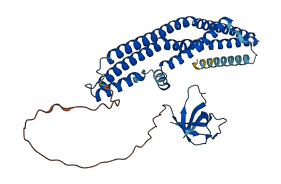
Descriptions
The autoinhibited protein was predicted that may have potential autoinhibitory elements via cis-regPred.
Autoinhibitory domains (AIDs)
Target domain |
|
Relief mechanism |
|
Assay |
cis-regPred |
Accessory elements
No accessory elements
Autoinhibited structure

Activated structure
1 structures for Q5R8P5
| Entry ID | Method | Resolution | Chain | Position | Source |
|---|---|---|---|---|---|
| AF-Q5R8P5-F1 | Predicted | AlphaFoldDB |
No variants for Q5R8P5
| Variant ID(s) | Position | Change | Description | Diseaes Association | Provenance |
|---|---|---|---|---|---|
| No variants for Q5R8P5 | |||||
No associated diseases with Q5R8P5
Functions
5 GO annotations of cellular component
| Name | Definition |
|---|---|
| autophagosome membrane | The lipid bilayer surrounding an autophagosome, a double-membrane-bounded vesicle in which endogenous cellular material is sequestered. |
| cytoplasmic vesicle | A vesicle found in the cytoplasm of a cell. |
| Golgi membrane | The lipid bilayer surrounding any of the compartments of the Golgi apparatus. |
| midbody | A thin cytoplasmic bridge formed between daughter cells at the end of cytokinesis. The midbody forms where the contractile ring constricts, and may persist for some time before finally breaking to complete cytokinesis. |
| mitochondrial outer membrane | The outer, i.e. cytoplasm-facing, lipid bilayer of the mitochondrial envelope. |
1 GO annotations of molecular function
| Name | Definition |
|---|---|
| lipid binding | Binding to a lipid. |
1 GO annotations of biological process
| Name | Definition |
|---|---|
| apoptotic process | A programmed cell death process which begins when a cell receives an internal (e.g. DNA damage) or external signal (e.g. an extracellular death ligand), and proceeds through a series of biochemical events (signaling pathway phase) which trigger an execution phase. The execution phase is the last step of an apoptotic process, and is typically characterized by rounding-up of the cell, retraction of pseudopodes, reduction of cellular volume (pyknosis), chromatin condensation, nuclear fragmentation (karyorrhexis), plasma membrane blebbing and fragmentation of the cell into apoptotic bodies. When the execution phase is completed, the cell has died. |
No homologous proteins in AiPD
| UniProt AC | Gene Name | Protein Name | Species | Evidence Code |
|---|---|---|---|---|
| No homologous proteins | ||||
| 10 | 20 | 30 | 40 | 50 | 60 |
| MNIMDFNVKK | LAADAGTFLS | RAVQFTEEKL | GQAEKTELDA | HLENLLSKAE | CTKIWTEKIM |
| 70 | 80 | 90 | 100 | 110 | 120 |
| KQTEVLLQPN | PNARIEEFVY | EKLDRKAPSR | INNPELLGQY | MIDAGTEFGP | GTAYGNALIK |
| 130 | 140 | 150 | 160 | 170 | 180 |
| CGETQKRIGT | ADRELIQTSA | LNFLTPLRNF | IEGDYKTIAK | ERKLLQNKRL | DLDAAKTRLK |
| 190 | 200 | 210 | 220 | 230 | 240 |
| KAKAAETRNS | SEQELRITQS | EFDRQAEITR | LLLEGISSTH | AHHLRCLNDF | VEAQMTYYAQ |
| 250 | 260 | 270 | 280 | 290 | 300 |
| CYQYMLDLQK | QLGSFPSNYL | SNNNQTSVTP | VPSVLPNAIG | SSAMASTSGL | VITSPSNLSD |
| 310 | 320 | 330 | 340 | 350 | 360 |
| LKECSGSRKA | RVLYDYDAAN | STELSLLADE | VITVFSVVGM | DSDWLMGERG | NQKGKVPITY |
| LELLN |