Q5R6K5
Gene name |
PLOD3 |
Protein name |
Multifunctional procollagen lysine hydroxylase and glycosyltransferase LH3 |
Names |
|
Species |
Pongo abelii (Sumatran orangutan) (Pongo pygmaeus abelii) |
KEGG Pathway |
pon:100189797 |
EC number |
1.14.11.4: With 2-oxoglutarate as one donor, and incorporation of one atom each of oxygen into both donors |
Protein Class |
|
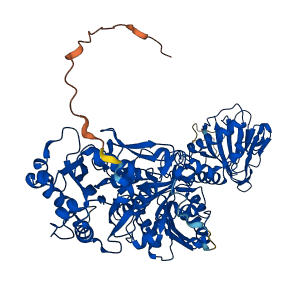
Descriptions
The autoinhibited protein was predicted that may have potential autoinhibitory elements via cis-regPred.
Autoinhibitory domains (AIDs)
Target domain |
|
Relief mechanism |
|
Assay |
cis-regPred |
Accessory elements
No accessory elements
Autoinhibited structure

Activated structure
1 structures for Q5R6K5
| Entry ID | Method | Resolution | Chain | Position | Source |
|---|---|---|---|---|---|
| AF-Q5R6K5-F1 | Predicted | AlphaFoldDB |
4 variants for Q5R6K5
| Variant ID(s) | Position | Change | Description | Diseaes Association | Provenance |
|---|---|---|---|---|---|
| rs178033835 | 8 | P>R | No | Ensembl | |
| rs178033834 | 13 | L>P | No | Ensembl | |
| rs178033833 | 15 | P>L | No | Ensembl | |
| rs178033820 | 230 | V>A | No | Ensembl |
No associated diseases with Q5R6K5
4 regional properties for Q5R6K5
| Type | Name | Position | InterPro Accession |
|---|---|---|---|
| conserved_site | Procollagen-lysine 5-dioxygenase, conserved site | 666 - 673 | IPR001006 |
| domain | Oxoglutarate/iron-dependent dioxygenase | 647 - 738 | IPR005123 |
| domain | Prolyl 4-hydroxylase, alpha subunit | 564 - 737 | IPR006620 |
| domain | Isopenicillin N synthase-like, Fe(2+) 2OG dioxygenase domain | 652 - 737 | IPR044861 |
Functions
| Description | ||
|---|---|---|
| EC Number | 1.14.11.4 | With 2-oxoglutarate as one donor, and incorporation of one atom each of oxygen into both donors |
| Subcellular Localization |
|
|
| PANTHER Family | ||
| PANTHER Subfamily | ||
| PANTHER Protein Class | ||
| PANTHER Pathway Category | No pathway information available | |
7 GO annotations of cellular component
| Name | Definition |
|---|---|
| collagen-containing extracellular matrix | An extracellular matrix consisting mainly of proteins (especially collagen) and glycosaminoglycans (mostly as proteoglycans) that provides not only essential physical scaffolding for the cellular constituents but can also initiate crucial biochemical and biomechanical cues required for tissue morphogenesis, differentiation and homeostasis. The components are secreted by cells in the vicinity and form a sheet underlying or overlying cells such as endothelial and epithelial cells. |
| endoplasmic reticulum | The irregular network of unit membranes, visible only by electron microscopy, that occurs in the cytoplasm of many eukaryotic cells. The membranes form a complex meshwork of tubular channels, which are often expanded into slitlike cavities called cisternae. The ER takes two forms, rough (or granular), with ribosomes adhering to the outer surface, and smooth (with no ribosomes attached). |
| endoplasmic reticulum lumen | The volume enclosed by the membranes of the endoplasmic reticulum. |
| endoplasmic reticulum membrane | The lipid bilayer surrounding the endoplasmic reticulum. |
| extracellular space | That part of a multicellular organism outside the cells proper, usually taken to be outside the plasma membranes, and occupied by fluid. |
| rough endoplasmic reticulum | The rough (or granular) endoplasmic reticulum (ER) has ribosomes adhering to the outer surface; the ribosomes are the site of translation of the mRNA for those proteins which are either to be retained within the cisternae (ER-resident proteins), the proteins of the lysosomes, or the proteins destined for export from the cell. Glycoproteins undergo their initial glycosylation within the cisternae. |
| trans-Golgi network | The network of interconnected tubular and cisternal structures located within the Golgi apparatus on the side distal to the endoplasmic reticulum, from which secretory vesicles emerge. The trans-Golgi network is important in the later stages of protein secretion where it is thought to play a key role in the sorting and targeting of secreted proteins to the correct destination. |
5 GO annotations of molecular function
| Name | Definition |
|---|---|
| iron ion binding | Binding to an iron (Fe) ion. |
| L-ascorbic acid binding | Binding to L-ascorbic acid, (2R)-2-[(1S)-1,2-dihydroxyethyl]-4-hydroxy-5-oxo-2,5-dihydrofuran-3-olate; L-ascorbic acid is vitamin C and has co-factor and anti-oxidant activities in many species. |
| procollagen galactosyltransferase activity | Catalysis of the reaction: UDP-galactose + procollagen 5-hydroxy-L-lysine = UDP + procollagen 5-(D-galactosyloxy)-L-lysine. |
| procollagen glucosyltransferase activity | Catalysis of the reaction: UDP-glucose + 5-(D-galactosyloxy)-L-lysine-procollagen = UDP + 1,2-D-glucosyl-5-D-(galactosyloxy)-L-lysine-procollagen. |
| procollagen-lysine 5-dioxygenase activity | Catalysis of the reaction: procollagen L-lysine + 2-oxoglutarate + O2 = procollagen 5-hydroxy-L-lysine + succinate + CO2. |
13 GO annotations of biological process
| Name | Definition |
|---|---|
| basement membrane assembly | The aggregation, arrangement and bonding together of a set of components to form a basement membrane, a part of the extracellular region that consists of a thin layer of dense material found in various animal tissues interposed between the cells and the adjacent connective tissue. |
| collagen fibril organization | Any process that determines the size and arrangement of collagen fibrils within an extracellular matrix. |
| collagen metabolic process | The chemical reactions and pathways involving collagen, any of a group of fibrous proteins of very high tensile strength that form the main component of connective tissue in animals. Collagen is highly enriched in glycine (some regions are 33% glycine) and proline, occurring predominantly as 3-hydroxyproline (about 20%). |
| endothelial cell morphogenesis | The change in form (cell shape and size) that occurs during the differentiation of an endothelial cell. |
| epidermis morphogenesis | The process in which the anatomical structures of the epidermis are generated and organized. The epidermis is the outer epithelial layer of an animal, it may be a single layer that produces an extracellular material (e.g. the cuticle of arthropods) or a complex stratified squamous epithelium, as in the case of many vertebrate species. |
| hydroxylysine biosynthetic process | The chemical reactions and pathways resulting in the formation of hydroxylysine (5-hydroxy-2,6-diaminohexanoic acid), a chiral alpha-amino acid. |
| in utero embryonic development | The process whose specific outcome is the progression of the embryo in the uterus over time, from formation of the zygote in the oviduct, to birth. An example of this process is found in Mus musculus. |
| lung morphogenesis | The process in which the anatomical structures of the lung are generated and organized. |
| neural tube development | The process whose specific outcome is the progression of the neural tube over time, from its formation to the mature structure. The mature structure of the neural tube exists when the tube has been segmented into the forebrain, midbrain, hindbrain and spinal cord regions. In addition neural crest has budded away from the epithelium. |
| peptidyl-lysine hydroxylation | The hydroxylation of peptidyl-lysine to form peptidyl-hydroxylysine. |
| protein localization | Any process in which a protein is transported to, or maintained in, a specific location. |
| protein O-linked glycosylation | A protein glycosylation process in which a carbohydrate or carbohydrate derivative unit is added to a protein via the hydroxyl group of peptidyl-serine, peptidyl-threonine, peptidyl-hydroxylysine, or peptidyl-hydroxyproline, or via the phenol group of peptidyl-tyrosine, forming an O-glycan. |
| vasodilation | An increase in the internal diameter of blood vessels, especially arterioles or capillaries, due to relaxation of smooth muscle cells that line the vessels, and usually resulting in a decrease in blood pressure. |
No homologous proteins in AiPD
| UniProt AC | Gene Name | Protein Name | Species | Evidence Code |
|---|---|---|---|---|
| No homologous proteins | ||||
| 10 | 20 | 30 | 40 | 50 | 60 |
| MTSSGPGPRF | LLLLPLLLPP | AASASDRPRG | RDPVNPEKLL | VITVATAETE | GYLRFLRSAE |
| 70 | 80 | 90 | 100 | 110 | 120 |
| FFNYTVRTLG | LGEEWRGGDV | ARTVGGGQKV | RWLKKEMEKY | ADREDMIIMF | VDSYDVILAG |
| 130 | 140 | 150 | 160 | 170 | 180 |
| SPTELLKKFV | QSGSRLLFSA | ESFCWPEWGL | AEQYPEVGTG | KRFLNSGGFI | GFATTIHQIV |
| 190 | 200 | 210 | 220 | 230 | 240 |
| RQWKYKDDDD | DQLFYTRLYL | DPGLREKLSL | NLDHKSRIFQ | NLNGALDEVV | LKFDRNRVRI |
| 250 | 260 | 270 | 280 | 290 | 300 |
| RNVAYDTLPV | VVHGNGPTKL | QLNYLGNYVP | KGWTPEGGCG | FCNQDRRTLP | GGQPPPRVFL |
| 310 | 320 | 330 | 340 | 350 | 360 |
| AVFVEQPTPF | LPRFLQRLLL | LDYPPDRVTL | FLHNNEVFHE | PHIADSWPQL | QDHFSAVKLV |
| 370 | 380 | 390 | 400 | 410 | 420 |
| GPEEALSPGE | ARDMAMDLCR | QDPECEFYFS | LDADTVLTNL | QTLRILIEEN | RKVIAPMLSR |
| 430 | 440 | 450 | 460 | 470 | 480 |
| HGKLWSNFWG | ALSPDEYYAR | SEDYVELVQR | KRVGVWNVPY | ISQAYVIRGD | TLRTELPQRD |
| 490 | 500 | 510 | 520 | 530 | 540 |
| VFSGSDTDPD | MAFCKSFRDK | GIFLHLSNQH | EFGRLLATSR | YDTEHLHPDL | WQIFDNPVDW |
| 550 | 560 | 570 | 580 | 590 | 600 |
| KEQYIHENYS | RALEGEGIVE | QPCPDVYWFP | LLSEQMCDEL | VAEMEHYGQW | SGGRHEDSRL |
| 610 | 620 | 630 | 640 | 650 | 660 |
| AGGYENVPTV | DIHMKQVGYE | DQWLQLLRTY | VGPMTESLFP | GYHTKARAVM | NFVVRYRPDE |
| 670 | 680 | 690 | 700 | 710 | 720 |
| QPSLRPHHDS | STFTLNVALN | HKGLDYEGGG | CRFLRYDCVI | SSPRKGWALL | HPGRLTHYHE |
| 730 | |||||
| GLPTTWGTRY | IMVSFVDP |