Q5R6G8
Gene name |
IST1 |
Protein name |
IST1 homolog |
Names |
Charged multivesicular body protein 8, CHMP8 |
Species |
Pongo abelii (Sumatran orangutan) (Pongo pygmaeus abelii) |
KEGG Pathway |
pon:100173540 |
EC number |
|
Protein Class |
|
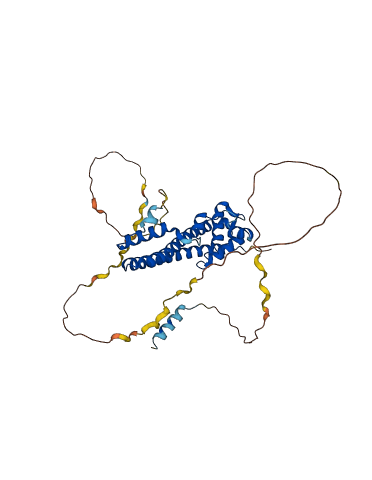
Descriptions
The autoinhibited protein was predicted that may have potential autoinhibitory elements via cis-regPred.
Autoinhibitory domains (AIDs)
Target domain |
|
Relief mechanism |
|
Assay |
cis-regPred |
Accessory elements
No accessory elements
Autoinhibited structure

Activated structure
1 structures for Q5R6G8
| Entry ID | Method | Resolution | Chain | Position | Source |
|---|---|---|---|---|---|
| AF-Q5R6G8-F1 | Predicted | AlphaFoldDB |
No variants for Q5R6G8
| Variant ID(s) | Position | Change | Description | Diseaes Association | Provenance |
|---|---|---|---|---|---|
| No variants for Q5R6G8 | |||||
No associated diseases with Q5R6G8
No regional properties for Q5R6G8
| Type | Name | Position | InterPro Accession |
|---|---|---|---|
| No domain, repeats, and functional sites for Q5R6G8 | |||
Functions
4 GO annotations of cellular component
| Name | Definition |
|---|---|
| cytoplasmic vesicle | A vesicle found in the cytoplasm of a cell. |
| microtubule organizing center | An intracellular structure that can catalyze gamma-tubulin-dependent microtubule nucleation and that can anchor microtubules by interacting with their minus ends, plus ends or sides. |
| midbody | A thin cytoplasmic bridge formed between daughter cells at the end of cytokinesis. The midbody forms where the contractile ring constricts, and may persist for some time before finally breaking to complete cytokinesis. |
| nuclear envelope | The double lipid bilayer enclosing the nucleus and separating its contents from the rest of the cytoplasm; includes the intermembrane space, a gap of width 20-40 nm (also called the perinuclear space). |
No GO annotations of molecular function
| Name | Definition |
|---|---|
| No GO annotations for molecular function |
3 GO annotations of biological process
| Name | Definition |
|---|---|
| cell cycle | The progression of biochemical and morphological phases and events that occur in a cell during successive cell replication or nuclear replication events. Canonically, the cell cycle comprises the replication and segregation of genetic material followed by the division of the cell, but in endocycles or syncytial cells nuclear replication or nuclear division may not be followed by cell division. |
| cell division | The process resulting in division and partitioning of components of a cell to form more cells; may or may not be accompanied by the physical separation of a cell into distinct, individually membrane-bounded daughter cells. |
| protein transport | The directed movement of proteins into, out of or within a cell, or between cells, by means of some agent such as a transporter or pore. |
No homologous proteins in AiPD
| UniProt AC | Gene Name | Protein Name | Species | Evidence Code |
|---|---|---|---|---|
| No homologous proteins | ||||
| 10 | 20 | 30 | 40 | 50 | 60 |
| MLGSGFKAER | LRVNLRLVIN | RLKLLEKKKT | ELAQKARKEI | ADYLAAGKDE | RARIRVEHII |
| 70 | 80 | 90 | 100 | 110 | 120 |
| REDYLVEAME | ILELYCDLLL | ARFGLIQSMK | ELDSGLAESV | STLIWAAPRL | QSEVAELKIV |
| 130 | 140 | 150 | 160 | 170 | 180 |
| ADQLCAKYSK | GYGKLCRTNQ | IGTVNDRLMH | KLSVEAPPKI | LVERYLIEIA | KNYNVPYEPD |
| 190 | 200 | 210 | 220 | 230 | 240 |
| SVVMAEAPPG | VETDLIDVGF | TDDVKKGGPG | RGGGGGFTAP | VGGPEGTVPM | PMPMPMPSAN |
| 250 | 260 | 270 | 280 | 290 | 300 |
| TPFSYPLPKG | PSDFNGLPMG | TYQAFPIIHP | PQIPATPPSY | ESVDDINADK | NISSAQIVGP |
| 310 | 320 | 330 | 340 | 350 | 360 |
| GPKPEASAKL | PSRPADNYDN | FVLPELPSVP | DTLPTASAGA | STSASEDIDF | DDLSRRFEEL |
| KKKT |