Q5R5V2
Gene name |
LAMP5 |
Protein name |
Lysosome-associated membrane glycoprotein 5 |
Names |
Brain and dendritic cell-associated LAMP, Brain-associated LAMP-like protein, BAD-LAMP, Lysosome-associated membrane protein 5, LAMP-5 |
Species |
Pongo abelii (Sumatran orangutan) (Pongo pygmaeus abelii) |
KEGG Pathway |
pon:100173676 |
EC number |
|
Protein Class |
|
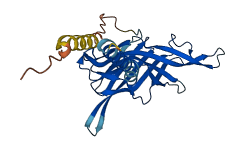
Descriptions
The autoinhibited protein was predicted that may have potential autoinhibitory elements via cis-regPred.
Autoinhibitory domains (AIDs)
Target domain |
|
Relief mechanism |
|
Assay |
cis-regPred |
Accessory elements
No accessory elements
Autoinhibited structure

Activated structure
1 structures for Q5R5V2
| Entry ID | Method | Resolution | Chain | Position | Source |
|---|---|---|---|---|---|
| AF-Q5R5V2-F1 | Predicted | AlphaFoldDB |
No variants for Q5R5V2
| Variant ID(s) | Position | Change | Description | Diseaes Association | Provenance |
|---|---|---|---|---|---|
| No variants for Q5R5V2 | |||||
No associated diseases with Q5R5V2
No regional properties for Q5R5V2
| Type | Name | Position | InterPro Accession |
|---|---|---|---|
| No domain, repeats, and functional sites for Q5R5V2 | |||
Functions
13 GO annotations of cellular component
| Name | Definition |
|---|---|
| anchoring junction | A cell junction that mechanically attaches a cell (and its cytoskeleton) to neighboring cells or to the extracellular matrix. |
| cytoplasmic vesicle membrane | The lipid bilayer surrounding a cytoplasmic vesicle. |
| dendrite membrane | The portion of the plasma membrane surrounding a dendrite. |
| early endosome membrane | The lipid bilayer surrounding an early endosome. |
| endoplasmic reticulum-Golgi intermediate compartment membrane | The lipid bilayer surrounding any of the compartments of the endoplasmic reticulum (ER)-Golgi intermediate compartment system. |
| endosome membrane | The lipid bilayer surrounding an endosome. |
| growth cone membrane | The portion of the plasma membrane surrounding a growth cone. |
| integral component of membrane | The component of a membrane consisting of the gene products and protein complexes having at least some part of their peptide sequence embedded in the hydrophobic region of the membrane. |
| late endosome | A prelysosomal endocytic organelle differentiated from early endosomes by lower lumenal pH and different protein composition. Late endosomes are more spherical than early endosomes and are mostly juxtanuclear, being concentrated near the microtubule organizing center. |
| lysosome | A small lytic vacuole that has cell cycle-independent morphology found in most animal cells and that contains a variety of hydrolases, most of which have their maximal activities in the pH range 5-6. The contained enzymes display latency if properly isolated. About 40 different lysosomal hydrolases are known and lysosomes have a great variety of morphologies and functions. |
| plasma membrane | The membrane surrounding a cell that separates the cell from its external environment. It consists of a phospholipid bilayer and associated proteins. |
| recycling endosome membrane | The lipid bilayer surrounding a recycling endosome. |
| synaptic vesicle membrane | The lipid bilayer surrounding a synaptic vesicle. |
No GO annotations of molecular function
| Name | Definition |
|---|---|
| No GO annotations for molecular function |
No GO annotations of biological process
| Name | Definition |
|---|---|
| No GO annotations for biological process |
No homologous proteins in AiPD
| UniProt AC | Gene Name | Protein Name | Species | Evidence Code |
|---|---|---|---|---|
| No homologous proteins | ||||
| 10 | 20 | 30 | 40 | 50 | 60 |
| MDLQGRAVPS | VDRLRVLLML | FHTMAQIMAE | QEVENLSGLS | TNPEKDIFVV | RENGTTCLMA |
| 70 | 80 | 90 | 100 | 110 | 120 |
| EFAAKFIVPY | DVWASNYVDL | ITEQADIALT | RGAEVGRCGH | SESELQVFWV | DRAYALKMLF |
| 130 | 140 | 150 | 160 | 170 | 180 |
| VKESHNMSKG | PEETWRLSKV | QFVYDSSEKT | HFKDAVSAGK | HTANSHHLSA | LVTPAGKSYE |
| 190 | 200 | 210 | 220 | 230 | 240 |
| CQAQQTISLA | SSDPQKTVTM | ILSAVHIQPF | DIISDFVFSE | EHKCAVDERE | QLEETLPLIL |
| 250 | 260 | ||||
| GLILGLVIVV | TLAIYHVHPQ | K |