Q5R5J1
Gene name |
PCK1 |
Protein name |
Phosphoenolpyruvate carboxykinase, cytosolic [GTP] |
Names |
PEPCK-C, Serine-protein kinase PCK1 |
Species |
Pongo abelii (Sumatran orangutan) (Pongo pygmaeus abelii) |
KEGG Pathway |
pon:100173760 |
EC number |
4.1.1.32: Carboxy-lyases |
Protein Class |
|
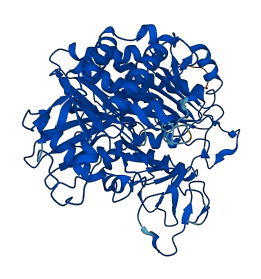
Descriptions
The autoinhibited protein was predicted that may have potential autoinhibitory elements via cis-regPred.
Autoinhibitory domains (AIDs)
Target domain |
|
Relief mechanism |
|
Assay |
cis-regPred |
Accessory elements
No accessory elements
Autoinhibited structure

Activated structure
1 structures for Q5R5J1
| Entry ID | Method | Resolution | Chain | Position | Source |
|---|---|---|---|---|---|
| AF-Q5R5J1-F1 | Predicted | AlphaFoldDB |
No variants for Q5R5J1
| Variant ID(s) | Position | Change | Description | Diseaes Association | Provenance |
|---|---|---|---|---|---|
| No variants for Q5R5J1 | |||||
No associated diseases with Q5R5J1
3 regional properties for Q5R5J1
| Type | Name | Position | InterPro Accession |
|---|---|---|---|
| conserved_site | Phosphoenolpyruvate carboxykinase, GTP-utilising, conserved site | 284 - 292 | IPR018091 |
| domain | Phosphoenolpyruvate carboxykinase, C-terminal P-loop domain | 260 - 618 | IPR035077 |
| domain | Phosphoenolpyruvate carboxykinase, GTP-utilising, N-terminal | 29 - 256 | IPR035078 |
Functions
| Description | ||
|---|---|---|
| EC Number | 4.1.1.32 | Carboxy-lyases |
| Subcellular Localization |
|
|
| PANTHER Family | ||
| PANTHER Subfamily | ||
| PANTHER Protein Class | ||
| PANTHER Pathway Category | No pathway information available | |
2 GO annotations of cellular component
| Name | Definition |
|---|---|
| cytosol | The part of the cytoplasm that does not contain organelles but which does contain other particulate matter, such as protein complexes. |
| endoplasmic reticulum | The irregular network of unit membranes, visible only by electron microscopy, that occurs in the cytoplasm of many eukaryotic cells. The membranes form a complex meshwork of tubular channels, which are often expanded into slitlike cavities called cisternae. The ER takes two forms, rough (or granular), with ribosomes adhering to the outer surface, and smooth (with no ribosomes attached). |
4 GO annotations of molecular function
| Name | Definition |
|---|---|
| GTP binding | Binding to GTP, guanosine triphosphate. |
| metal ion binding | Binding to a metal ion. |
| phosphoenolpyruvate carboxykinase (GTP) activity | Catalysis of the reaction: GTP + oxaloacetate = GDP + phosphoenolpyruvate + CO2. |
| protein serine kinase activity (using GTP as donor) | Catalysis of the reactions: GTP + L-seryl- = GDP + H(+) + O-phospho-L-seryl- |
7 GO annotations of biological process
| Name | Definition |
|---|---|
| cellular response to glucose stimulus | Any process that results in a change in state or activity of a cell (in terms of movement, secretion, enzyme production, gene expression, etc.) as a result of a glucose stimulus. |
| cellular response to insulin stimulus | Any process that results in a change in state or activity of a cell (in terms of movement, secretion, enzyme production, gene expression, etc.) as a result of an insulin stimulus. Insulin is a polypeptide hormone produced by the islets of Langerhans of the pancreas in mammals, and by the homologous organs of other organisms. |
| gluconeogenesis | The formation of glucose from noncarbohydrate precursors, such as pyruvate, amino acids and glycerol. |
| oxaloacetate metabolic process | The chemical reactions and pathways involving oxaloacetate, the anion of oxobutanedioic acid, an important intermediate in metabolism, especially as a component of the TCA cycle. |
| peptidyl-serine phosphorylation | The phosphorylation of peptidyl-serine to form peptidyl-O-phospho-L-serine. |
| positive regulation of memory T cell differentiation | Any process that activates or increases the frequency, rate or extent of memory T cell differentiation. |
| regulation of lipid biosynthetic process | Any process that modulates the frequency, rate or extent of the chemical reactions and pathways resulting in the formation of lipids. |
No homologous proteins in AiPD
| UniProt AC | Gene Name | Protein Name | Species | Evidence Code |
|---|---|---|---|---|
| No homologous proteins | ||||
| 10 | 20 | 30 | 40 | 50 | 60 |
| MPPQLQNGLN | LSAKVVQGSL | DSLPQAVRKF | LENNAELCQP | DHIHICDGSE | EENGRLLGQM |
| 70 | 80 | 90 | 100 | 110 | 120 |
| EEEGILRRLK | KYDNCWLALT | DPRDVARIGS | KTVIVTQEQR | DTVPIPKTGL | SQLGRWMSEE |
| 130 | 140 | 150 | 160 | 170 | 180 |
| DFEKALNARF | PGCMKGRTMY | VIPFSMGPLG | SPLSKIGIEL | TDSPYVVASM | RIMTRMGTPV |
| 190 | 200 | 210 | 220 | 230 | 240 |
| LEALGDGEFV | KCLHSVGCPL | PLQKPLVNNW | PCNPELTLIA | HLPDRREIIS | FGSGYGGNSL |
| 250 | 260 | 270 | 280 | 290 | 300 |
| LGKKCFALRM | ASRLAKEEGW | LAEHMLILGI | TNPEGEKKYL | AAAFPSACGK | TNLAMMNPSL |
| 310 | 320 | 330 | 340 | 350 | 360 |
| PGWKVECVGD | DIAWMKFDAQ | GHLRAINPEN | GFFGVAPGTS | VKTNPNAIKT | IQKNTIFTNV |
| 370 | 380 | 390 | 400 | 410 | 420 |
| AETSDGGVYW | EGIDEPLASG | VTITSWKNKE | WSPEDGEPCA | HPNSRFCTPA | SQCPIIDAAW |
| 430 | 440 | 450 | 460 | 470 | 480 |
| ESPEGVPIEG | IIFGGRRPAG | VPLVYEALSW | QHGVFVGAAM | RSEATAAAEH | KGKIIMHDPF |
| 490 | 500 | 510 | 520 | 530 | 540 |
| AMRPFFGYNF | GKYLAHWLSM | AQHPAAKLPK | IFHVNWFRKD | KEGKFLWPGF | GENSRVLEWM |
| 550 | 560 | 570 | 580 | 590 | 600 |
| FNRIDGKAGA | KLTPIGYIPK | EDALNLKGLG | HINVMELFSI | SKEFWEKEVE | DIEKYLEDQV |
| 610 | 620 | ||||
| NADLPCEIER | EILALKQRIS | QM |