Q5R587
Gene name |
POLR2E |
Protein name |
DNA-directed RNA polymerases I, II, and III subunit RPABC1 |
Names |
RNA polymerases I, II, and III subunit ABC1, DNA-directed RNA polymerase II subunit E, RPB5 homolog |
Species |
Pongo abelii (Sumatran orangutan) (Pongo pygmaeus abelii) |
KEGG Pathway |
pon:100173829 |
EC number |
|
Protein Class |
|
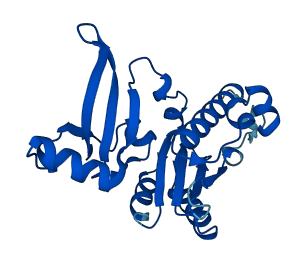
Descriptions
The autoinhibited protein was predicted that may have potential autoinhibitory elements via cis-regPred.
Autoinhibitory domains (AIDs)
Target domain |
|
Relief mechanism |
|
Assay |
cis-regPred |
Accessory elements
No accessory elements
Autoinhibited structure

Activated structure
1 structures for Q5R587
| Entry ID | Method | Resolution | Chain | Position | Source |
|---|---|---|---|---|---|
| AF-Q5R587-F1 | Predicted | AlphaFoldDB |
No variants for Q5R587
| Variant ID(s) | Position | Change | Description | Diseaes Association | Provenance |
|---|---|---|---|---|---|
| No variants for Q5R587 | |||||
No associated diseases with Q5R587
2 GO annotations of cellular component
| Name | Definition |
|---|---|
| nucleus | A membrane-bounded organelle of eukaryotic cells in which chromosomes are housed and replicated. In most cells, the nucleus contains all of the cell's chromosomes except the organellar chromosomes, and is the site of RNA synthesis and processing. In some species, or in specialized cell types, RNA metabolism or DNA replication may be absent. |
| RNA polymerase II, core complex | RNA polymerase II, one of three nuclear DNA-directed RNA polymerases found in all eukaryotes, is a multisubunit complex; typically it produces mRNAs, snoRNAs, and some of the snRNAs. Two large subunits comprise the most conserved portion including the catalytic site and share similarity with other eukaryotic and bacterial multisubunit RNA polymerases. The largest subunit of RNA polymerase II contains an essential carboxyl-terminal domain (CTD) composed of a variable number of heptapeptide repeats (YSPTSPS). The remainder of the complex is composed of smaller subunits (generally ten or more), some of which are also found in RNA polymerases I and III. Although the core is competent to mediate ribonucleic acid synthesis, it requires additional factors to select the appropriate template. |
2 GO annotations of molecular function
| Name | Definition |
|---|---|
| DNA binding | Any molecular function by which a gene product interacts selectively and non-covalently with DNA (deoxyribonucleic acid). |
| DNA-directed 5'-3' RNA polymerase activity | Catalysis of the reaction: nucleoside triphosphate + RNA(n) = diphosphate + RNA(n+1). Utilizes a DNA template, i.e. the catalysis of DNA-template-directed extension of the 3'-end of an RNA strand by one nucleotide at a time. Can initiate a chain 'de novo'. |
1 GO annotations of biological process
| Name | Definition |
|---|---|
| transcription by RNA polymerase II | The synthesis of RNA from a DNA template by RNA polymerase II (RNAP II), originating at an RNA polymerase II promoter. Includes transcription of messenger RNA (mRNA) and certain small nuclear RNAs (snRNAs). |
No homologous proteins in AiPD
| UniProt AC | Gene Name | Protein Name | Species | Evidence Code |
|---|---|---|---|---|
| No homologous proteins | ||||
| 10 | 20 | 30 | 40 | 50 | 60 |
| MDDEEETYRL | WKIRKTIMQL | CHDRGYLVTQ | DELDQTLEEF | RAQFGDKPSE | GRPRRTDLTV |
| 70 | 80 | 90 | 100 | 110 | 120 |
| LVAHNDDPTD | QMFVFFPEEP | KVGIKTIKVY | CQRMQEENIT | RALIVVQQGM | TPSAKQSLVD |
| 130 | 140 | 150 | 160 | 170 | 180 |
| MAPKYILEQF | LQQELLINIT | EHELVPEHVV | MTKEEVTELL | ARYKLRENQL | PRIQAGDPVA |
| 190 | 200 | ||||
| RYFGIKRGQV | VKIIRPSETA | GRYITYRLVQ |