Q5R4K9
Gene name |
PRKCI |
Protein name |
Protein kinase C iota type |
Names |
nPKC-iota |
Species |
Pongo abelii (Sumatran orangutan) (Pongo pygmaeus abelii) |
KEGG Pathway |
pon:100173964 |
EC number |
2.7.11.13: Protein-serine/threonine kinases |
Protein Class |
|
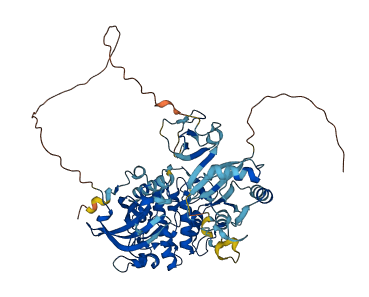
Descriptions
The autoinhibited protein was predicted that may have potential autoinhibitory elements via cis-regPred.
Autoinhibitory domains (AIDs)
Target domain |
|
Relief mechanism |
|
Assay |
cis-regPred |
Accessory elements
395-418 (Activation loop from InterPro)
Target domain |
233-596 (Catalytic domain of the Serine/Threonine Kinase, Atypical Protein Kinase C iota) |
Relief mechanism |
|
Assay |
|
Autoinhibited structure

Activated structure
1 structures for Q5R4K9
| Entry ID | Method | Resolution | Chain | Position | Source |
|---|---|---|---|---|---|
| AF-Q5R4K9-F1 | Predicted | AlphaFoldDB |
No variants for Q5R4K9
| Variant ID(s) | Position | Change | Description | Diseaes Association | Provenance |
|---|---|---|---|---|---|
| No variants for Q5R4K9 | |||||
No associated diseases with Q5R4K9
13 regional properties for Q5R4K9
| Type | Name | Position | InterPro Accession |
|---|---|---|---|
| domain | PB1 domain | 25 - 108 | IPR000270 |
| domain | Protein kinase domain | 254 - 522 | IPR000719 |
| domain | AGC-kinase, C-terminal | 523 - 594 | IPR000961 |
| domain | Protein kinase C-like, phorbol ester/diacylglycerol-binding domain | 140 - 192 | IPR002219 |
| active_site | Serine/threonine-protein kinase, active site | 374 - 386 | IPR008271 |
| binding_site | Protein kinase, ATP binding site | 260 - 287 | IPR017441 |
| domain | Protein kinase, C-terminal | 551 - 584 | IPR017892 |
| domain | Diacylglycerol/phorbol-ester binding | 138 - 152 | IPR020454-1 |
| domain | Diacylglycerol/phorbol-ester binding | 154 - 163 | IPR020454-2 |
| domain | Diacylglycerol/phorbol-ester binding | 167 - 178 | IPR020454-3 |
| domain | Diacylglycerol/phorbol-ester binding | 179 - 191 | IPR020454-4 |
| domain | Atypical protein kinase C iota type, catalytic domain | 233 - 596 | IPR034661 |
| domain | Protein kinase C, PB1 domain | 26 - 108 | IPR034877 |
Functions
| Description | ||
|---|---|---|
| EC Number | 2.7.11.13 | Protein-serine/threonine kinases |
| Subcellular Localization |
|
|
| PANTHER Family | ||
| PANTHER Subfamily | ||
| PANTHER Protein Class | ||
| PANTHER Pathway Category | No pathway information available | |
8 GO annotations of cellular component
| Name | Definition |
|---|---|
| apical plasma membrane | The region of the plasma membrane located at the apical end of the cell. |
| cytosol | The part of the cytoplasm that does not contain organelles but which does contain other particulate matter, such as protein complexes. |
| endosome | A vacuole to which materials ingested by endocytosis are delivered. |
| intercellular bridge | A direct connection between the cytoplasm of two cells that is formed following the completion of cleavage furrow ingression during cell division. They are usually present only briefly prior to completion of cytokinesis. However, in some cases, such as the bridges between germ cells during their development, they become stabilised. |
| microtubule cytoskeleton | The part of the cytoskeleton (the internal framework of a cell) composed of microtubules and associated proteins. |
| nucleus | A membrane-bounded organelle of eukaryotic cells in which chromosomes are housed and replicated. In most cells, the nucleus contains all of the cell's chromosomes except the organellar chromosomes, and is the site of RNA synthesis and processing. In some species, or in specialized cell types, RNA metabolism or DNA replication may be absent. |
| PAR polarity complex | A protein kinase complex that is required for the establishment of a cell polarity axis during the cell division cycle. Binds directly to activated CDC42 GTPase and is required for orchestrating a cellular gradient of CDC42. In S. cerevisiae components are: BEM1, CDC24 and CLA4; from worms to vertebrates it contains a PAR6 protein, PAR3 protein and an atypical PKC. |
| Schmidt-Lanterman incisure | Regions within compact myelin in which the cytoplasmic faces of the enveloping myelin sheath are not tightly juxtaposed, and include cytoplasm from the cell responsible for making the myelin. Schmidt-Lanterman incisures occur in the compact myelin internode, while lateral loops are analogous structures found in the paranodal region adjacent to the nodes of Ranvier. |
6 GO annotations of molecular function
| Name | Definition |
|---|---|
| ATP binding | Binding to ATP, adenosine 5'-triphosphate, a universally important coenzyme and enzyme regulator. |
| calcium-dependent protein kinase C activity | Calcium-dependent catalysis of the reaction: ATP + a protein = ADP + a phosphoprotein. |
| metal ion binding | Binding to a metal ion. |
| phospholipid binding | Binding to a phospholipid, a class of lipids containing phosphoric acid as a mono- or diester. |
| protein kinase activity | Catalysis of the phosphorylation of an amino acid residue in a protein, usually according to the reaction: a protein + ATP = a phosphoprotein + ADP. |
| protein serine kinase activity | Catalysis of the reactions: ATP + protein serine = ADP + protein serine phosphate. |
15 GO annotations of biological process
| Name | Definition |
|---|---|
| actin filament organization | A process that is carried out at the cellular level which results in the assembly, arrangement of constituent parts, or disassembly of cytoskeletal structures comprising actin filaments. Includes processes that control the spatial distribution of actin filaments, such as organizing filaments into meshworks, bundles, or other structures, as by cross-linking. |
| cell-cell junction organization | A process that is carried out at the cellular level which results in the assembly, arrangement of constituent parts, or disassembly of a cell-cell junction. A cell-cell junction is a specialized region of connection between two cells. |
| cellular response to insulin stimulus | Any process that results in a change in state or activity of a cell (in terms of movement, secretion, enzyme production, gene expression, etc.) as a result of an insulin stimulus. Insulin is a polypeptide hormone produced by the islets of Langerhans of the pancreas in mammals, and by the homologous organs of other organisms. |
| establishment of apical/basal cell polarity | The specification and formation of the polarity of a cell along its apical/basal axis. |
| establishment or maintenance of epithelial cell apical/basal polarity | Any cellular process that results in the specification, formation or maintenance of the apicobasal polarity of an epithelial cell. |
| eye photoreceptor cell development | Development of a photoreceptor, a sensory cell in the eye that reacts to the presence of light. They usually contain a pigment that undergoes a chemical change when light is absorbed, thus stimulating a nerve. |
| negative regulation of glial cell apoptotic process | Any process that stops, prevents, or reduces the frequency, rate, or extent of glial cell apoptotic process. |
| negative regulation of neuron apoptotic process | Any process that stops, prevents, or reduces the frequency, rate or extent of cell death by apoptotic process in neurons. |
| peptidyl-serine phosphorylation | The phosphorylation of peptidyl-serine to form peptidyl-O-phospho-L-serine. |
| positive regulation of endothelial cell apoptotic process | Any process that activates or increases the frequency, rate or extent of endothelial cell apoptotic process. |
| positive regulation of glial cell proliferation | Any process that activates or increases the rate or extent of glial cell proliferation. |
| positive regulation of glucose import | Any process that activates or increases the frequency, rate or extent of the import of the hexose monosaccharide glucose into a cell or organelle. |
| positive regulation of neuron projection development | Any process that increases the rate, frequency or extent of neuron projection development. Neuron projection development is the process whose specific outcome is the progression of a neuron projection over time, from its formation to the mature structure. A neuron projection is any process extending from a neural cell, such as axons or dendrites (collectively called neurites). |
| positive regulation of NF-kappaB transcription factor activity | Any process that activates or increases the frequency, rate or extent of activity of the transcription factor NF-kappaB. |
| positive regulation of protein localization to plasma membrane | Any process that activates or increases the frequency, rate or extent of protein localization to plasma membrane. |
No homologous proteins in AiPD
| UniProt AC | Gene Name | Protein Name | Species | Evidence Code |
|---|---|---|---|---|
| No homologous proteins | ||||
| 10 | 20 | 30 | 40 | 50 | 60 |
| MPTQRDSSTM | SHTVAGGGSG | DHSHQVRVKA | YYRGDIMITH | FEPSISFEGL | CNEVRDMCSF |
| 70 | 80 | 90 | 100 | 110 | 120 |
| DNEQLFTMKW | IDEEGDPCTV | SSQLELEEAF | RLYELNKDSE | LLIHVFPCVP | ERPGMPCPGE |
| 130 | 140 | 150 | 160 | 170 | 180 |
| DKSIYRRGAR | RWRKLYCANG | HTFQAKRFNR | RAHCAICTDR | IWGLGRQGYK | CINCKLLVHK |
| 190 | 200 | 210 | 220 | 230 | 240 |
| KCHKLVTIEC | GRHSLPPEPM | MPMDQSSMHS | DHAQTVIPYN | PSSHESLDQV | GEEKEAMNTR |
| 250 | 260 | 270 | 280 | 290 | 300 |
| ESGKASSSLG | LQDFDLLRVI | GRGSYAKVLL | VRLKKTDRIY | AMKVVKKELV | NDDEDIDWVQ |
| 310 | 320 | 330 | 340 | 350 | 360 |
| TEKHVFEQAS | NHPFLVGLHS | CFQTESRLFF | VIEYVNGGDL | MFHMQRQRKL | PEEHARFYSA |
| 370 | 380 | 390 | 400 | 410 | 420 |
| EISLALNYLH | ERGIIYRDLK | LDNVLLDSEG | HIKLTDYGMC | KEGLRPGDTT | STFCGTPNYI |
| 430 | 440 | 450 | 460 | 470 | 480 |
| APEILRGEDY | GFSVDWWALG | VLMFEMMAGR | SPFDIVGSSD | NPDQNTEDYL | FQVILEKQIR |
| 490 | 500 | 510 | 520 | 530 | 540 |
| IPRSLSVKAA | SVLKSFLNKD | PKERLGCHPQ | TGFADIQGHP | FFRNVDWDMM | EQKQVVPPFK |
| 550 | 560 | 570 | 580 | 590 | |
| PNISGEFGLD | NFDSQFTNEP | VQLTPDDDDI | VRKIDQSEFE | GFEYINPLLM | SAEECV |