Q5R4I3
Gene name |
UBXN4 (UBXD2) |
Protein name |
UBX domain-containing protein 4 |
Names |
UBX domain-containing protein 2 |
Species |
Pongo abelii (Sumatran orangutan) (Pongo pygmaeus abelii) |
KEGG Pathway |
pon:100173981 |
EC number |
|
Protein Class |
|
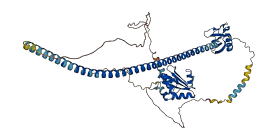
Descriptions
The autoinhibited protein was predicted that may have potential autoinhibitory elements via cis-regPred.
Autoinhibitory domains (AIDs)
Target domain |
|
Relief mechanism |
|
Assay |
cis-regPred |
Accessory elements
No accessory elements
Autoinhibited structure

Activated structure
1 structures for Q5R4I3
| Entry ID | Method | Resolution | Chain | Position | Source |
|---|---|---|---|---|---|
| AF-Q5R4I3-F1 | Predicted | AlphaFoldDB |
No variants for Q5R4I3
| Variant ID(s) | Position | Change | Description | Diseaes Association | Provenance |
|---|---|---|---|---|---|
| No variants for Q5R4I3 | |||||
No associated diseases with Q5R4I3
1 regional properties for Q5R4I3
| Type | Name | Position | InterPro Accession |
|---|---|---|---|
| domain | UBX domain | 311 - 395 | IPR001012 |
Functions
3 GO annotations of cellular component
| Name | Definition |
|---|---|
| cytosol | The part of the cytoplasm that does not contain organelles but which does contain other particulate matter, such as protein complexes. |
| endoplasmic reticulum membrane | The lipid bilayer surrounding the endoplasmic reticulum. |
| nuclear envelope | The double lipid bilayer enclosing the nucleus and separating its contents from the rest of the cytoplasm; includes the intermembrane space, a gap of width 20-40 nm (also called the perinuclear space). |
No GO annotations of molecular function
| Name | Definition |
|---|---|
| No GO annotations for molecular function |
2 GO annotations of biological process
| Name | Definition |
|---|---|
| response to unfolded protein | Any process that results in a change in state or activity of a cell or an organism (in terms of movement, secretion, enzyme production, gene expression, etc.) as a result of an unfolded protein stimulus. |
| ubiquitin-dependent ERAD pathway | The series of steps necessary to target endoplasmic reticulum (ER)-resident proteins for degradation by the cytoplasmic proteasome. Begins with recognition of the ER-resident protein, includes retrotranslocation (dislocation) of the protein from the ER to the cytosol, protein ubiquitination necessary for correct substrate transfer, transport of the protein to the proteasome, and ends with degradation of the protein by the cytoplasmic proteasome. |
No homologous proteins in AiPD
| UniProt AC | Gene Name | Protein Name | Species | Evidence Code |
|---|---|---|---|---|
| No homologous proteins | ||||
| 10 | 20 | 30 | 40 | 50 | 60 |
| MLWFQGAIPA | AIATAKRSGA | VFVVFVAGDD | EQSTQMAASW | EDDKVTEASS | NSFVAIKIDT |
| 70 | 80 | 90 | 100 | 110 | 120 |
| KSEACLQFSQ | IYPVVCVPSS | FFIGDSGIPL | EVIAGSVSAD | ELVTRIHKVR | QMHLLKSETS |
| 130 | 140 | 150 | 160 | 170 | 180 |
| VANGSQSESS | VSTPSASFEP | NNTCENSQSR | NAELCEIPPT | SDTKSDTATG | GESAGHATSS |
| 190 | 200 | 210 | 220 | 230 | 240 |
| QEPSGCSDQR | PAEDLNIRVE | RLTKKLEERR | EEKRKEEEQR | EIKKEIERRK | TGKEMLDYKR |
| 250 | 260 | 270 | 280 | 290 | 300 |
| KQEEELTKRM | LEERNREKAE | DRAARERIKQ | QIALDRAERA | ARFAKTKEEV | EAAKAAALLA |
| 310 | 320 | 330 | 340 | 350 | 360 |
| KQAEMEVKRE | SYARERSTVA | RIQFRLPDGS | SFTNQFPSDA | PLEEARQFAA | QTVGNTYGNF |
| 370 | 380 | 390 | 400 | 410 | 420 |
| SLATMFPRRE | FTKEDYKKKL | LDLELAPSAS | VVVLPAGRPT | ASIVHSSSGD | IWTLLGTVLY |
| 430 | 440 | 450 | 460 | 470 | 480 |
| PFLAIWRLIS | NFLFSNPPPT | QTSVRVTSSE | PPNPASSSKS | EKREPVRKRV | LEKRGDDFKK |
| 490 | 500 | ||||
| EGKIYRLRTQ | DDGEDENNTW | NGNSTQQM |