Q5R495
Gene name |
OXSR1 |
Protein name |
Serine/threonine-protein kinase OSR1 |
Names |
Oxidative stress-responsive 1 protein |
Species |
Pongo abelii (Sumatran orangutan) (Pongo pygmaeus abelii) |
KEGG Pathway |
pon:100174028 |
EC number |
2.7.11.1: Protein-serine/threonine kinases |
Protein Class |
|
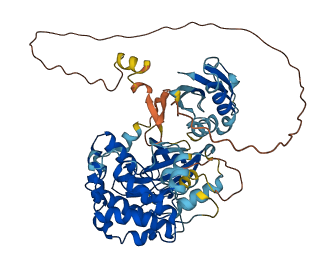
Descriptions
The autoinhibited protein was predicted that may have potential autoinhibitory elements via cis-regPred.
Autoinhibitory domains (AIDs)
Target domain |
|
Relief mechanism |
|
Assay |
cis-regPred |
Accessory elements
163-191 (Activation loop from InterPro)
Target domain |
17-291 (Protein kinase domain) |
Relief mechanism |
|
Assay |
|
Autoinhibited structure

Activated structure
1 structures for Q5R495
| Entry ID | Method | Resolution | Chain | Position | Source |
|---|---|---|---|---|---|
| AF-Q5R495-F1 | Predicted | AlphaFoldDB |
No variants for Q5R495
| Variant ID(s) | Position | Change | Description | Diseaes Association | Provenance |
|---|---|---|---|---|---|
| No variants for Q5R495 | |||||
No associated diseases with Q5R495
Functions
| Description | ||
|---|---|---|
| EC Number | 2.7.11.1 | Protein-serine/threonine kinases |
| Subcellular Localization |
|
|
| PANTHER Family | ||
| PANTHER Subfamily | ||
| PANTHER Protein Class | ||
| PANTHER Pathway Category | No pathway information available | |
1 GO annotations of cellular component
| Name | Definition |
|---|---|
| cytosol | The part of the cytoplasm that does not contain organelles but which does contain other particulate matter, such as protein complexes. |
6 GO annotations of molecular function
| Name | Definition |
|---|---|
| ATP binding | Binding to ATP, adenosine 5'-triphosphate, a universally important coenzyme and enzyme regulator. |
| identical protein binding | Binding to an identical protein or proteins. |
| magnesium ion binding | Binding to a magnesium (Mg) ion. |
| protein kinase binding | Binding to a protein kinase, any enzyme that catalyzes the transfer of a phosphate group, usually from ATP, to a protein substrate. |
| protein serine kinase activity | Catalysis of the reactions: ATP + protein serine = ADP + protein serine phosphate. |
| protein serine/threonine kinase activity | Catalysis of the reactions: ATP + protein serine = ADP + protein serine phosphate, and ATP + protein threonine = ADP + protein threonine phosphate. |
12 GO annotations of biological process
| Name | Definition |
|---|---|
| cellular hypotonic response | Any process that results in a change in state or activity of a cell (in terms of movement, secretion, enzyme production, gene expression, etc.) as a result of detection of, or exposure to, a hypotonic environment, i.e. an environment with a lower concentration of solutes than the organism or cell. |
| chemokine (C-C motif) ligand 21 signaling pathway | The series of molecular signals initiated by the binding of the C-C chemokine CCL21 to its receptor on the surface of a target cell, and ending with the regulation of a downstream cellular process, e.g. transcription. |
| chemokine (C-X-C motif) ligand 12 signaling pathway | The series of molecular signals initiated by the binding of the chemokine CXCL12 to its receptor on the surface of a target cell, and ending with the regulation of a downstream cellular process, e.g. transcription. |
| intracellular signal transduction | The process in which a signal is passed on to downstream components within the cell, which become activated themselves to further propagate the signal and finally trigger a change in the function or state of the cell. |
| negative regulation of potassium ion transmembrane transporter activity | Any process that stops, prevents or reduces the frequency, rate or extent of potassium ion transmembrane transporter activity. |
| osmosensory signaling pathway | The series of molecular signals initiated in response to osmotic change. |
| peptidyl-threonine phosphorylation | The phosphorylation of peptidyl-threonine to form peptidyl-O-phospho-L-threonine. |
| positive regulation of T cell chemotaxis | Any process that increases the rate, frequency or extent of T cell chemotaxis. T cell chemotaxis is the directed movement of a T cell in response to an external stimulus. |
| protein autophosphorylation | The phosphorylation by a protein of one or more of its own amino acid residues (cis-autophosphorylation), or residues on an identical protein (trans-autophosphorylation). |
| protein phosphorylation | The process of introducing a phosphate group on to a protein. |
| response to oxidative stress | Any process that results in a change in state or activity of a cell or an organism (in terms of movement, secretion, enzyme production, gene expression, etc.) as a result of oxidative stress, a state often resulting from exposure to high levels of reactive oxygen species, e.g. superoxide anions, hydrogen peroxide (H2O2), and hydroxyl radicals. |
| response to xenobiotic stimulus | Any process that results in a change in state or activity of a cell or an organism (in terms of movement, secretion, enzyme production, gene expression, etc.) as a result of a stimulus from a xenobiotic, a compound foreign to the organim exposed to it. It may be synthesized by another organism (like ampicilin) or it can be a synthetic chemical. |
No homologous proteins in AiPD
| UniProt AC | Gene Name | Protein Name | Species | Evidence Code |
|---|---|---|---|---|
| No homologous proteins | ||||
| 10 | 20 | 30 | 40 | 50 | 60 |
| MSEDSSALPW | SINRDDYELQ | EVIGSGATAV | VQAAYCAPKK | EKVAIKRINL | EKCQTSMDEL |
| 70 | 80 | 90 | 100 | 110 | 120 |
| LKEIQAMSQC | HHPNIVSYYT | SFVVKDELWL | VMKLLSGGSV | LDIIKHIVAK | GEHKSGVLDE |
| 130 | 140 | 150 | 160 | 170 | 180 |
| STIATILREV | LEGLEYLHKN | GQIHRDVKAG | NILLGEDGSV | QIADFGVSAF | LATGGDITRN |
| 190 | 200 | 210 | 220 | 230 | 240 |
| KVRKTFVGTP | CWMAPEVMEQ | VRGYDFKADI | WSFGITAIEL | ATGAAPYHKY | PPMKVLMLTL |
| 250 | 260 | 270 | 280 | 290 | 300 |
| QNDPPSLETG | VQDKEMLKKY | GKSFRKMISL | CLQKDPEKRP | TAAELLRHKF | FQKAKNKEFL |
| 310 | 320 | 330 | 340 | 350 | 360 |
| QEKILQRAPT | ISERAKKVRR | VPGSSGRLHK | TEDGGWEWSD | DEFDEESEEG | KAAISQLRSP |
| 370 | 380 | 390 | 400 | 410 | 420 |
| RVKESISNSE | LFPTTDPVGT | LLQVPEQISA | HLPQPAGQMP | TQPTQVSLPP | TAEPAKTAQA |
| 430 | 440 | 450 | 460 | 470 | 480 |
| LSSGSGSQET | KIPISLVLRL | RNSKKELNDI | RFEFTPGRDT | AEGVSQELIS | AGLVDGRDLV |
| 490 | 500 | 510 | 520 | ||
| IVAANLQKIV | EEPQSNRSVT | FKLASGVEGS | DIPDDGKLIG | FAQLSIS |