Q5R410
Gene name |
NSF |
Protein name |
Vesicle-fusing ATPase |
Names |
N-ethylmaleimide-sensitive fusion protein, NEM-sensitive fusion protein, Vesicular-fusion protein NSF |
Species |
Methylibium petroleiphilum (strain ATCC BAA-1232 / LMG 22953 / PM1) |
KEGG Pathway |
pon:100174078 |
EC number |
|
Protein Class |
|
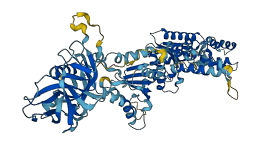
Descriptions
Autoinhibitory domains (AIDs)
Target domain |
252-399 (D1 domain or ATPase domain) |
Relief mechanism |
Partner binding |
Assay |
|
Accessory elements
No accessory elements
Autoinhibited structure

Activated structure
1 structures for Q5R410
| Entry ID | Method | Resolution | Chain | Position | Source |
|---|---|---|---|---|---|
| AF-Q5R410-F1 | Predicted | AlphaFoldDB |
No variants for Q5R410
| Variant ID(s) | Position | Change | Description | Diseaes Association | Provenance |
|---|---|---|---|---|---|
| No variants for Q5R410 | |||||
No associated diseases with Q5R410
1 GO annotations of cellular component
| Name | Definition |
|---|---|
| cytoplasm | The contents of a cell excluding the plasma membrane and nucleus, but including other subcellular structures. |
3 GO annotations of molecular function
| Name | Definition |
|---|---|
| ATP binding | Binding to ATP, adenosine 5'-triphosphate, a universally important coenzyme and enzyme regulator. |
| ATP hydrolysis activity | Catalysis of the reaction: ATP + H2O = ADP + H+ phosphate. ATP hydrolysis is used in some reactions as an energy source, for example to catalyze a reaction or drive transport against a concentration gradient. |
| metal ion binding | Binding to a metal ion. |
2 GO annotations of biological process
| Name | Definition |
|---|---|
| protein transport | The directed movement of proteins into, out of or within a cell, or between cells, by means of some agent such as a transporter or pore. |
| SNARE complex disassembly | The disaggregation of the SNARE protein complex into its constituent components. The SNARE complex is a protein complex involved in membrane fusion; a stable ternary complex consisting of a four-helix bundle, usually formed from one R-SNARE and three Q-SNAREs with an ionic layer sandwiched between hydrophobic layers. |
No homologous proteins in AiPD
| UniProt AC | Gene Name | Protein Name | Species | Evidence Code |
|---|---|---|---|---|
| No homologous proteins | ||||
| 10 | 20 | 30 | 40 | 50 | 60 |
| MSLIRQLWLL | LLATVMVGVL | GSALVTVGSA | RGYLETQLRL | KNSDNAQALA | LTLSQQNGDL |
| 70 | 80 | 90 | 100 | 110 | 120 |
| ALAELAISAQ | FDTGFYERIS | LRGPEGQMLV | ERLGAAEPTE | VPTWFRGLVP | IQSLPGVAQV |
| 130 | 140 | 150 | 160 | 170 | 180 |
| SDGWRSLGTL | EVVSASSFAL | DDLWQSSLRS | AGWLVLIGLL | AGALGSLVLR | RIRAPLQATV |
| 190 | 200 | 210 | 220 | 230 | 240 |
| DQARAIVERR | FVTVPEPRVP | ELRQLSRAMN | AMVQRLQAVF | GEQGAQLEAL | RQQAQTDPLT |
| 250 | 260 | 270 | 280 | 290 | 300 |
| GLSNRSHFLA | QLSSMLVRED | TPRAGVLLLA | RVHDLAGLNR | NAGHAATDAL | LQTLALSLRS |
| 310 | 320 | 330 | 340 | 350 | 360 |
| ATAGGAAPMT | GRLNGADFAV | QAADADAAHV | AAVLQTAVKT | ALKPWTGVRV | AIGAVSWRAG |
| 370 | 380 | 390 | 400 | 410 | 420 |
| DSVATLMQAA | DAALVRAETQ | DGFGLAVDGL | SETNAETALG | ESGWRLLLRQ | ALERGDAQLG |
| 430 | 440 | 450 | 460 | 470 | 480 |
| SFPVIGRDAR | LLHLESPLRL | RLHEGGAFEP | AARWLPWVLR | SQFSASTDLL | AVRLALEQIA |
| 490 | 500 | 510 | 520 | 530 | 540 |
| LDGVPRGVNL | AADSLADSGF | LASLRGLVSA | HAQAARVLWL | EVGERAAVEQ | LPVLRDLGQQ |
| 550 | 560 | 570 | 580 | 590 | 600 |
| LRPLGVQLGL | EHAGERLARI | DRLYEAGLDY | VKLDGALASG | LAQDSTRADF | VRGLAWTLHG |
| 610 | 620 | 630 | |||
| LEIRVLAEGV | ADAADAQALW | ACGLDGITGP | WVSTQPLR |