Q5PPI1
Gene name |
Srsf9 (Sfrs9) |
Protein name |
Serine/arginine-rich splicing factor 9 |
Names |
Splicing factor, arginine/serine-rich 9 |
Species |
Rattus norvegicus (Rat) |
KEGG Pathway |
rno:288701 |
EC number |
|
Protein Class |
|
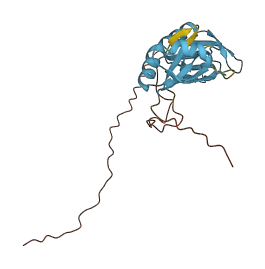
Descriptions
The autoinhibited protein was predicted that may have potential autoinhibitory elements via cis-regPred.
Autoinhibitory domains (AIDs)
Target domain |
|
Relief mechanism |
|
Assay |
cis-regPred |
Accessory elements
No accessory elements
Autoinhibited structure

Activated structure
1 structures for Q5PPI1
| Entry ID | Method | Resolution | Chain | Position | Source |
|---|---|---|---|---|---|
| AF-Q5PPI1-F1 | Predicted | AlphaFoldDB |
No variants for Q5PPI1
| Variant ID(s) | Position | Change | Description | Diseaes Association | Provenance |
|---|---|---|---|---|---|
| No variants for Q5PPI1 | |||||
No associated diseases with Q5PPI1
4 regional properties for Q5PPI1
| Type | Name | Position | InterPro Accession |
|---|---|---|---|
| domain | RNA recognition motif domain | 14 - 89 | IPR000504-1 |
| domain | RNA recognition motif domain | 111 - 187 | IPR000504-2 |
| domain | SRSF9, RNA recognition motif 1 | 15 - 86 | IPR034503 |
| domain | SRSF9, RNA recognition motif 2 | 103 - 186 | IPR034995 |
2 GO annotations of cellular component
| Name | Definition |
|---|---|
| nuclear speck | A discrete extra-nucleolar subnuclear domain, 20-50 in number, in which splicing factors are seen to be localized by immunofluorescence microscopy. |
| nucleolus | A small, dense body one or more of which are present in the nucleus of eukaryotic cells. It is rich in RNA and protein, is not bounded by a limiting membrane, and is not seen during mitosis. Its prime function is the transcription of the nucleolar DNA into 45S ribosomal-precursor RNA, the processing of this RNA into 5.8S, 18S, and 28S components of ribosomal RNA, and the association of these components with 5S RNA and proteins synthesized outside the nucleolus. This association results in the formation of ribonucleoprotein precursors; these pass into the cytoplasm and mature into the 40S and 60S subunits of the ribosome. |
2 GO annotations of molecular function
| Name | Definition |
|---|---|
| protein domain specific binding | Binding to a specific domain of a protein. |
| RNA binding | Binding to an RNA molecule or a portion thereof. |
5 GO annotations of biological process
| Name | Definition |
|---|---|
| alternative mRNA splicing, via spliceosome | The process of generating multiple mRNA molecules from a given set of exons by differential use of exons from the primary transcript(s) to form multiple mature mRNAs that vary in their exon composition. |
| mRNA splicing, via spliceosome | The joining together of exons from one or more primary transcripts of messenger RNA (mRNA) and the excision of intron sequences, via a spliceosomal mechanism, so that mRNA consisting only of the joined exons is produced. |
| negative regulation of mRNA splicing, via spliceosome | Any process that stops, prevents or reduces the rate or extent of mRNA splicing via a spliceosomal mechanism. |
| response to alkaloid | Any process that results in a change in state or activity of a cell or an organism (in terms of movement, secretion, enzyme production, gene expression, etc.) as a result of an alkaloid stimulus. Alkaloids are a large group of nitrogenous substances found in naturally in plants, many of which have extracts that are pharmacologically active. |
| response to toxic substance | Any process that results in a change in state or activity of a cell or an organism (in terms of movement, secretion, enzyme production, gene expression, etc.) as a result of a toxic stimulus. |
| 10 | 20 | 30 | 40 | 50 | 60 |
| MSGWADERGG | EGDGRIYVGN | LPTDVREKDL | EDLFYKYGRI | REIELKNRHG | LVPFAFVRFE |
| 70 | 80 | 90 | 100 | 110 | 120 |
| DPRDAEDAIY | GRNGYDYGQC | RLRVEFPRAY | GGRGGWPRAS | RNGPPTRRSD | FRVLVSGLPP |
| 130 | 140 | 150 | 160 | 170 | 180 |
| SGSWQDLKDH | MREAGDVCYA | DVQKDGMGMV | EYLRKEDMEY | ALRKLDDTKF | RSHEGETSYI |
| 190 | 200 | 210 | 220 | ||
| RVYPERGTSY | GCSRSRSGSR | GRDSPYQSRG | SPHYFSPFRP | Y |