Q5L659
Gene name |
lepA |
Protein name |
Elongation factor 4 |
Names |
EF-4, Ribosomal back-translocase LepA |
Species |
Chlamydia abortus (strain DSM 27085 / S26/3) (Chlamydophila abortus) |
KEGG Pathway |
cab:CAB419 |
EC number |
3.6.5.n1: Acting on GTP; involved in cellular and subcellular movement |
Protein Class |
|
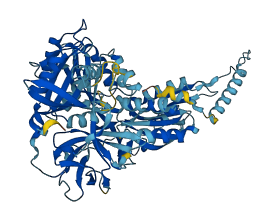
Descriptions
The autoinhibited protein was predicted that may have potential autoinhibitory elements via cis-regPred.
Autoinhibitory domains (AIDs)
Target domain |
|
Relief mechanism |
|
Assay |
cis-regPred |
Accessory elements
No accessory elements
Autoinhibited structure

Activated structure
1 structures for Q5L659
| Entry ID | Method | Resolution | Chain | Position | Source |
|---|---|---|---|---|---|
| AF-Q5L659-F1 | Predicted | AlphaFoldDB |
No variants for Q5L659
| Variant ID(s) | Position | Change | Description | Diseaes Association | Provenance |
|---|---|---|---|---|---|
| No variants for Q5L659 | |||||
No associated diseases with Q5L659
6 regional properties for Q5L659
| Type | Name | Position | InterPro Accession |
|---|---|---|---|
| domain | Elongation factor EFG, domain V-like | 405 - 484 | IPR000640 |
| domain | Translational (tr)-type GTP-binding domain | 7 - 188 | IPR000795 |
| domain | Translation elongation factor EFTu-like, domain 2 | 211 - 281 | IPR004161 |
| domain | Small GTP-binding protein domain | 10 - 179 | IPR005225 |
| domain | GTP-binding protein LepA, C-terminal | 494 - 600 | IPR013842 |
| domain | Elongation factor 4, domain IV | 407 - 484 | IPR035654 |
Functions
| Description | ||
|---|---|---|
| EC Number | 3.6.5.n1 | Acting on GTP; involved in cellular and subcellular movement |
| Subcellular Localization |
|
|
| PANTHER Family | ||
| PANTHER Subfamily | ||
| PANTHER Protein Class | ||
| PANTHER Pathway Category | No pathway information available | |
1 GO annotations of cellular component
| Name | Definition |
|---|---|
| plasma membrane | The membrane surrounding a cell that separates the cell from its external environment. It consists of a phospholipid bilayer and associated proteins. |
4 GO annotations of molecular function
| Name | Definition |
|---|---|
| GTP binding | Binding to GTP, guanosine triphosphate. |
| GTPase activity | Catalysis of the reaction: GTP + H2O = GDP + H+ + phosphate. |
| ribosome binding | Binding to a ribosome. |
| translation elongation factor activity | Functions in chain elongation during polypeptide synthesis at the ribosome. |
1 GO annotations of biological process
| Name | Definition |
|---|---|
| positive regulation of translation | Any process that activates or increases the frequency, rate or extent of the chemical reactions and pathways resulting in the formation of proteins by the translation of mRNA or circRNA. |
No homologous proteins in AiPD
| UniProt AC | Gene Name | Protein Name | Species | Evidence Code |
|---|---|---|---|---|
| No homologous proteins | ||||
| 10 | 20 | 30 | 40 | 50 | 60 |
| MKEYKLENIR | NFSIIAHIDH | GKSTIADRLL | ESTSTVEQRE | MREQLLDSMD | LERERGITIK |
| 70 | 80 | 90 | 100 | 110 | 120 |
| AHPVTMYYKY | NGEVYQLNLI | DTPGHVDFSY | EVSRSLTACE | GALLIVDAAQ | GVQAQSLANV |
| 130 | 140 | 150 | 160 | 170 | 180 |
| YLALERDLEI | IPILNKIDLP | AANPEKIRKQ | IEDYIGLDTT | HAIACSAKTG | EGISEILEAI |
| 190 | 200 | 210 | 220 | 230 | 240 |
| VELIPPPKSP | EETELKALIF | DSHYDPYVGI | MVYVRVMSGE | IKKGDRITFM | ATKGSSFEVL |
| 250 | 260 | 270 | 280 | 290 | 300 |
| GVGAFLPEAT | LIEGSLRAGQ | VGYFIANLKK | VKDVKIGDTV | TTVKHSAKVP | LEGFKEINPV |
| 310 | 320 | 330 | 340 | 350 | 360 |
| MFAGIYPIDS | SDFDALKDAL | SRLQLNDSAL | TIEQESSHSL | GFGFRCGFLG | LLHLEIVFER |
| 370 | 380 | 390 | 400 | 410 | 420 |
| IIREFDLDII | ATAPSVIYKV | VLKNGKTLFI | DNPTAYPDPS | IIEHMEEPWV | HVNIITPQEY |
| 430 | 440 | 450 | 460 | 470 | 480 |
| LSSIMNLCLD | KRGVCLKTEM | LDQHRLVLSY | DLPLNEIVSD | FNDKLKSVTK | GYGSFDYRLG |
| 490 | 500 | 510 | 520 | 530 | 540 |
| DYRKGSIIKL | EILINDEPVD | AFSCLVHRDK | AEARGRSICE | KLVGVIPQQL | FKIPIQAAIN |
| 550 | 560 | 570 | 580 | 590 | 600 |
| KKVIARETIR | ALSKNVTAKC | YGGDITRKRK | LWEKQKKGKK | RMKEFGKVSI | PNTAFIEVLK |
| ID |