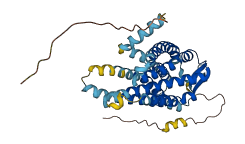
Descriptions
The autoinhibited protein was predicted that may have potential autoinhibitory elements via cis-regPred.
Autoinhibitory domains (AIDs)
Target domain |
|
Relief mechanism |
|
Assay |
cis-regPred |
Accessory elements
No accessory elements
Autoinhibited structure

Activated structure
1 structures for Q5KSK8
| Entry ID | Method | Resolution | Chain | Position | Source |
|---|---|---|---|---|---|
| AF-Q5KSK8-F1 | Predicted | AlphaFoldDB |
No variants for Q5KSK8
| Variant ID(s) | Position | Change | Description | Diseaes Association | Provenance |
|---|---|---|---|---|---|
| No variants for Q5KSK8 | |||||
No associated diseases with Q5KSK8
1 regional properties for Q5KSK8
| Type | Name | Position | InterPro Accession |
|---|---|---|---|
| domain | GPCR, rhodopsin-like, 7TM | 70 - 318 | IPR017452 |
3 GO annotations of cellular component
| Name | Definition |
|---|---|
| external side of plasma membrane | The leaflet of the plasma membrane that faces away from the cytoplasm and any proteins embedded or anchored in it or attached to its surface. |
| integral component of membrane | The component of a membrane consisting of the gene products and protein complexes having at least some part of their peptide sequence embedded in the hydrophobic region of the membrane. |
| plasma membrane | The membrane surrounding a cell that separates the cell from its external environment. It consists of a phospholipid bilayer and associated proteins. |
5 GO annotations of molecular function
| Name | Definition |
|---|---|
| C-C chemokine binding | Binding to a C-C chemokine; C-C chemokines do not have an amino acid between the first two cysteines of the characteristic four-cysteine motif. |
| C-C chemokine receptor activity | Combining with a C-C chemokine and transmitting the signal from one side of the membrane to the other to initiate a change in cell activity. C-C chemokines do not have an amino acid between the first two cysteines of the characteristic four-cysteine motif. |
| C-X-C chemokine binding | Binding to a C-X-C chemokine; C-X-C chemokines have a single amino acid between the first two cysteines of the characteristic four cysteine motif. |
| C-X-C chemokine receptor activity | Combining with a C-X-C chemokine and transmitting the signal from one side of the membrane to the other to initiate a change in cell activity. A C-X-C chemokine has a single amino acid between the first two cysteines of the characteristic four cysteine motif. |
| signaling receptor activity | Receiving a signal and transmitting it in the cell to initiate a change in cell activity. A signal is a physical entity or change in state that is used to transfer information in order to trigger a response. |
13 GO annotations of biological process
| Name | Definition |
|---|---|
| angiogenesis | Blood vessel formation when new vessels emerge from the proliferation of pre-existing blood vessels. |
| calcium-mediated signaling | Any intracellular signal transduction in which the signal is passed on within the cell via calcium ions. |
| cell chemotaxis | The directed movement of a motile cell guided by a specific chemical concentration gradient. Movement may be towards a higher concentration (positive chemotaxis) or towards a lower concentration (negative chemotaxis). |
| G protein-coupled receptor signaling pathway | The series of molecular signals initiated by a ligand binding to its receptor, in which the activated receptor promotes the exchange of GDP for GTP on the alpha-subunit of an associated heterotrimeric G-protein complex. The GTP-bound activated alpha-G-protein then dissociates from the beta- and gamma-subunits to further transmit the signal within the cell. The pathway begins with receptor-ligand interaction, and ends with regulation of a downstream cellular process. The pathway can start from the plasma membrane, Golgi or nuclear membrane. |
| immune response | Any immune system process that functions in the calibrated response of an organism to a potential internal or invasive threat. |
| inflammatory response | The immediate defensive reaction (by vertebrate tissue) to infection or injury caused by chemical or physical agents. The process is characterized by local vasodilation, extravasation of plasma into intercellular spaces and accumulation of white blood cells and macrophages. |
| negative regulation of execution phase of apoptosis | Any process that stops, prevents or reduces the frequency, rate or extent of execution phase of apoptosis. |
| positive regulation of angiogenesis | Any process that activates or increases angiogenesis. |
| positive regulation of cell population proliferation | Any process that activates or increases the rate or extent of cell proliferation. |
| positive regulation of chemotaxis | Any process that activates or increases the frequency, rate or extent of the directed movement of a motile cell or organism in response to a specific chemical concentration gradient. |
| positive regulation of cytosolic calcium ion concentration | Any process that increases the concentration of calcium ions in the cytosol. |
| positive regulation of release of sequestered calcium ion into cytosol | Any process that activates or increases the frequency, rate or extent of the release into the cytosolic compartment of calcium ions sequestered in the endoplasmic reticulum or mitochondria. |
| regulation of leukocyte migration | Any process that modulates the frequency, rate, or extent of leukocyte migration. |
No homologous proteins in AiPD
| UniProt AC | Gene Name | Protein Name | Species | Evidence Code |
|---|---|---|---|---|
| No homologous proteins | ||||
| 10 | 20 | 30 | 40 | 50 | 60 |
| MVPEMSERQV | FQASELTYLL | ENCSSSYDYA | ENESDSCCAS | PPCPQDISLN | FDRAFLPALY |
| 70 | 80 | 90 | 100 | 110 | 120 |
| GLLFLLGLLG | NGAVAAVLCS | QRAARTSTDT | FLLHLAVADM | LLVLTLPLWR | VDTAVQWVFG |
| 130 | 140 | 150 | 160 | 170 | 180 |
| SGLCKVAGAL | FNINFYAGAL | LLACISFDRY | LSIVHATQPY | RRGPPARVTL | TCVVVWGLCL |
| 190 | 200 | 210 | 220 | 230 | 240 |
| FFAIPDFIFL | SANRDERLNA | MHCRYNFPQV | GRTALRGLQL | VAGFLLPLLV | MAYCYARILA |
| 250 | 260 | 270 | 280 | 290 | 300 |
| VLLVSRGQRR | QRRMRLVVVV | VVAFALCWTP | YHLVVLVDTL | MDLGALDRNC | GRESRVDVAK |
| 310 | 320 | 330 | 340 | 350 | 360 |
| SVTSGLGYMH | CCLNPLLYAF | VGVKFRERMW | MLLLRLGCPD | HRGHQRHPTL | SRRESSWSET |
| PSTPR |