Q5FVQ9
Gene name |
Tbce |
Protein name |
Tubulin-specific chaperone E |
Names |
Tubulin-folding cofactor E |
Species |
Rattus norvegicus (Rat) |
KEGG Pathway |
rno:361255 |
EC number |
|
Protein Class |
|
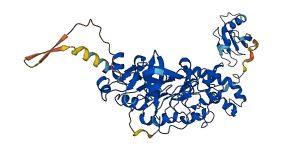
Descriptions
The autoinhibited protein was predicted that may have potential autoinhibitory elements via cis-regPred.
Autoinhibitory domains (AIDs)
Target domain |
|
Relief mechanism |
|
Assay |
cis-regPred |
Accessory elements
No accessory elements
Autoinhibited structure

Activated structure
1 structures for Q5FVQ9
| Entry ID | Method | Resolution | Chain | Position | Source |
|---|---|---|---|---|---|
| AF-Q5FVQ9-F1 | Predicted | AlphaFoldDB |
3 variants for Q5FVQ9
| Variant ID(s) | Position | Change | Description | Diseaes Association | Provenance |
|---|---|---|---|---|---|
| rs105344098 | 70 | V>I | No | EVA | |
| rs198163385 | 91 | L>F | No | EVA | |
| rs3323017437 | 251 | A>V | No | EVA |
No associated diseases with Q5FVQ9
2 GO annotations of cellular component
| Name | Definition |
|---|---|
| cytoplasm | The contents of a cell excluding the plasma membrane and nucleus, but including other subcellular structures. |
| cytoskeleton | A cellular structure that forms the internal framework of eukaryotic and prokaryotic cells. The cytoskeleton includes intermediate filaments, microfilaments, microtubules, the microtrabecular lattice, and other structures characterized by a polymeric filamentous nature and long-range order within the cell. The various elements of the cytoskeleton not only serve in the maintenance of cellular shape but also have roles in other cellular functions, including cellular movement, cell division, endocytosis, and movement of organelles. |
1 GO annotations of molecular function
| Name | Definition |
|---|---|
| alpha-tubulin binding | Binding to the microtubule constituent protein alpha-tubulin. |
10 GO annotations of biological process
| Name | Definition |
|---|---|
| adult locomotory behavior | Locomotory behavior in a fully developed and mature organism. |
| axonogenesis | De novo generation of a long process of a neuron, including the terminal branched region. Refers to the morphogenesis or creation of shape or form of the developing axon, which carries efferent (outgoing) action potentials from the cell body towards target cells. |
| developmental growth | The increase in size or mass of an entire organism, a part of an organism or a cell, where the increase in size or mass has the specific outcome of the progression of the organism over time from one condition to another. |
| microtubule cytoskeleton organization | A process that is carried out at the cellular level which results in the assembly, arrangement of constituent parts, or disassembly of cytoskeletal structures comprising microtubules and their associated proteins. |
| mitotic spindle organization | A process that is carried out at the cellular level which results in the assembly, arrangement of constituent parts, or disassembly of the microtubule spindle during a mitotic cell cycle. |
| muscle atrophy | A process, occurring in the muscle, that is characterized by a decrease in protein content, fiber diameter, force production and fatigue resistance in response to different conditions such as starvation, aging and disuse. |
| peripheral nervous system neuron axonogenesis | Generation of a long process from a neuron whose cell body resides in the peripheral nervous system. The axon carries action potential from the cell body towards target cells. |
| post-chaperonin tubulin folding pathway | Completion of folding of alpha- and beta-tubulin; takes place subsequent to chaperonin-mediated partial folding; mediated by a complex of folding cofactors. |
| post-embryonic development | The process whose specific outcome is the progression of the organism over time, from the completion of embryonic development to the mature structure. See embryonic development. |
| tubulin complex assembly | The aggregation and bonding together of alpha- and beta-tubulin to form a tubulin heterodimer. |
1 homologous proteins in AiPD
| UniProt AC | Gene Name | Protein Name | Species | Evidence Code |
|---|---|---|---|---|
| Q15813 | TBCE | Tubulin-specific chaperone E | Homo sapiens (Human) | PR |
| 10 | 20 | 30 | 40 | 50 | 60 |
| MSDILPLDVI | GRRVEVNGEY | ATVRFCGAVP | PVAGLWLGVE | WDNPERGKHD | GSHEGTMYFK |
| 70 | 80 | 90 | 100 | 110 | 120 |
| CRHPTGGSFV | RPNIVNFGED | FLTALKKRYV | LTDGPDDDEK | SCSLKVGSKQ | VQTIGFEHIT |
| 130 | 140 | 150 | 160 | 170 | 180 |
| KKQSQLRSLQ | DISLWKCAVS | CAGERGRIAE | ACPNIRVVDL | SKNLLSTWDE | VILIAEQLKD |
| 190 | 200 | 210 | 220 | 230 | 240 |
| LEALDLSENK | LQFPSDSPTL | TRTFSTLKTL | VLNKTGITWT | EVLHCAPSWP | VLQELYLKSN |
| 250 | 260 | 270 | 280 | 290 | 300 |
| GISISERPVN | ALQNLRLLDL | SSNPSIDESQ | LCLIAYLPRL | EHLLLSDIGL | SSIHFPDAEI |
| 310 | 320 | 330 | 340 | 350 | 360 |
| GCKTSMFPAL | TYLIVNDNQI | SEWSFINELD | KLQSLQALSC | ARNPLTKGDK | AEEIIIAKIG |
| 370 | 380 | 390 | 400 | 410 | 420 |
| QLKTLNRCQI | LPEERRGAEL | DYRKAFGKEW | RKAGGHPDPD | RNRPSAEFLS | AHPRYQLLCC |
| 430 | 440 | 450 | 460 | 470 | 480 |
| KYGAPEDEEL | KTQQPFMLKN | QLLTLKIKCS | NQPEQQILEK | QLPDSMTIQK | VKGLLSRLLK |
| 490 | 500 | 510 | 520 | ||
| VPVSELLLSY | ESSKMPGREI | ELENDLQPLQ | FYSVENGDCL | LVRW |