Q5D7I5
Gene name |
TRIM5 |
Protein name |
Tripartite motif-containing protein 5 |
Names |
RING-type E3 ubiquitin transferase TRIM5, TRIM5alpha |
Species |
Cebuella pygmaea (Pygmy marmoset) (Callithrix pygmaea) |
KEGG Pathway |
|
EC number |
2.3.2.27: Aminoacyltransferases |
Protein Class |
|
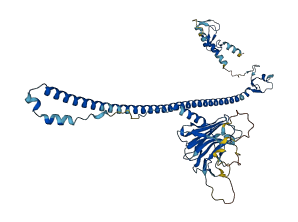
Descriptions
The autoinhibited protein was predicted that may have potential autoinhibitory elements via cis-regPred.
Autoinhibitory domains (AIDs)
Target domain |
|
Relief mechanism |
|
Assay |
cis-regPred |
Accessory elements
No accessory elements
Autoinhibited structure

Activated structure
1 structures for Q5D7I5
| Entry ID | Method | Resolution | Chain | Position | Source |
|---|---|---|---|---|---|
| AF-Q5D7I5-F1 | Predicted | AlphaFoldDB |
No variants for Q5D7I5
| Variant ID(s) | Position | Change | Description | Diseaes Association | Provenance |
|---|---|---|---|---|---|
| No variants for Q5D7I5 | |||||
No associated diseases with Q5D7I5
9 regional properties for Q5D7I5
| Type | Name | Position | InterPro Accession |
|---|---|---|---|
| domain | B-box-type zinc finger | 91 - 132 | IPR000315 |
| domain | Zinc finger, RING-type | 15 - 59 | IPR001841 |
| domain | B30.2/SPRY domain | 280 - 494 | IPR001870 |
| domain | SPRY domain | 348 - 493 | IPR003877 |
| domain | Butyrophylin-like, SPRY domain | 314 - 331 | IPR003879-1 |
| domain | Butyrophylin-like, SPRY domain | 430 - 454 | IPR003879-2 |
| domain | Butyrophylin-like, SPRY domain | 462 - 480 | IPR003879-3 |
| conserved_site | Zinc finger, RING-type, conserved site | 30 - 39 | IPR017907 |
| domain | Zinc finger, RING-type, eukaryotic | 15 - 56 | IPR027370 |
Functions
| Description | ||
|---|---|---|
| EC Number | 2.3.2.27 | Aminoacyltransferases |
| Subcellular Localization |
|
|
| PANTHER Family | ||
| PANTHER Subfamily | ||
| PANTHER Protein Class | ||
| PANTHER Pathway Category | No pathway information available | |
2 GO annotations of cellular component
| Name | Definition |
|---|---|
| nucleus | A membrane-bounded organelle of eukaryotic cells in which chromosomes are housed and replicated. In most cells, the nucleus contains all of the cell's chromosomes except the organellar chromosomes, and is the site of RNA synthesis and processing. In some species, or in specialized cell types, RNA metabolism or DNA replication may be absent. |
| P-body | A focus in the cytoplasm where mRNAs may become inactivated by decapping or some other mechanism. Protein and RNA localized to these foci are involved in mRNA degradation, nonsense-mediated mRNA decay (NMD), translational repression, and RNA-mediated gene silencing. |
3 GO annotations of molecular function
| Name | Definition |
|---|---|
| pattern recognition receptor activity | Combining with a pathogen-associated molecular pattern (PAMP), a structure conserved among microbial species to initiate an innate immune response. |
| ubiquitin-protein transferase activity | Catalysis of the transfer of ubiquitin from one protein to another via the reaction X-Ub + Y --> Y-Ub + X, where both X-Ub and Y-Ub are covalent linkages. |
| zinc ion binding | Binding to a zinc ion (Zn). |
9 GO annotations of biological process
| Name | Definition |
|---|---|
| activation of innate immune response | Any process that initiates an innate immune response. Innate immune responses are defense responses mediated by germline encoded components that directly recognize components of potential pathogens. Examples of this process include activation of the hypersensitive response of Arabidopsis thaliana and activation of any NOD or TLR signaling pathway in vertebrate species. |
| autophagy | The cellular catabolic process in which cells digest parts of their own cytoplasm; allows for both recycling of macromolecular constituents under conditions of cellular stress and remodeling the intracellular structure for cell differentiation. |
| defense response to virus | Reactions triggered in response to the presence of a virus that act to protect the cell or organism. |
| innate immune response | Innate immune responses are defense responses mediated by germline encoded components that directly recognize components of potential pathogens. |
| positive regulation of I-kappaB kinase/NF-kappaB signaling | Any process that activates or increases the frequency, rate or extent of I-kappaB kinase/NF-kappaB signaling. |
| positive regulation of MAPK cascade | Any process that activates or increases the frequency, rate or extent of signal transduction mediated by the MAPK cascade. |
| positive regulation of NF-kappaB transcription factor activity | Any process that activates or increases the frequency, rate or extent of activity of the transcription factor NF-kappaB. |
| protein K63-linked ubiquitination | A protein ubiquitination process in which a polymer of ubiquitin, formed by linkages between lysine residues at position 63 of the ubiquitin monomers, is added to a protein. K63-linked ubiquitination does not target the substrate protein for degradation, but is involved in several pathways, notably as a signal to promote error-free DNA postreplication repair. |
| regulation of lipopolysaccharide-mediated signaling pathway | Any process that modulates the frequency, rate or extent of signaling in response to detection of lipopolysaccharide. |
No homologous proteins in AiPD
| UniProt AC | Gene Name | Protein Name | Species | Evidence Code |
|---|---|---|---|---|
| No homologous proteins | ||||
| 10 | 20 | 30 | 40 | 50 | 60 |
| MASRILVNIK | EEVTCPICLE | LLTEPLSLDC | GHSFCQACIT | ANHKESTLHQ | GERSCPLCRM |
| 70 | 80 | 90 | 100 | 110 | 120 |
| SYPSENLRPN | RHLANIVERL | KEVMLSPEEG | QKVDHCARHG | EKLLLFCQQD | GNVICWLCER |
| 130 | 140 | 150 | 160 | 170 | 180 |
| SQEHRGHHTF | LVEEVAEKYQ | GKLQVALEMM | RQKQQDAEKL | EADVREEQAS | WKIQIQNDKT |
| 190 | 200 | 210 | 220 | 230 | 240 |
| NIMAEFKQLR | DILDCEESKE | LQNLEKEEKN | ILKRLVQSES | DMVLQTQSIR | VLISDLERRL |
| 250 | 260 | 270 | 280 | 290 | 300 |
| QGSVMELLQG | VDDVIKRIEK | VTLQKPKTFL | NEKRRVFRAP | DLKGMLQAFK | ELTEVQRYWA |
| 310 | 320 | 330 | 340 | 350 | 360 |
| HVTLVPSHPS | CTVISEDERQ | VRYQVPIHQP | LVKVKYFYGV | LGSLSITSGK | HYWEVDVSNK |
| 370 | 380 | 390 | 400 | 410 | 420 |
| RGWILGVCGS | WKCNAKWNVL | RPENYQPKNG | YWVIGLRNTD | NYSAFQDAVK | YSDVQDGSRS |
| 430 | 440 | 450 | 460 | 470 | 480 |
| VSSGPLIVPL | FMTICPNRVG | VFLDYEACTI | SFFNVTSNGF | LIYKFSNCHF | SYPVFPYFSP |
| 490 | |||||
| TTCELPMTLC | SPSS |