Q5BJD2
Gene name |
terb2 |
Protein name |
Telomere repeats-binding bouquet formation protein 2 |
Names |
|
Species |
Danio rerio (Zebrafish) (Brachydanio rerio) |
KEGG Pathway |
dre:541341 |
EC number |
|
Protein Class |
|
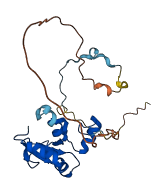
Descriptions
The autoinhibited protein was predicted that may have potential autoinhibitory elements via cis-regPred.
Autoinhibitory domains (AIDs)
Target domain |
|
Relief mechanism |
|
Assay |
cis-regPred |
Accessory elements
No accessory elements
Autoinhibited structure

Activated structure
1 structures for Q5BJD2
| Entry ID | Method | Resolution | Chain | Position | Source |
|---|---|---|---|---|---|
| AF-Q5BJD2-F1 | Predicted | AlphaFoldDB |
No variants for Q5BJD2
| Variant ID(s) | Position | Change | Description | Diseaes Association | Provenance |
|---|---|---|---|---|---|
| No variants for Q5BJD2 | |||||
No associated diseases with Q5BJD2
No regional properties for Q5BJD2
| Type | Name | Position | InterPro Accession |
|---|---|---|---|
| No domain, repeats, and functional sites for Q5BJD2 | |||
2 GO annotations of cellular component
| Name | Definition |
|---|---|
| chromosome, telomeric region | The end of a linear chromosome, required for the integrity and maintenance of the end. A chromosome telomere usually includes a region of telomerase-encoded repeats the length of which rarely exceeds 20 bp each and that permits the formation of a telomeric loop (T-loop). The telomeric repeat region is usually preceded by a sub-telomeric region that is gene-poor but rich in repetitive elements. Some telomeres only consist of the latter part (for eg. D. melanogaster telomeres). |
| nuclear inner membrane | The inner, i.e. lumen-facing, lipid bilayer of the nuclear envelope. |
No GO annotations of molecular function
| Name | Definition |
|---|---|
| No GO annotations for molecular function |
3 GO annotations of biological process
| Name | Definition |
|---|---|
| homologous chromosome pairing at meiosis | The meiotic cell cycle process where side by side pairing and physical juxtaposition of homologous chromosomes is created during meiotic prophase. Homologous chromosome pairing begins when the chromosome arms begin to pair from the clustered telomeres and ends when synaptonemal complex or linear element assembly is complete. |
| meiotic attachment of telomere to nuclear envelope | The meiotic cell cycle process in which physical connections are formed between telomeric heterochromatin and the nuclear envelope, facilitating bouquet formation. |
| meiotic telomere clustering | The cell cycle process in which the dynamic reorganization of telomeres occurs in early meiotic prophase, during which meiotic chromosome ends are gathered in a bouquet arrangement at the inner surface of the nuclear envelope proximal to the spindle pole body. This plays an important role in progression through meiosis and precedes synapsis. |
No homologous proteins in AiPD
| UniProt AC | Gene Name | Protein Name | Species | Evidence Code |
|---|---|---|---|---|
| No homologous proteins | ||||
| 10 | 20 | 30 | 40 | 50 | 60 |
| MFKRKTAWFS | DSVEKEVISF | WVSEGGDISS | WKTAGYLFSD | DASSEDTKRI | YGSEDYVKNR |
| 70 | 80 | 90 | 100 | 110 | 120 |
| ATVFHSSFLL | ACQPRQSVTS | VPIGHYVLPP | DFVQNEMKAI | IGRFIWEKDE | QVICEEQINP |
| 130 | 140 | 150 | 160 | 170 | 180 |
| EVPKDILSGE | TEDHALRERS | SQDDYQTVTS | QSKVCSCCEM | RQYPVNNMIS | GYVHIDQMRK |
| 190 | 200 | 210 | |||
| YSGELKDFLP | SLHGHDVSRS | NDPTPPFHRK | AV |