Q5BBL3
Gene name |
ste20 (AN2067) |
Protein name |
Serine/threonine-protein kinase ste20 |
Names |
|
Species |
Emericella nidulans (strain FGSC A4 / ATCC 38163 / CBS 112.46 / NRRL 194 / M139) (Aspergillus nidulans) |
KEGG Pathway |
ani:AN2067.2 |
EC number |
2.7.11.1: Protein-serine/threonine kinases |
Protein Class |
|
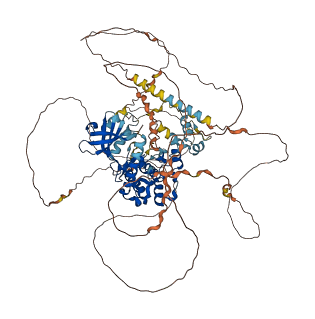
Descriptions
The autoinhibited protein was predicted that may have potential autoinhibitory elements via cis-regPred.
Autoinhibitory domains (AIDs)
Target domain |
|
Relief mechanism |
|
Assay |
cis-regPred |
Accessory elements
703-726 (Activation loop from InterPro)
Target domain |
567-818 (Protein kinase domain) |
Relief mechanism |
|
Assay |
|
Autoinhibited structure

Activated structure
1 structures for Q5BBL3
| Entry ID | Method | Resolution | Chain | Position | Source |
|---|---|---|---|---|---|
| AF-Q5BBL3-F1 | Predicted | AlphaFoldDB |
No variants for Q5BBL3
| Variant ID(s) | Position | Change | Description | Diseaes Association | Provenance |
|---|---|---|---|---|---|
| No variants for Q5BBL3 | |||||
No associated diseases with Q5BBL3
5 regional properties for Q5BBL3
| Type | Name | Position | InterPro Accession |
|---|---|---|---|
| domain | CRIB domain | 238 - 295 | IPR000095 |
| domain | Protein kinase domain | 567 - 818 | IPR000719 |
| active_site | Serine/threonine-protein kinase, active site | 682 - 694 | IPR008271 |
| binding_site | Protein kinase, ATP binding site | 573 - 596 | IPR017441 |
| domain | p21 activated kinase binding domain | 239 - 282 | IPR033923 |
Functions
| Description | ||
|---|---|---|
| EC Number | 2.7.11.1 | Protein-serine/threonine kinases |
| Subcellular Localization |
|
|
| PANTHER Family | ||
| PANTHER Subfamily | ||
| PANTHER Protein Class | ||
| PANTHER Pathway Category | No pathway information available | |
4 GO annotations of cellular component
| Name | Definition |
|---|---|
| cytoplasm | The contents of a cell excluding the plasma membrane and nucleus, but including other subcellular structures. |
| incipient cellular bud site | The portion of the budding yeast plasma membrane where a daughter cell will emerge. The yeast marks this spot with bud-site selection proteins before bud emergence occurs. Actin is polarized to this spot just prior to and during bud emergence. |
| mating projection tip | The apex of the mating projection in unicellular fungi exposed to mating pheromone; site of polarized growth. |
| nucleus | A membrane-bounded organelle of eukaryotic cells in which chromosomes are housed and replicated. In most cells, the nucleus contains all of the cell's chromosomes except the organellar chromosomes, and is the site of RNA synthesis and processing. In some species, or in specialized cell types, RNA metabolism or DNA replication may be absent. |
5 GO annotations of molecular function
| Name | Definition |
|---|---|
| ATP binding | Binding to ATP, adenosine 5'-triphosphate, a universally important coenzyme and enzyme regulator. |
| enzyme binding | Binding to an enzyme, a protein with catalytic activity. |
| histone kinase activity (H2B-S14 specific) | Catalysis of the transfer of a phosphate group to the serine-14 or an equivalent residue of the N-terminal tail of histone H2B. |
| protein serine kinase activity | Catalysis of the reactions: ATP + protein serine = ADP + protein serine phosphate. |
| protein serine/threonine kinase activity | Catalysis of the reactions: ATP + protein serine = ADP + protein serine phosphate, and ATP + protein threonine = ADP + protein threonine phosphate. |
17 GO annotations of biological process
| Name | Definition |
|---|---|
| bipolar cellular bud site selection | The process of defining subsequent sites of bud emergence such that budding takes place at alternating poles of a budding cell. |
| budding cell apical bud growth | Growth at the tip of a bud, in a cell that reproduces by budding. |
| intracellular signal transduction | The process in which a signal is passed on to downstream components within the cell, which become activated themselves to further propagate the signal and finally trigger a change in the function or state of the cell. |
| invasive growth in response to glucose limitation | A growth pattern exhibited by budding haploid cells under certain growth conditions, in which cells retain the typical axial budding pattern of haploids, but become elongated and fail to separate after division; during growth on a solid substrate, this results in penetration of cells into the agar medium. An example of this process is found in Saccharomyces cerevisiae. |
| negative regulation of gene expression | Any process that decreases the frequency, rate or extent of gene expression. Gene expression is the process in which a gene's coding sequence is converted into a mature gene product (protein or RNA). |
| negative regulation of transcription by RNA polymerase II | Any process that stops, prevents, or reduces the frequency, rate or extent of transcription mediated by RNA polymerase II. |
| osmosensory signaling pathway via Sho1 osmosensor | The series of molecular signals generated in response to osmotic change, as mediated through a Sho1 osmosensor system. |
| pheromone-dependent signal transduction involved in conjugation with cellular fusion | A signal transduction process resulting in the relay, amplification or dampening of a signal generated in response to pheromone exposure in organisms that undergo conjugation with cellular fusion. An example of this process is found in Saccharomyces cerevisiae. |
| positive regulation of apoptotic process | Any process that activates or increases the frequency, rate or extent of cell death by apoptotic process. |
| protein phosphorylation | The process of introducing a phosphate group on to a protein. |
| pseudohyphal growth | The process in which cells grow as a chain of physically attached, elongated cells in response to an environmental stimulus or stimuli. |
| regulation of exit from mitosis | Any process involved in the progression from anaphase/telophase to G1 that is associated with a conversion from high to low mitotic CDK activity. |
| regulation of MAPK cascade | Any process that modulates the frequency, rate or extent of signal transduction mediated by the MAP kinase (MAPK) cascade. |
| signal transduction involved in filamentous growth | Relaying of environmental signals promoting filamentous growth. |
| sterol import | The directed movement of a sterol into a cell or organelle. Sterols are steroids with one or more hydroxyl groups and a hydrocarbon side-chain in the molecule. |
| stress granule assembly | The aggregation, arrangement and bonding together of proteins and RNA molecules to form a stress granule. |
| vacuole inheritance | The distribution of vacuoles into daughter cells after mitosis or meiosis, mediated by interactions between vacuoles and the cytoskeleton. |
No homologous proteins in AiPD
| UniProt AC | Gene Name | Protein Name | Species | Evidence Code |
|---|---|---|---|---|
| No homologous proteins | ||||
| 10 | 20 | 30 | 40 | 50 | 60 |
| MNNDSFSSFK | FRRPSSKLHK | DPPGYGSRAL | NSQQSTTSLK | RHPSAPVYPR | SSAAGSREHL |
| 70 | 80 | 90 | 100 | 110 | 120 |
| RTRSNAYGSS | SSSLDQNSAG | ASPVLGSSDS | GHFHSSHSSR | SRPPYSGRFS | LNDQSSDELI |
| 130 | 140 | 150 | 160 | 170 | 180 |
| GAPFDSRGML | SALEEHTAEP | DNRSYQPPDP | AERYTEKPPN | FRSQTTPNPR | ALRQSASFTT |
| 190 | 200 | 210 | 220 | 230 | 240 |
| LPPRMEAFPN | AAGNDRPTNT | KRFSDEATPV | RPPGPSRSKK | SSFSSFVNSM | LGSPRGIKIS |
| 250 | 260 | 270 | 280 | 290 | 300 |
| APENPVHVTH | VGYDNQTGQF | TGLPKEWQRL | LQESGITQKE | QEEHPQTMVD | IMRFYEKNAR |
| 310 | 320 | 330 | 340 | 350 | 360 |
| GDDEVWHKFD | HAYPQQPTAA | SPISQPAGST | TYGTQRTSPP | TSPRFPQNHE | GSFENPRAPP |
| 370 | 380 | 390 | 400 | 410 | 420 |
| PIPRAAPIAA | HAMSPPLGGL | VPNRAPPKPP | TAAANLVPSR | PAPQPPTSSP | YSNISTRPSP |
| 430 | 440 | 450 | 460 | 470 | 480 |
| ETQSPQFSTP | PIPETEPLPS | ESQRSRSNSR | TNGAQGPWPS | VSPSHYQQQQ | EQAMAVAQQA |
| 490 | 500 | 510 | 520 | 530 | 540 |
| LANKQLERSR | SQRQQQQSPR | PDQMPIAQPA | LPQHAPSPED | VALTQASQTA | RAAPAARPRQ |
| 550 | 560 | 570 | 580 | 590 | 600 |
| RPRQSNAMDV | RARLVAICTP | GDPTKLYYNL | NKIGQGASGG | VFTAYEQHTN | NCVAIKQMNL |
| 610 | 620 | 630 | 640 | 650 | 660 |
| DLQPKKDLII | NEILVMKDSK | HKNIVNFLDS | YLHGLDLWVV | MEYMEGGSLT | DVVTFNIMSE |
| 670 | 680 | 690 | 700 | 710 | 720 |
| PQIAAVCRET | LNGLQHLHSK | GVIHRDIKSD | NILLSLDGNI | KLTDFGFCAQ | INDSQNKRNT |
| 730 | 740 | 750 | 760 | 770 | 780 |
| MVGTPYWMAP | EVVTRKEYGR | KVDIWSLGIM | AIEMIEGEPP | YLTESPLRAL | YLIATNGTPK |
| 790 | 800 | 810 | 820 | 830 | 840 |
| IKDEHNLSPV | FKDFLHFALR | VDPEKRASAH | DLLKHPFMNL | CAPLNHLSPL | VKAARISRAQ |
| EKAQKGGV |