Q5AZX0
Gene name |
pfs2 (AN6160) |
Protein name |
Polyadenylation factor subunit 2 |
Names |
|
Species |
Emericella nidulans (strain FGSC A4 / ATCC 38163 / CBS 112.46 / NRRL 194 / M139) (Aspergillus nidulans) |
KEGG Pathway |
ani:AN6160.2 |
EC number |
|
Protein Class |
|
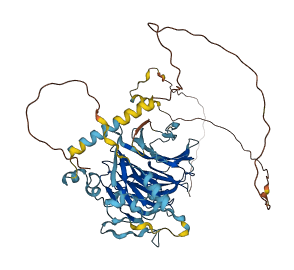
Descriptions
The autoinhibited protein was predicted that may have potential autoinhibitory elements via cis-regPred.
Autoinhibitory domains (AIDs)
Target domain |
|
Relief mechanism |
|
Assay |
cis-regPred |
Accessory elements
No accessory elements
Autoinhibited structure

Activated structure
1 structures for Q5AZX0
| Entry ID | Method | Resolution | Chain | Position | Source |
|---|---|---|---|---|---|
| AF-Q5AZX0-F1 | Predicted | AlphaFoldDB |
No variants for Q5AZX0
| Variant ID(s) | Position | Change | Description | Diseaes Association | Provenance |
|---|---|---|---|---|---|
| No variants for Q5AZX0 | |||||
No associated diseases with Q5AZX0
4 regional properties for Q5AZX0
| Type | Name | Position | InterPro Accession |
|---|---|---|---|
| repeat | WD40 repeat | 83 - 122 | IPR001680-1 |
| repeat | WD40 repeat | 143 - 270 | IPR001680-2 |
| repeat | WD40 repeat | 271 - 311 | IPR001680-3 |
| repeat | WD40 repeat | 340 - 380 | IPR001680-4 |
2 GO annotations of cellular component
| Name | Definition |
|---|---|
| chromatin | The ordered and organized complex of DNA, protein, and sometimes RNA, that forms the chromosome. |
| mRNA cleavage and polyadenylation specificity factor complex | A multisubunit complex that binds to the canonical AAUAAA hexamer and to U-rich upstream sequence elements on the pre-mRNA, thereby stimulating the otherwise weakly active and nonspecific polymerase to elongate efficiently RNAs containing a poly(A) signal. |
No GO annotations of molecular function
| Name | Definition |
|---|---|
| No GO annotations for molecular function |
2 GO annotations of biological process
| Name | Definition |
|---|---|
| chromosome segregation | The process in which genetic material, in the form of chromosomes, is organized into specific structures and then physically separated and apportioned to two or more sets. In eukaryotes, chromosome segregation begins with the condensation of chromosomes, includes chromosome separation, and ends when chromosomes have completed movement to the spindle poles. |
| mRNA polyadenylation | The enzymatic addition of a sequence of 40-200 adenylyl residues at the 3' end of a eukaryotic mRNA primary transcript. |
No homologous proteins in AiPD
| UniProt AC | Gene Name | Protein Name | Species | Evidence Code |
|---|---|---|---|---|
| No homologous proteins | ||||
| 10 | 20 | 30 | 40 | 50 | 60 |
| MAYYDDGGND | SQPFGRAQGG | IQGPRRPRLV | TDYGSSMVQW | MRNRRPKYQG | GHRMETERPS |
| 70 | 80 | 90 | 100 | 110 | 120 |
| ASYMVDMLPP | LARIHSPVDS | IPVRHLHQSI | GKSKKPITVV | RWTPEGRRLL | TGGHTGEFML |
| 130 | 140 | 150 | 160 | 170 | 180 |
| WNGTAFNFET | VMDKGDVKYW | RPNFNNVETI | DDAHHDAVRD | LAWSPSDTKF | LSASDDTTLK |
| 190 | 200 | 210 | 220 | 230 | 240 |
| IYDFTARTCD | TVLTGHNWDV | KSCDWHPTKG | LLVSGSKDHQ | VKFWDPRTAR | CLTTLHSHKN |
| 250 | 260 | 270 | 280 | 290 | 300 |
| TVTATKFSRV | NNNLLATSSR | DQTARVFDLR | MMRDICILRG | HEKPISTLTW | HPVHCSLIST |
| 310 | 320 | 330 | 340 | 350 | 360 |
| GSEDGSLYHY | LLDEPNLPAG | QIPTVAPYDS | PDPANTPAQV | IYPAHRIQYA | HAATIWTLDW |
| 370 | 380 | 390 | 400 | 410 | 420 |
| HPLGHILASG | SKDNFTRFWS | RARPGETSYL | KDRFHIGEEA | AEAQGTWSRN | FGRRQMREEE |
| 430 | 440 | 450 | 460 | 470 | 480 |
| EQELQDEADS | LVDQRKTPGT | GLPGIQSASQ | PDGLGSSLLP | GIGAAQPPPP | PGLSTSMAPP |
| 490 | 500 | 510 | 520 | 530 | 540 |
| GNAFPPNPVF | PAFPFAPPFS | GAPPASGAQP | MNSPNVNLAE | LQKQLAAQGI | TLPPGFPHHF |
| 550 | 560 | ||||
| TPVSTPLAGG | GLPGLQGGYQ | PDNNYGR |