Q5AAG6
Gene name |
MKC1 |
Protein name |
Mitogen-activated protein kinase MKC1 |
Names |
MAP kinase MKC1 |
Species |
Candida albicans (strain SC5314 / ATCC MYA-2876) (Yeast) |
KEGG Pathway |
cal:CAALFM_CR00120CA |
EC number |
2.7.11.24: Protein-serine/threonine kinases |
Protein Class |
|
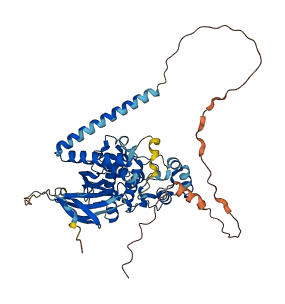
Descriptions
The autoinhibited protein was predicted that may have potential autoinhibitory elements via cis-regPred.
Autoinhibitory domains (AIDs)
Target domain |
|
Relief mechanism |
|
Assay |
cis-regPred |
Accessory elements
191-218 (Activation loop from InterPro)
Target domain |
28-339 (Protein kinase domain) |
Relief mechanism |
|
Assay |
|
Autoinhibited structure

Activated structure
1 structures for Q5AAG6
| Entry ID | Method | Resolution | Chain | Position | Source |
|---|---|---|---|---|---|
| AF-Q5AAG6-F1 | Predicted | AlphaFoldDB |
No variants for Q5AAG6
| Variant ID(s) | Position | Change | Description | Diseaes Association | Provenance |
|---|---|---|---|---|---|
| No variants for Q5AAG6 | |||||
No associated diseases with Q5AAG6
Functions
| Description | ||
|---|---|---|
| EC Number | 2.7.11.24 | Protein-serine/threonine kinases |
| Subcellular Localization |
|
|
| PANTHER Family | ||
| PANTHER Subfamily | ||
| PANTHER Protein Class | ||
| PANTHER Pathway Category | No pathway information available | |
2 GO annotations of cellular component
| Name | Definition |
|---|---|
| cytoplasm | The contents of a cell excluding the plasma membrane and nucleus, but including other subcellular structures. |
| nucleus | A membrane-bounded organelle of eukaryotic cells in which chromosomes are housed and replicated. In most cells, the nucleus contains all of the cell's chromosomes except the organellar chromosomes, and is the site of RNA synthesis and processing. In some species, or in specialized cell types, RNA metabolism or DNA replication may be absent. |
4 GO annotations of molecular function
| Name | Definition |
|---|---|
| ATP binding | Binding to ATP, adenosine 5'-triphosphate, a universally important coenzyme and enzyme regulator. |
| MAP kinase activity | Catalysis of the reaction: protein + ATP = protein phosphate + ADP. This reaction is the phosphorylation of proteins. Mitogen-activated protein kinase; a family of protein kinases that perform a crucial step in relaying signals from the plasma membrane to the nucleus. They are activated by a wide range of proliferation- or differentiation-inducing signals; activation is strong with agonists such as polypeptide growth factors and tumor-promoting phorbol esters, but weak (in most cell backgrounds) by stress stimuli. |
| protein serine kinase activity | Catalysis of the reactions: ATP + protein serine = ADP + protein serine phosphate. |
| protein serine/threonine kinase activity | Catalysis of the reactions: ATP + protein serine = ADP + protein serine phosphate, and ATP + protein threonine = ADP + protein threonine phosphate. |
19 GO annotations of biological process
| Name | Definition |
|---|---|
| cell wall integrity MAPK cascade | A MAPK cascade that contributes to cell wall organization or biogenesis. |
| cellular response to heat | Any process that results in a change in state or activity of a cell (in terms of movement, secretion, enzyme production, gene expression, etc.) as a result of a heat stimulus, a temperature stimulus above the optimal temperature for that organism. |
| cellular response to oxidative stress | Any process that results in a change in state or activity of a cell (in terms of movement, secretion, enzyme production, gene expression, etc.) as a result of oxidative stress, a state often resulting from exposure to high levels of reactive oxygen species, e.g. superoxide anions, hydrogen peroxide (H2O2), and hydroxyl radicals. |
| cellular response to reactive oxygen species | Any process that results in a change in state or activity of a cell (in terms of movement, secretion, enzyme production, gene expression, etc.) as a result of a reactive oxygen species stimulus. Reactive oxygen species include singlet oxygen, superoxide, and oxygen free radicals. |
| filamentous growth | The process in which a multicellular organism, a unicellular organism or a group of unicellular organisms grow in a threadlike, filamentous shape. |
| filamentous growth of a population of unicellular organisms in response to starvation | The process in which a group of unicellular organisms grow in a threadlike, filamentous shape in response to deprivation of nourishment. |
| fungal-type cell wall organization | A process that is carried out at the cellular level which results in the assembly, arrangement of constituent parts, or disassembly of the fungal-type cell wall. |
| intracellular signal transduction | The process in which a signal is passed on to downstream components within the cell, which become activated themselves to further propagate the signal and finally trigger a change in the function or state of the cell. |
| negative regulation of glucose mediated signaling pathway | Any process that stops, prevents or reduces the frequency, rate or extent of glucose mediated signaling pathway. |
| negative regulation of mitotic cytokinesis | Any process that stops, prevents or reduces the frequency, rate or extent of mitotic cytokinesis. |
| positive regulation of calcium ion import across plasma membrane | Any process that activates or increases the frequency, rate or extent of calcium ion import across plasma membrane. |
| positive regulation of calcium-mediated signaling | Any process that activates or increases the frequency, rate or extent of calcium-mediated signaling. |
| positive regulation of filamentous growth of a population of unicellular organisms in response to starvation | Any process that activates or increases the frequency, rate or extent of filamentous growth of a population of unicellular organisms in response to starvation. |
| protein phosphorylation | The process of introducing a phosphate group on to a protein. |
| regulation of fungal-type cell wall organization | Any process that modulates the rate, frequency or extent of the formation, arrangement of constituent parts, or disassembly of the fungal-type cell wall. |
| regulation of single-species biofilm formation on inanimate substrate | Any process that modulates the frequency, rate or extent of single-species biofilm formation on inanimate substrate. |
| signal transduction | The cellular process in which a signal is conveyed to trigger a change in the activity or state of a cell. Signal transduction begins with reception of a signal (e.g. a ligand binding to a receptor or receptor activation by a stimulus such as light), or for signal transduction in the absence of ligand, signal-withdrawal or the activity of a constitutively active receptor. Signal transduction ends with regulation of a downstream cellular process, e.g. regulation of transcription or regulation of a metabolic process. Signal transduction covers signaling from receptors located on the surface of the cell and signaling via molecules located within the cell. For signaling between cells, signal transduction is restricted to events at and within the receiving cell. |
| single-species biofilm formation on inanimate substrate | A process in which microorganisms of the same species attach to and grow on an inanimate surface such as a rock or pipe, and produce extracellular polymers that facilitate attachment and matrix formation, resulting in an alteration in the phenotype of the organisms with respect to growth rate and gene transcription. |
| stress-activated protein kinase signaling cascade | The series of molecular signals in which a stress-activated protein kinase (SAPK) cascade relays a signal. |
No homologous proteins in AiPD
| UniProt AC | Gene Name | Protein Name | Species | Evidence Code |
|---|---|---|---|---|
| No homologous proteins | ||||
| 10 | 20 | 30 | 40 | 50 | 60 |
| MDQQEAPIYY | GRSVNKVYNQ | EFIIDSRFKI | VKELGHGAYG | IVCSAKYDNG | SKKVPDSNNG |
| 70 | 80 | 90 | 100 | 110 | 120 |
| NASSSANASF | VAIKKITNIF | SKNILCKRAL | RELKLLQFFR | GHKNITCLYD | LDIIPNPMTG |
| 130 | 140 | 150 | 160 | 170 | 180 |
| EFNEIYLYEE | LMECDMHQII | RSGQPLSDQH | YQSFIYQVLC | GLNFIHSADV | LHRDLKPGNL |
| 190 | 200 | 210 | 220 | 230 | 240 |
| LVNADCELKI | CDFGLARGFS | ENPDENAGFM | TEYVATRWYR | APEIMLSFTN | YTKAIDIWSV |
| 250 | 260 | 270 | 280 | 290 | 300 |
| GCILAELLGG | KPLFRGKDYV | DQLNQILMIL | GTPPESTLQR | IGSHRAQNYV | RSLPITRKAS |
| 310 | 320 | 330 | 340 | 350 | 360 |
| YEELFPDANP | LALDLLERML | TLDPRERITV | RDALNHKYLE | LWHDPKEEIE | CQVKFDFKSF |
| 370 | 380 | 390 | 400 | 410 | 420 |
| ETVDGLDEMK | QLIMDEVQKF | REFVRKPIEE | QQRIQMQLHM | QKREEQRQEE | EEKELLEQQR |
| 430 | 440 | 450 | 460 | 470 | 480 |
| QFPAQESMDI | SQTPYNNLET | NIGTPQVEDD | YPRPQELDEF | TFSNLESSSS | MNLFQDMAKP |
| 490 | 500 | ||||
| SGEEYIKLEE | ELGFGLDGAM | FNNYCNDHQ |