Q5A688
Gene name |
PMT6 (PMT3, CAALFM_C404780WA, CaO19.11283, CaO19.3802) |
Protein name |
Dolichyl-phosphate-mannose--protein mannosyltransferase 6 |
Names |
Protein mannosyltransferase 6 |
Species |
Candida albicans (strain SC5314 / ATCC MYA-2876) (Yeast) |
KEGG Pathway |
cal:CAALFM_C404780WA |
EC number |
2.4.1.109: Hexosyltransferases |
Protein Class |
|
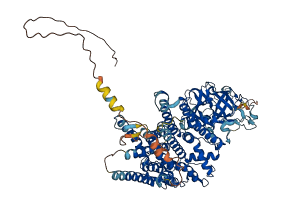
Descriptions
The autoinhibited protein was predicted that may have potential autoinhibitory elements via cis-regPred.
Autoinhibitory domains (AIDs)
Target domain |
|
Relief mechanism |
|
Assay |
cis-regPred |
Accessory elements
No accessory elements
Autoinhibited structure

Activated structure
1 structures for Q5A688
| Entry ID | Method | Resolution | Chain | Position | Source |
|---|---|---|---|---|---|
| AF-Q5A688-F1 | Predicted | AlphaFoldDB |
No variants for Q5A688
| Variant ID(s) | Position | Change | Description | Diseaes Association | Provenance |
|---|---|---|---|---|---|
| No variants for Q5A688 | |||||
No associated diseases with Q5A688
Functions
| Description | ||
|---|---|---|
| EC Number | 2.4.1.109 | Hexosyltransferases |
| Subcellular Localization |
|
|
| PANTHER Family | ||
| PANTHER Subfamily | ||
| PANTHER Protein Class | ||
| PANTHER Pathway Category | No pathway information available | |
3 GO annotations of cellular component
| Name | Definition |
|---|---|
| endoplasmic reticulum | The irregular network of unit membranes, visible only by electron microscopy, that occurs in the cytoplasm of many eukaryotic cells. The membranes form a complex meshwork of tubular channels, which are often expanded into slitlike cavities called cisternae. The ER takes two forms, rough (or granular), with ribosomes adhering to the outer surface, and smooth (with no ribosomes attached). |
| endoplasmic reticulum membrane | The lipid bilayer surrounding the endoplasmic reticulum. |
| integral component of membrane | The component of a membrane consisting of the gene products and protein complexes having at least some part of their peptide sequence embedded in the hydrophobic region of the membrane. |
1 GO annotations of molecular function
| Name | Definition |
|---|---|
| dolichyl-phosphate-mannose-protein mannosyltransferase activity | Catalysis of the reaction: dolichyl phosphate D-mannose + protein = dolichyl phosphate + O-D-mannosylprotein. |
8 GO annotations of biological process
| Name | Definition |
|---|---|
| cellular response to neutral pH | Any process that results in a change in state or activity of a cell (in terms of movement, secretion, enzyme production, gene expression, etc.) as a result of a neutral pH (pH close to 7) stimulus. pH is a measure of the acidity or basicity of an aqueous solution. |
| cellular response to starvation | Any process that results in a change in state or activity of a cell (in terms of movement, secretion, enzyme production, gene expression, etc.) as a result of deprivation of nourishment. |
| filamentous growth | The process in which a multicellular organism, a unicellular organism or a group of unicellular organisms grow in a threadlike, filamentous shape. |
| filamentous growth of a population of unicellular organisms | The process in which a group of unicellular organisms grow in a threadlike, filamentous shape. |
| filamentous growth of a population of unicellular organisms in response to neutral pH | The process in which a group of unicellular organisms grow in a threadlike, filamentous shape in response to a neutral pH (pH close to 7) stimulus. |
| filamentous growth of a population of unicellular organisms in response to starvation | The process in which a group of unicellular organisms grow in a threadlike, filamentous shape in response to deprivation of nourishment. |
| protein O-linked mannosylation | The transfer of mannose from dolichyl activated mannose to the hydroxyl group of a seryl or threonyl residue of a protein acceptor molecule, to form an O-linked protein-sugar linkage. |
| single-species biofilm formation on inanimate substrate | A process in which microorganisms of the same species attach to and grow on an inanimate surface such as a rock or pipe, and produce extracellular polymers that facilitate attachment and matrix formation, resulting in an alteration in the phenotype of the organisms with respect to growth rate and gene transcription. |
No homologous proteins in AiPD
| UniProt AC | Gene Name | Protein Name | Species | Evidence Code |
|---|---|---|---|---|
| No homologous proteins | ||||
| 10 | 20 | 30 | 40 | 50 | 60 |
| MATGYSTGVS | PFDLDENNHN | DSIHHRHQNH | HSQSHDSSGE | RDDTEIEDII | QKTSKLNINT |
| 70 | 80 | 90 | 100 | 110 | 120 |
| STSTKIKNFF | FQSSNRHDSS | NSPPLREVFI | KTINPLILTA | ISSFVRLYRI | DVANSVVWDE |
| 130 | 140 | 150 | 160 | 170 | 180 |
| AHFGKFGSQY | LKRQFYFDVH | PPLGKLLIGL | SGYLADYDGN | FDFESSNVYP | DNVNYVFMRI |
| 190 | 200 | 210 | 220 | 230 | 240 |
| FNCFFGILVT | PLAYKTAVIL | GYNQFTCWLI | AFMVIFEQLS | LTLSKFILLD | SMLLFFTVLT |
| 250 | 260 | 270 | 280 | 290 | 300 |
| MYCLVKVHTL | AIARVGSNSK | TPLTKLEIKW | YILTGISIGC | VCSVKWVGLF | VTALVGFYTI |
| 310 | 320 | 330 | 340 | 350 | 360 |
| VDLWIKFYQT | FAIDKKSPKK | MSVVNYLIHW | VVRIFTLIII | PMTIYVATFK | VHFMVLNHTG |
| 370 | 380 | 390 | 400 | 410 | 420 |
| PDDGTLSTLL | QGSLIGNDLQ | SGPRSVAFGS | LVTIRSQGLS | PNLIHSHPHN | YPQGSQEQQV |
| 430 | 440 | 450 | 460 | 470 | 480 |
| TTYGFKDDNN | EFLFEFGVDA | GLRNQHATLE | NENSTRNGGN | DDDYYHVIIH | DGDTVRINHK |
| 490 | 500 | 510 | 520 | 530 | 540 |
| NTGSYLRANA | VGAPITSSSY | EVSCFGDVES | NDWADEWVIE | IQSQDQSPDP | MFQDEDPSEI |
| 550 | 560 | 570 | 580 | 590 | 600 |
| HSVSTSFRLK | HKQLGCYLAT | TGKSYPAWGY | QQGEVVCKYS | VFSRDKNTWW | NIEKHVNNKL |
| 610 | 620 | 630 | 640 | 650 | 660 |
| PLPATEYVPP | KPKFWKEFIL | LNYAMMASNN | ALIPDPDRFD | KLSSEWWEWP | ILNTGLRMNS |
| 670 | 680 | 690 | 700 | 710 | 720 |
| WGDADIKYFL | LGNPLITWIS | TIALIVCPLY | LLVVGIKYQR | QWILLSATDT | SNANPANSQS |
| 730 | 740 | 750 | 760 | 770 | 780 |
| LSLLAARALL | PLAGWVLHYV | PFILMGRVKY | LHHYVPALYF | AIFVAGFIVD | AILNLDFSYH |
| 790 | 800 | 810 | 820 | 830 | |
| NNKFQYIFKV | VIYSTLYLVI | CISFWYFKDL | SFGMEGSSVD | YRHLRLLGSW | MI |