Q5A2V2
Gene name |
RMD9 (CAALFM_C306700CA, CaO19.7459) |
Protein name |
RNA-binding protein RMD9, mitochondrial |
Names |
|
Species |
Candida albicans (strain SC5314 / ATCC MYA-2876) (Yeast) |
KEGG Pathway |
cal:CAALFM_C306700CA |
EC number |
|
Protein Class |
|
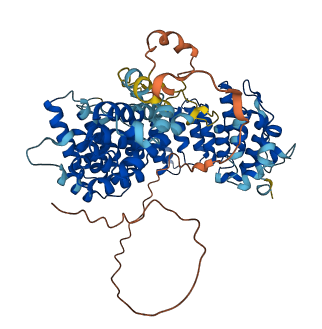
Descriptions
The autoinhibited protein was predicted that may have potential autoinhibitory elements via cis-regPred.
Autoinhibitory domains (AIDs)
Target domain |
|
Relief mechanism |
|
Assay |
cis-regPred |
Accessory elements
No accessory elements
Autoinhibited structure

Activated structure
1 structures for Q5A2V2
| Entry ID | Method | Resolution | Chain | Position | Source |
|---|---|---|---|---|---|
| AF-Q5A2V2-F1 | Predicted | AlphaFoldDB |
No variants for Q5A2V2
| Variant ID(s) | Position | Change | Description | Diseaes Association | Provenance |
|---|---|---|---|---|---|
| No variants for Q5A2V2 | |||||
No associated diseases with Q5A2V2
7 regional properties for Q5A2V2
| Type | Name | Position | InterPro Accession |
|---|---|---|---|
| repeat | HAT (Half-A-TPR) repeat | 327 - 364 | IPR003107-1 |
| repeat | HAT (Half-A-TPR) repeat | 377 - 412 | IPR003107-2 |
| repeat | HAT (Half-A-TPR) repeat | 423 - 456 | IPR003107-3 |
| repeat | HAT (Half-A-TPR) repeat | 565 - 597 | IPR003107-4 |
| repeat | HAT (Half-A-TPR) repeat | 743 - 775 | IPR003107-5 |
| repeat | HAT (Half-A-TPR) repeat | 777 - 811 | IPR003107-6 |
| domain | Suppressor of forked | 694 - 1023 | IPR008847 |
1 GO annotations of cellular component
| Name | Definition |
|---|---|
| mitochondrial inner membrane | The inner, i.e. lumen-facing, lipid bilayer of the mitochondrial envelope. It is highly folded to form cristae. |
No GO annotations of molecular function
| Name | Definition |
|---|---|
| No GO annotations for molecular function |
4 GO annotations of biological process
| Name | Definition |
|---|---|
| filamentous growth of a population of unicellular organisms | The process in which a group of unicellular organisms grow in a threadlike, filamentous shape. |
| filamentous growth of a population of unicellular organisms in response to neutral pH | The process in which a group of unicellular organisms grow in a threadlike, filamentous shape in response to a neutral pH (pH close to 7) stimulus. |
| single-species biofilm formation on inanimate substrate | A process in which microorganisms of the same species attach to and grow on an inanimate surface such as a rock or pipe, and produce extracellular polymers that facilitate attachment and matrix formation, resulting in an alteration in the phenotype of the organisms with respect to growth rate and gene transcription. |
| sporulation resulting in formation of a cellular spore | The process in which a relatively unspecialized cell acquires the specialized features of a cellular spore, a cell form that can be used for dissemination, for survival of adverse conditions because of its heat and dessication resistance, and/or for reproduction. |
No homologous proteins in AiPD
| UniProt AC | Gene Name | Protein Name | Species | Evidence Code |
|---|---|---|---|---|
| No homologous proteins | ||||
| 10 | 20 | 30 | 40 | 50 | 60 |
| MFRLIASGAQ | QGLRPSLISK | VKPPTTTTTT | STTSKFTSTT | QHFPFENNNL | LGYQVRNNSS |
| 70 | 80 | 90 | 100 | 110 | 120 |
| QAGVASEPKI | SLPETDVYQQ | KLLKYNIKKH | EPYHLKFNPK | TKNQRNNDSA | SSFSIDEFSQ |
| 130 | 140 | 150 | 160 | 170 | 180 |
| LLQDETFRNQ | LNEKHLFVYA | SNLYSGTINS | RRARLNKSKN | RDKDQRSAFR | EDMTLQSAVL |
| 190 | 200 | 210 | 220 | 230 | 240 |
| NLTEIISTGE | LNSVLSARTL | FKVFGTLLQF | KLNDEIVNLW | ETGVNSDVGK | LYLAHEVLSI |
| 250 | 260 | 270 | 280 | 290 | 300 |
| VIQVGHETRR | FNYDEIKQIY | EMSVKEDKTV | HPYLSDRMGQ | VAVMEGDYVT | ALDALESLMN |
| 310 | 320 | 330 | 340 | 350 | 360 |
| LYEQNPNEKS | VLGALAQIHL | SFIGHSKDLA | IAERFFEKGL | QKEGLPYSVI | MKAPYMTSFL |
| 370 | 380 | 390 | 400 | 410 | 420 |
| SNCIAGGYSM | EEVIDFWRRI | SKHYLEQDFD | LISSQSTLHA | GFFKSFFEKY | PEPSKEAIDL |
| 430 | 440 | 450 | 460 | 470 | 480 |
| LNLAIESAPK | VNEVLLNTLI | SNLPWADKEI | FNKLLNLYQE | KNVTKSIVSH | RIILKQSKQI |
| 490 | 500 | 510 | 520 | 530 | 540 |
| EYTNEEILQL | WNELLGKLDE | AGYTYIANAD | WSALRASTMF | SGKFSYQRTG | LYLSVLGKYK |
| 550 | 560 | 570 | 580 | 590 | 600 |
| DYMQNNFAAI | QFLRNWVRDA | NAYRLISKIT | LEENPQFDGA | IKVDIPEFDS | LRPNINYREV |
| 610 | |||||
| TKQVTDADPR | LLE |